Banking

Peru’s new payment rules will foster greater digitalization, a credit Positive

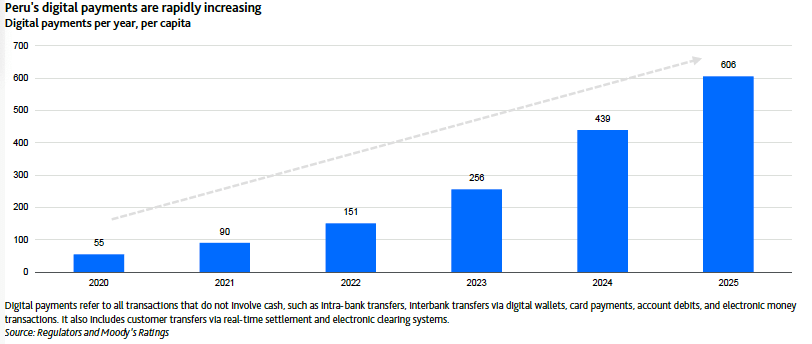
Peru, December 6, 2025 – The Central Reserve Bank of Peru (BCRP) published its updated rulebook for payments in the official gazette, strengthening its compliance framework and fostering transparency through data requirements, including new cyber-security rules, as the banking system rapidly accelerates digitalization of its operations. The new rules mandate that payment fees be nondiscriminatory, cost-based, and subject to an annual review by the regulators. The new rulebook is effective 1 April (replacing the 2010 version) and is credit positive for Peru’s financial system because it promotes competition, supporting the continued expansion of digital payments (see exhibit) and increased credit volumes by enhancing efficiencies across the banking sector.

Currently, low-value digital payments (less than PEN15,000 or $5,000) in Peru are largely controlled by banks, with interbank transfers comprising 66% of this total in the first half of 2025 (H1 2025), in accordance with data available in the BCRP’s September 2025 National Payments Systems Report. The updated rulebook will encourage new payment solutions and require interoperability among new systems, cementing the 2023 Payment Services Interoperability Regulation aimed mainly for digital wallets, enabling users to transfer funds regardless of provider or account type. This shift will initially reduce debit and credit card and current account revenue for Peru’s banks, which comprised on average about 8% of net revenues of the four largest banks as of September 2025. In addition, greater use of digital payments can drive growth in banking services, leading to larger deposit inflows and an expanded addressable market.

Instant payments accounted for 11% of low-value payments in H1 2025 and were dominated by two digital wallets: Yape, managed by the country’s largest bank Banco de Crédito del Perú (BCP, Baa1 stable, baa11), with 82% market share, and Plin, with 18%, a joint venture between next three largest banks in Peru, Banco BBVA Perú (Baa1 stable, baa2), Scotiabank Perú S.A.A. (Baa1 stable, baa2), and Banco Internacional del Perú S.A.A. (Baa1/Baa1 stable, baa2).

Competition for payments is poised to increase in Peru with the BCRP’s late 2026 planned introduction of its national digital payments platform, which is similar to Brazil’s PIX, Colombia’s Bre-B, or India’s UPI. However, Yape is already gearing up for competition, diversifying revenue streams beyond transaction fees, offering small installment loans and insurance brokerage, accelerating its path to the monetization of its client base. Payments are still the dominant contributor to Yape’s revenues, at 53%, followed by lending at 20%, as of September 2025.

As more customers adopt digital payments, electronic transactions through bank accounts increase. The shift allows banks to reduce their costs for cash transport and security – expenses that are particularly high in Peru, where many communities face limited access to financial services because of the country’s complex geography.

Credit Outlook: 15 December 2025. Pg. 14

Moody’s Investors Service

Corporates

BHP’s minority stake sale strengthens liquidity and supports growth

Australia, December 9, 2025 – Australian resources company BHP Group Limited (A1 stable) announced it has entered into a binding agreement with Global Infrastructure Partners (GIP), a part of BlackRock, regarding BHP’s share of the Western Australia Iron Ore (WAIO) inland power network. Under the agreement, a trust entity will be established, 51% owned and controlled by BHP, with GIP providing $2 billion in funding for a 49% minority stake. BHP will pay the entity a tariff linked to its share of WAIO’s inland power over a 25-year period. Importantly, BHP retains full operational control of WAIO and its inland power infrastructure, and the agreement does not affect existing joint venture arrangements or asset ownership.

BHP announced that the net proceeds will be incorporated into and evaluated in accordance with its capital allocation framework.

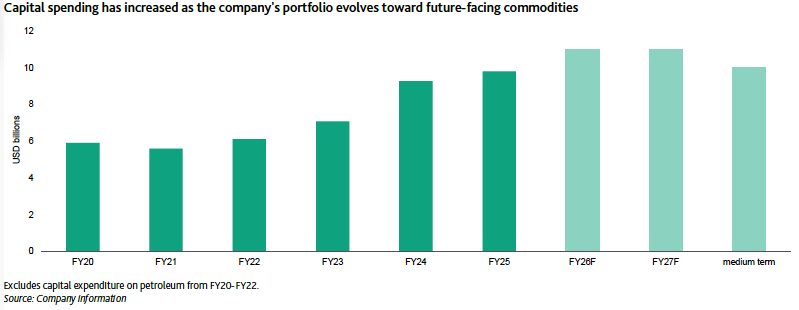
We expect the proceeds from the minority stake sale to increase liquidity and support the high capital spending requirements of the company in the medium term. BHP’s capital spending has increased as the company’s portfolio evolves toward future-facing commodities such as copper and potash. The company expects capital and exploration spending of around $11 billion annually in fiscal 2026 (ending June 2026) and fiscal 2027, with a planned reduction to around $10 billion a year on average from fiscal 2028 through to fiscal 2030 (see exhibit).

We regard the minority stake sale as equity in nature. Our understanding is that there is no mechanism for GIP to achieve preset target returns.

It is our expectation that BHP will fully consolidate the trust entity and that the cash outflow related to the tariff payments will represent less than 1% of the overall group’s earnings. Given BHP’s robust earnings generation capacity, these payments are immaterial and are not expected to have a meaningful impact on the group’s credit metrics or overall credit quality. We expect BHP’s track record of conservative credit metrics, excellent liquidity position, clearly articulated financial policies and flexible dividends to support its current growth phase while retaining credit metrics in line with our parameters for its ratings.

Credit Outlook: 15 December 2025. Pg. 10

Moody’s Investors Service

Countries

Fitch Upgrades Spain to ‘A’; Outlook Stable

Spain, September 26, 2025 – FitchRatings has upgraded Spain’s Long-Term Foreign-Currency Issuer Default Rating (IDR) to ‘A’ from ‘A-‘. The Outlook is Stable. Fitch has also upgraded Spain’s Short-Term IDR to ‘F1+’ from ‘F1’.

Key Rating DriversThe upgrade of Spain’s IDRs reflects the following key rating drivers and their relative weights:

High

Economic Outperformance: Spain’s economic performance has exceeded expectations and significantly outpaced other major eurozone economies. Economic growth is supported by large migration inflows and strong, increasingly diversified services exports. Recent productivity gains, moderate wage growth and relatively low energy prices have boosted external competitiveness and strengthened private external balance sheets. Fitch expects the economy to remain resilient, helped by limited exposure to US tariffs and ongoing net external deleveraging.

Growth Exceeds Expectations: We have raised our real GDP growth forecast for Spain to 2.7% in 2025 and 2.0% in 2026, reflecting stronger-than-expected quarterly growth in 1H25. Growth has been broad, with the services sector strengthening due to a rebound in tourism (with higher off-season inflows and quality upgrades) and solid performance in non-tourism services such as information communication technology and professional services. Business and consumer sentiment indicators are positive. The manufacturing sector (11% of gross value added) has benefited from increased solar and wind generation, which has helped lower electricity prices to well below the eurozone average.

Favourable Growth Prospects: Fitch has revised Spain’s potential growth estimate to 2% from 1.4%, mainly due to rapid expansion in labour inputs and supported by higher total factor productivity. Strong labour force growth reflects significant migration inflows, mostly from Latin America, while recent reforms and a shared language have supported labour market integration. Labour productivity growth has risen to over 1% annually from 2022 to 2024, compared with 0.3% between 2014 and 2021, although further improvements are needed to lift GDP per capita growth, which remains below headline growth.

Labour Market Supports Growth: Labour market conditions have strengthened significantly, with activity and employment rates reaching record highs, bolstering economic growth. Temporary employment has fallen to historical lows, supported by the 2022 labour market reform. The unemployment rate remains the highest in the euro area, at about 10.4% as of July, despite recent progress in reducing it.

Medium

Reduced External Vulnerabilities: Net external indebtedness continues to fall, extending the trend that began after the eurozone crisis and was interrupted only briefly by the pandemic. Net external debt declined to 44% of GDP at end-2024, down from a peak of 95% in 2013, driven by improving private external balance sheets and ongoing current account surpluses. The current account balance improved to 3.1% of GDP in 2024, supported by a stronger service surplus from tourism and diversification into non-tourism exports deficit. The primary and secondary income balance remain highly negative due to large remittance outflows and Recovery and Resilience Facility grants.

Fitch expects current account surpluses to average 2.6% of GDP between 2025 and 2027 (relative to an average deficit of 0.5% for the ‘A’ rated median), with net external debt falling below 40% of GDP, reaching 37% by 2027, gradually closing the gap to the net creditor position of the peer median of 6.1%.

Spain’s ‘A’ IDRs also reflect the following key rating drivers:

Rating Fundamentals: The ratings are supported by governance indicators consistent with the ‘A’ rating category and eurozone membership supporting institutional stability. These strengths are balanced against a still high public debt ratio.

Political Deadlock: Spain’s centre-left minority government increasingly struggles to secure parliamentary support, including for the passage of budgets since 2023, from smaller parties, including from the Catalan separatist party. Prime Minister Sánchez faces mounting pressure from corruption allegations involving the Socialist Party and family members, while political and regional fragmentation impedes progress on crucial reforms, including housing supply solutions and the development of a coherent fiscal consolidation strategy. Parliamentary elections are not due until 2027.

Moderate Fiscal Deficits: We forecast the general government deficit will fall to 2.6% of GDP in 2025 from 3.1% in 2024, driven by the absence of one-off expenses and continued revenue growth offsetting a gradual increase in interest costs. Spain will meet its NATO defence spending target of 2% of GDP this year, up from 1.4% in 2024, with a limited impact on the deficit due to spending reallocations and reclassifications. We forecast a deficit of 2.4% of GDP in 2026, reflecting the phase-out of flood relief measures, rising to 2.5% in 2027 as elections approach and interest expenses increase. This is slightly below the ‘A’ rated peer median of 3.1% in 2026 and 2.9% in 2027.

Fiscal Uncertainties: Pro-active fiscal consolidation efforts have been limited, in Fitch’s view, and fiscal improvement has been driven mostly by the phasing out of temporary measures and strong revenue growth supported by a solid labour market and robust GDP growth. Political fragmentation raises uncertainty about parliamentary approval of the 2026 budget, and Fitch expects the 2023 budget to be rolled over for a third consecutive year, with new measures likely passed on a law by law throughout the year.

Fiscal uncertainty extends to the medium term due to the lack of a credible fiscal strategy. The government targets a deficit of 1.5% of GDP and a debt/GDP ratio of 94.8% by 2029 under its seven-year adjustment plan, but the plan lacks detailed measures and faces challenges from the absence of a budget and political majority for consolidation.

High Debt, Gradual Reduction: Fitch projects the general government debt ratio will fall from 101.6% of GDP in 2024 to 100.7% by 2027, and below 100% thereafter, supported by sound nominal GDP growth. This is high relative to the ‘A’ category median of 53.7%. However, we expect debt will temporarily increase in the short term, even as fiscal deficits narrow, due to Recovery and Resilience Facility funds and cash-to-accrual accounting adjustments totalling 3.6% of GDP in 2025-2026.

ESG – Governance: Spain has an ESG Relevance Score (RS) of ‘5[+]’ for Political Stability and Rights and the Rule of Law, Institutional and Regulatory Quality and Control of Corruption. These scores reflect the high weight that the World Bank Governance Indicators (WBGI) have in our proprietary Sovereign Rating Model. Spain has a high WBGI ranking at 74, reflecting its long record of stable and peaceful political transitions, well-established rights for participation in the political process, strong institutional capacity, effective rule of law and a low level of corruption.

Source: Fitch Ratings

Banking

Fitch Affirms Credicorp Bank’s Long-Term IDR at ‘BB+’; Outlook Stable

Panama, October 06, 2025 – Fitch Ratings has affirmed Credicorp Bank, S.A.’s Long-Term Issuer Default Rating (IDR) at ‘BB+’, Short-Term IDR at ‘B’, Viability Rating (VR) at ‘bb+’ and the Government Support Rating (GSR) at ‘No Support’ (‘ns’). Fitch has also affirmed Credicorp’s Long- and Short-Term National Ratings at ‘AA(pan)’ and ‘F1+(pan)’, respectively. The Rating Outlook for the Long-Term IDR and Long-Term National Ratings is Stable.

Key Rating Drivers

Operating Environment with Moderate Influence: Panama’s sovereign rating (BB+/Stable) and broader operating environment moderately influence Credicorp’s VR, with the sovereign rating continuing to cap the Operating Environment (OE) score despite fundamentals that point to a ‘bbb’ category. While GDP growth has slowed and interest rates remain high, system credit growth, asset quality, and profitability are outperforming Fitch’s expectations. Fitch projects GDP per capita and Operational Risk Index (ORI) to remain stable and continue to preserve operating conditions for banks.

Consistent Business Profile with High Capitalization: Credicorp’s international and national scale ratings are driven by its ‘bb+’ VR. Fitch views Credicorp’s business profile as strong, supported by conservative risk management, which has led to good asset quality and resilient profitability. Credicorp’s capital strength significantly influences Fitch’s decision to rate the bank at the same level as the Panamanian sovereign and mitigates the risks inherent in its business model.

Consolidated Business Model: Fitch’s ‘bb-‘ score for Credicorp’s business profile exceeds the implied level of ‘b’. Credicorp’s consistent business model, marked by a lower-risk, atomized customer base and proven earnings generation, offsets its lower levels of total operating income (TOI) compared to regional peers. From 2022 to 2025, the bank’s average TOI was USD74 million.

Credicorp’s market position is moderate, with a market share of 1.5% by assets in the banking system. The bank’s strategy focuses on strengthening its local franchise through consumer lending and enhancing operational and commercial efficiencies via medium-term digital transformation.

Well-Managed Risks: Fitch views Credicorp’s underwriting standards and risk controls as sound, demonstrated by controlled loan deterioration over the economic cycle, resulting in lower credit costs than direct peers. As of June 2025, its loan impairment charges-to-average gross loans ratio was 0.3%, below other mid-sized banks. Fitch’s assessment is also supported by the bank’s reasonable collateral levels, prudent investment policies and conservative balance sheet growth.

Good Asset Quality: Credicorp has maintained good asset-quality metrics that compare favorably with most local peers by metrics and concentration. As of June 2025, stage 3 loans comprised 2.0% of the portfolio. Loan loss allowance coverage of stage 3 loans was a reasonable 74.9%. Good levels of collaterals also support this assessment Fitch expects asset quality ratios to remain stable, with a forecasted stage 3 ratio of 2.1% for 2026 and 2027.

As of June 2025, Credicorp’s collaterals represented 81.2% to the total loan portfolio, while the top 20 borrowers represented 0.64x of the common equity Tier 1 (CET1) ratio. Fitch expects the bank to keep loan delinquencies at manageable levels by focusing on sectors and products where it has extensive expertise.

Consistent Profitability Supported by Associates: Credicorp has demonstrated good profitability and resilience. As of June 2025, the operating profit-to-risk-weighted assets (RWA) ratio was 2.4%, above the 2022-2025 average of 2.0%. Stable asset performance and recurrent profits from investments in associated companies have bolstered profitability. The net interest income from the loan book continues to compose nearly 68.8% of TOI.

However, Credicorp’s operating profits are substantially supported by the profits generated by associates, which as of June 2025 made up 50.6% of the bank’s operating profit (average 2022-2025: 41.1%). Fitch expects Credicorp’s profitability to remain strong, supported by its growth targets and benefits from its associates. Fitch forecasts an operating profit to RWA ratio of 2.2% for 2026 and 2027.

Capitalization a Rating Strength: Credicorp’s capitalization and leverage ratios are stronger versus similarly rated peers, and Fitch deems them a rating strength. As of June 2025, the bank’s regulatory CET1-to-RWA ratio was 21.9%, far exceeding the 10.5% total regulatory minimum. When including the regulatory countercyclical buffer (CCyB), the CET1 ratio reaches 23.6%.

Fitch expects the bank’s capitalization ratios to remain strong in the foreseeable future, supported by reasonable credit growth, consistent earnings generation, and moderate dividend payments. Fitch forecasts a CET1 ratio (including dynamic provision) of approximately 24% for 2026 and 2027.

Stable Deposit Base: Credicorp’s financing is supported by a growing deposit base that has historically maintained the loan-to-deposit ratio below 100%, ahead of its closest peers. As of June 2025, the ratio was 91.5%, influenced by moderate loan growth. Although its funding is concentrated, with customer deposits representing 92.8% of total funding, Credicorp complements its funding structure with medium-term wholesale sources that support asset-liability management.

As of June 2025, the balance of the 20 largest depositors represented 27.8% of total deposits, a proportion that has decreased in recent years, in line with the bank’s funding deconcentration strategy (June 2022: 36.8%). Fitch expects funding and liquidity metrics to remain stable in the medium term, with a likely loans to deposits ratio of 91.8% for both 2026 and 2027.

Source: Fitch Ratings

Infrastructure

Latin American Sovereign External Issuance Surges in 1H25

Latin America, July 23, 2025 – Latin American sovereign hard currency issuance surged to USD38.6 billion in 1H25, a 54% increase from the previous year and nearly matching the total for all of 2024, Fitch Ratings says in a new report. Ten sovereigns accessed external markets despite global geopolitical volatility and persistent high US policy rates, as emerging market sovereign spreads narrowed since the April ‘Liberation Day’ spike. However, volatility could return after the US tariff pause ends in August.

Issuance continues to be mainly in US dollars (73%), but this proportion is down from 91% in the first half of 2024, reflecting increased regional interest in diversifying currency exposure. Chile and Mexico issued euro bonds and Uruguay debuted Swiss franc bonds, while Panama stayed out of capital markets but raised significant funds via euro and Swiss franc loans. Activity also continued in global local currency-linked bonds (Dominican Republic, Paraguay).

Barbados returned to international markets with bonds featuring the world’s first pandemic clause, following its 2019 bond with natural disaster provisions. Fitch rated the bond in line with the sovereign’s rating, noting that payment deferrals under the clause would not be considered a default.

Distressed emerging-market sovereign spreads have tightened, although market access for some remains a challenge. Ecuador saw the biggest gain after re-electing a market-friendly government and reaffirming its IMF commitments; Argentina also saw narrowing spreads after securing a new IMF program and receiving a large upfront disbursement. Bolivia still faces high yields, rising default risks, and uncertain prospects ahead of elections and a large bond payment in 2026.

Source: Fitch Ratings