
São Paulo city skyline with high-rise buildings and busy roads at sunset
Banking

Brazil’s credit relief for tariff-affected companies is positive for banks

Brazil, July 29, 2026 – Brazil’s (Ba1 stable) President Luiz Inácio Lula da Silva authorized the National Treasury and development bank Banco Nacional de Desenvolvimento Economico e Social (BNDES, Ba1 stable, ba11) to provide up to BRL18.5 billion ($3.6 billion) in subsidized funding for working capital and investment to support industries affected by the latest 25% US tariff increase, which took effect on 22 July. Dubbed Brazil Sovereign 3, the program will also assist companies affected by Middle East conflict-related disruptions, supporting economic activity and the labor market.

The program will help banks limit asset risks and contain loan delinquencies, which have been historically high this year amid a policy interest rate at 14.25% per year as of July. However, strong stimulus for loan origination amid still-elevated household indebtedness and asset-quality pressure would likely have negative credit implications from 2027 onward if interest rates remain significantly high. Frequent use of these support measures would also likely create incentives for borrowers to rely on additional government forbearance in the future.

Under Brazil Sovereign 3, the National Treasury will provide BRL13.5 billion, largely from funds not used in the first phase of the program, while BNDES will contribute BRL5 billion. BNDES will be responsible for disbursing the credit lines, which will carry below-market interest rates between 3% and 9.8% per year. Loan origination will begin once the detailed framework underpinning the program is published in a presidential decree in the coming weeks.

At this stage, the government has only a limited estimate of total demand for the credit lines, although subsidized rates will likely encourage companies to access the program. The program’s total volume, which will also be sufficient to provide aid to companies affected by a potential additional 12.5% tariff, accounted for just 0.25% of total system credit as of May.

Although below-market funding has an immediate positive effect on production and companies’ financial profiles, it can also distort the financial system if used indiscriminately. Such distortions were evident in the 2010s, when the government relied on sizable subsidized lending to promote economic growth, crowding out private-sector banks.

The first group of companies targeted by the measure comprises exporters directly affected by the new tariffs. A second group includes companies in strategic sectors that are relevant to Brazil’s trade balance, including critical minerals and fertilizers. The third group consists of exporters to Persian Gulf countries that are exposed to disruptions related to the Middle East conflict.

In recent weeks, the government has intensified efforts to reduce credit leverage and support economic activity ahead of the presidential elections scheduled for October. On 15 July, a provisional presidential decree authorized banks and rural producers to renegotiate up to BRL100 billion in rural debt originated exclusively by banks. To be eligible for the renegotiation program, producers must prove that they suffered losses in two harvests between 2019 and 2025 because of adverse weather or lower income caused by market conditions. The new credit lines will carry interest rates between 5% and 12% per year and tenors of eight to 10 years, depending on the size of losses, with a two-year grace period.

Although the rural debt renegotiation program will be available to all Brazilian banks, it will particularly benefit government- ownedBanco do Brasil S.A. (BB, Ba1 stable, ba1) and Caixa Economica Federal (Caixa, Ba1 stable, ba2). Their problem loan ratios in rural lending were 6.2% at BB and 18.3% at Caixa in March 2026, compared with the financial system average of 4.4%.

The measure will allow rural producers to renegotiate loans on more favorable financial terms and help prevent a further rise in delinquencies in 2026, a credit positive for banks. On 30 June, the government unveiled its BRL622 billion Crop Plan for the 2026-27 production cycle. Potential borrowers can access these funds provided they have no overdue debt obligations with banks, a condition that can also be met through these renegotiations.

Credit Outlook: 3 August 2026. Pg. 15

Moody’s Investors Service
Banking

Peru’s new payment rules will foster greater digitalization, a credit Positive

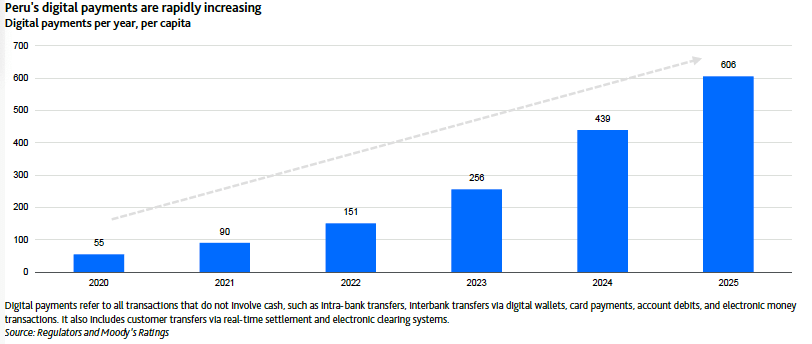
Peru, December 6, 2025 – The Central Reserve Bank of Peru (BCRP) published its updated rulebook for payments in the official gazette, strengthening its compliance framework and fostering transparency through data requirements, including new cyber-security rules, as the banking system rapidly accelerates digitalization of its operations. The new rules mandate that payment fees be nondiscriminatory, cost-based, and subject to an annual review by the regulators. The new rulebook is effective 1 April (replacing the 2010 version) and is credit positive for Peru’s financial system because it promotes competition, supporting the continued expansion of digital payments (see exhibit) and increased credit volumes by enhancing efficiencies across the banking sector.

Currently, low-value digital payments (less than PEN15,000 or $5,000) in Peru are largely controlled by banks, with interbank transfers comprising 66% of this total in the first half of 2025 (H1 2025), in accordance with data available in the BCRP’s September 2025 National Payments Systems Report. The updated rulebook will encourage new payment solutions and require interoperability among new systems, cementing the 2023 Payment Services Interoperability Regulation aimed mainly for digital wallets, enabling users to transfer funds regardless of provider or account type. This shift will initially reduce debit and credit card and current account revenue for Peru’s banks, which comprised on average about 8% of net revenues of the four largest banks as of September 2025. In addition, greater use of digital payments can drive growth in banking services, leading to larger deposit inflows and an expanded addressable market.

Instant payments accounted for 11% of low-value payments in H1 2025 and were dominated by two digital wallets: Yape, managed by the country’s largest bank Banco de Crédito del Perú (BCP, Baa1 stable, baa11), with 82% market share, and Plin, with 18%, a joint venture between next three largest banks in Peru, Banco BBVA Perú (Baa1 stable, baa2), Scotiabank Perú S.A.A. (Baa1 stable, baa2), and Banco Internacional del Perú S.A.A. (Baa1/Baa1 stable, baa2).

Competition for payments is poised to increase in Peru with the BCRP’s late 2026 planned introduction of its national digital payments platform, which is similar to Brazil’s PIX, Colombia’s Bre-B, or India’s UPI. However, Yape is already gearing up for competition, diversifying revenue streams beyond transaction fees, offering small installment loans and insurance brokerage, accelerating its path to the monetization of its client base. Payments are still the dominant contributor to Yape’s revenues, at 53%, followed by lending at 20%, as of September 2025.

As more customers adopt digital payments, electronic transactions through bank accounts increase. The shift allows banks to reduce their costs for cash transport and security – expenses that are particularly high in Peru, where many communities face limited access to financial services because of the country’s complex geography.

Credit Outlook: 15 December 2025. Pg. 14

Moody’s Investors Service

Banking

Fitch Affirms Credicorp Bank’s Long-Term IDR at ‘BB+’; Outlook Stable

Panama, October 06, 2025 – Fitch Ratings has affirmed Credicorp Bank, S.A.’s Long-Term Issuer Default Rating (IDR) at ‘BB+’, Short-Term IDR at ‘B’, Viability Rating (VR) at ‘bb+’ and the Government Support Rating (GSR) at ‘No Support’ (‘ns’). Fitch has also affirmed Credicorp’s Long- and Short-Term National Ratings at ‘AA(pan)’ and ‘F1+(pan)’, respectively. The Rating Outlook for the Long-Term IDR and Long-Term National Ratings is Stable.

Key Rating Drivers

Operating Environment with Moderate Influence: Panama’s sovereign rating (BB+/Stable) and broader operating environment moderately influence Credicorp’s VR, with the sovereign rating continuing to cap the Operating Environment (OE) score despite fundamentals that point to a ‘bbb’ category. While GDP growth has slowed and interest rates remain high, system credit growth, asset quality, and profitability are outperforming Fitch’s expectations. Fitch projects GDP per capita and Operational Risk Index (ORI) to remain stable and continue to preserve operating conditions for banks.

Consistent Business Profile with High Capitalization: Credicorp’s international and national scale ratings are driven by its ‘bb+’ VR. Fitch views Credicorp’s business profile as strong, supported by conservative risk management, which has led to good asset quality and resilient profitability. Credicorp’s capital strength significantly influences Fitch’s decision to rate the bank at the same level as the Panamanian sovereign and mitigates the risks inherent in its business model.

Consolidated Business Model: Fitch’s ‘bb-‘ score for Credicorp’s business profile exceeds the implied level of ‘b’. Credicorp’s consistent business model, marked by a lower-risk, atomized customer base and proven earnings generation, offsets its lower levels of total operating income (TOI) compared to regional peers. From 2022 to 2025, the bank’s average TOI was USD74 million.

Credicorp’s market position is moderate, with a market share of 1.5% by assets in the banking system. The bank’s strategy focuses on strengthening its local franchise through consumer lending and enhancing operational and commercial efficiencies via medium-term digital transformation.

Well-Managed Risks: Fitch views Credicorp’s underwriting standards and risk controls as sound, demonstrated by controlled loan deterioration over the economic cycle, resulting in lower credit costs than direct peers. As of June 2025, its loan impairment charges-to-average gross loans ratio was 0.3%, below other mid-sized banks. Fitch’s assessment is also supported by the bank’s reasonable collateral levels, prudent investment policies and conservative balance sheet growth.

Good Asset Quality: Credicorp has maintained good asset-quality metrics that compare favorably with most local peers by metrics and concentration. As of June 2025, stage 3 loans comprised 2.0% of the portfolio. Loan loss allowance coverage of stage 3 loans was a reasonable 74.9%. Good levels of collaterals also support this assessment Fitch expects asset quality ratios to remain stable, with a forecasted stage 3 ratio of 2.1% for 2026 and 2027.

As of June 2025, Credicorp’s collaterals represented 81.2% to the total loan portfolio, while the top 20 borrowers represented 0.64x of the common equity Tier 1 (CET1) ratio. Fitch expects the bank to keep loan delinquencies at manageable levels by focusing on sectors and products where it has extensive expertise.

Consistent Profitability Supported by Associates: Credicorp has demonstrated good profitability and resilience. As of June 2025, the operating profit-to-risk-weighted assets (RWA) ratio was 2.4%, above the 2022-2025 average of 2.0%. Stable asset performance and recurrent profits from investments in associated companies have bolstered profitability. The net interest income from the loan book continues to compose nearly 68.8% of TOI.

However, Credicorp’s operating profits are substantially supported by the profits generated by associates, which as of June 2025 made up 50.6% of the bank’s operating profit (average 2022-2025: 41.1%). Fitch expects Credicorp’s profitability to remain strong, supported by its growth targets and benefits from its associates. Fitch forecasts an operating profit to RWA ratio of 2.2% for 2026 and 2027.

Capitalization a Rating Strength: Credicorp’s capitalization and leverage ratios are stronger versus similarly rated peers, and Fitch deems them a rating strength. As of June 2025, the bank’s regulatory CET1-to-RWA ratio was 21.9%, far exceeding the 10.5% total regulatory minimum. When including the regulatory countercyclical buffer (CCyB), the CET1 ratio reaches 23.6%.

Fitch expects the bank’s capitalization ratios to remain strong in the foreseeable future, supported by reasonable credit growth, consistent earnings generation, and moderate dividend payments. Fitch forecasts a CET1 ratio (including dynamic provision) of approximately 24% for 2026 and 2027.

Stable Deposit Base: Credicorp’s financing is supported by a growing deposit base that has historically maintained the loan-to-deposit ratio below 100%, ahead of its closest peers. As of June 2025, the ratio was 91.5%, influenced by moderate loan growth. Although its funding is concentrated, with customer deposits representing 92.8% of total funding, Credicorp complements its funding structure with medium-term wholesale sources that support asset-liability management.

As of June 2025, the balance of the 20 largest depositors represented 27.8% of total deposits, a proportion that has decreased in recent years, in line with the bank’s funding deconcentration strategy (June 2022: 36.8%). Fitch expects funding and liquidity metrics to remain stable in the medium term, with a likely loans to deposits ratio of 91.8% for both 2026 and 2027.

Source: Fitch Ratings

Banking

Fitch Takes Actions on Davivienda and Scotiabank following integration announcement

Colombia, January 15, 2025 – Fitch Ratings has affirmed Banco Davivienda S.A.’s Long-and Short-Term Local and Foreign Currency Issuer Default Ratings at ‘BB+’ and ‘B’, respectively. The rating outlook for the Long-Term IDRs is Stable. Fitch has also affirmed Banco Davivienda (Costa Rica), S.A.’s (Davivienda CR) Long- and Short-Term Local and Foreign Currency Issuer Default Ratings at ‘BB+’ and ‘B’, respectively, and its Shareholder Support Rating at ‘bb+’. The Rating Outlook for the Long-Term IDRs is Stable.

Fitch has placed Scotiabank Colpatria S.A.’s (SBC) Long-Term Foreign Currency and Local Currency IDRs of ‘BBB-‘ and ‘BBB’, respectively, its Shareholder Support Rating of ‘bbb-‘, and its local subordinated debt on rating watch negative. At the same time, Fitch affirmed the bank’s Viability Rating (VR) at ‘bb’, its national ratings, including the local senior unsecured debt, at ‘AAA(col)’ and ‘F1+(col)’, respectively.

The rating watch negative on SBC’s ratings reflects the potential credit implications due to anticipated changes in its shareholder structure. This is because, upon completion of the transaction, the expected main shareholder, Davivienda, would be rated lower than the current shareholder, The Bank of Nova Scotia (BNS) ‘AA-‘/ROS. Consequently, the Shareholder Support Rating, which drives the ratings, will be capped at Davivienda’s rating of ‘BB+’. Upon completion of the integration, Fitch expects SBC’s IDRs to converge toward those of Davivienda, which are in turn driven by the latter’s intrinsic credit profile as reflected in its own VR.

Fitch Ratings has also affirmed the Long- and Short-Term National Ratings of Scotiabank de Costa Rica, S.A. (Scotiabank CR) at ‘AAA(cri)’ and ‘F1+(cri)’, respectively. The Long-Term National Rating Outlook is Stable. At the same time, it affirmed the senior unsecured debt ratings at ‘AAA(cri)’.

These actions follow the Jan. 6, 2025 announcement that Davivienda has reached an agreement with BNS to integrate Scotiabank’s operations in Colombia, Costa Rica, and Panama into Davivienda. In exchange, Scotiabank will receive approximately 20% ownership stake in the new combined operations and participation on the Board of Directors. Simultaneously, BNS will purchase Grupo Mercantil Colpatria S.A.’s stake (44%) in SBC. This strategic move aims to consolidate their market position in Colombia and Central America and capitalize on synergies between Davivienda and BNS. The transaction is dependent on regulatory approval from authorities in Colombia, Costa Rica and Panama.

Upon completion of the non-cash agreement, Davivienda’s assets, liabilities, and equity are expected to grow by 40% while maintaining its capital position relatively stable without any goodwill generation. The strengthened market position in these three markets will enhance Davivienda’s footprint as a regional leader, while synergies from BNS will provide access to a broad global offering of financial solutions.

Fitch expects to resolve the rating watch negative on SBC upon closing of the transaction, which could take more than six months.

Key Rating Drivers: The affirmation of Davivienda’s ratings reflects Fitch’s expectation that this transaction will not negatively impact its operations or its strong business and financial profiles. Particularly, Fitch expects Capitalization core metric to be maintained above 10%, once the transaction is completed. Upside potential is limited due to challenges regarding the integration of bank operations and the significant efforts needed to normalize asset quality and profitability, mainly in Colombia, which remain contingent on its disciplined lending standards and pace of growth.

Strong Business Profile: Davivienda’s business profile is underpinned by its stable total operating income, strong market position in Colombia and leading franchise in Central America. Davivienda has a diversified business model, serving more than 24 million customers and offering a full suite of retail and commercial banking, as well as wealth management and capital market services. Fitch expects improvements in total operating income, efficiency and profitability, based on strengthened geographic diversification and synergies between the two entities once the integration of operations is completed.

Source: Fitch Ratings

Banking

Nubank expands product offering in Mexico with Akala acquisition, a credit positive

Brazil, September 21, 2021 – Brazilian leading online credit card fintech Nu Pagamentos S.A. (Nubank) announced the acquisition of Akala S.A. de C.V., Sociedad Financiera Popular, a savings and loans cooperative in Mexico, through its newly established Mexican subsidiary NU BN Servicios México, S.A. de C.V. (Nu Mexico). Nubank did not disclose the price of the transaction, but it has already received approval from Mexico’s banking regulator, Comisión Nacional Bancaria y de Valores (CNBV).

The acquisition is credit positive for Nu Mexico and Nubank in Brazil because it will provide the financial technology firm (fintech) with an operating license to access cheap and stable core deposits and allow Nu Mexico to launch new products and services to support its Mexican expansion. This transaction is also aligned to the parent’s growth plans in the region and the rapid implementation of its successful online credit card franchise focused on low income and underserved individuals. This also signals Nubank’s strategy to start its operations by leverage regulatory and market knowledge from local and licensed operating companies.

Acquiring Akala, which is regulated and has a financial services designation, demonstrates Nubank’s intention to fast expand its operations in Latin America’s second-largest economy behind Brazil. The Mexican market has garnered interest because of its favorable operating environment, low credit penetration and strong potential for financial inclusion. According to Mexico’s Instituto Nacional de Estadística y Geografía, the national census bureau, the country has around 70 million internet users and 65 million smartphones, but only 24 million people, or 25% of the country’s working age population, has a credit card.

By being able to receive deposits from the public, Nu Mexico will be able to start with low cost of funding, which will allow it to manage its prices and have a competitive position with incumbent banks that dominate the credit card business in Mexico. With an innovative and low cost business model, the fintech will likely challenge large banks to accelerate their investments in innovation and to expand its business lines beyond their traditional products and segments.

Nubank’s acquisition follows the deal announced by Credijusto (Apjusto, S.A.P.I. de C.V., SOFOM, E.R.), a small Mexican digital lender to small and midsize enterprises (SMEs), in June that acquired Banco Finterra, S.A., a local bank focused on offering financial services to SMEs in the agricultural sector. Such transactions (see exhibit) indicate a path for fintechs to overcome the high barriers to entry into Mexico’s banking sector, and signal that licensed fintechs and digital banks specializing in niche markets will intensify competition in various credit markets, challenging the profitability of smaller incumbent banks.

Sources: Dealogic, Moody’s Analytics and Moody’s Investors Service

It is unlikely that fintechs will displace large Mexican banks because large banks will retain their dominance in the financial system by focusing on customers at the top of the economic pyramid. By comparison, fintechs and digital banks usually cater to Mexico’s sizable unbanked and under-banked segments. Additionally, several Mexican banks are forming alliances with fintechs, creating fintechs through joint ventures with large technology companies or are seeking smaller fintechs that can accelerate and improve banks’ digital strategies.

Nubank’s expansion into Mexico began when the company opened its Mexican subsidiary in May 2019, its first operation outside Brazil. In June 2021, Nubank raised $750 million in capital. which allowed it speed up its Latin American expansion. The expansion plans received an additional boost when Nubank in April 2021 received a $70 million capital injection and $65 million in revolving credit lines from US banks.

Credit Outlook: 27 September 2021. Pg. 9
Moody’s Investors Service