News

Countries

US corporate default tally in 2023 was highest since pandemic, with more to come this year

United States, January 31, 2024

  • Elevated defaults point to rising tide in early 2024 before easing by year-end. Nonfinancial corporate family defaults nearly tripled to 92 in 2023 from 31 in 2022, the highest annual default tally since 2020. Our 12-month trailing issuer-weighted default rate wrapped the year at 5.6%, and is set to peak at 5.8% in early 2024, before slowly reverting to its historic average by June 2024 and then moderating further to around 4% by year-end. Although Q.o.Q. defaults were unchanged at 20 in Q4, levels remain elevated.
  • Private equity (PE) backed companies lead Q4 defaults. In contrast to public counterparts, defaulted PE-owned companies affected more loans than bonds, with about $7.8 billion versus $5.0 billion, respectively. Given the high incidence of senior secured loan-only LBOs among distressed issuers, leveraged loans will continue to experience higher defaults than high yield bonds. Majority of Q4 DEs involved amend-and-extend transactions, including loan maturity extensions, interest rate conversions to PIK.
  • Half of Q4 defaults were repeat defaulters, with 70% of these having a PE backer. Most re-defaulters were companies which completed at least one round of DEs in the past, followed by another out-of-court restructuring during the last three months of the year. Many were companies which had undergone one or two rounds of DEs previously and ultimately sought Chapter 11 protection or missed debt payments. We expect this trend to persist through most of next year, as the default rate is set to remain above average through the first half of the year.
  • Media sector stood out in Q4 with three defaults, completed as distressed exchanges (DEs) . However, the total defaulted debt for this group was small relative to the largest defaults in the telecommunications, retail, services, healthcare and packaging sectors. Looking ahead, the telecommunications and durable consumer goods sectors will face the highest default rates projected for 2024.
  • Credit risks remain high for lower-rated segment of spec-grade universe. The distressed subset of the B3N List, Caa2-PD and lower rated companies rose to 97, up from 87 in the previous quarter and 82 a year earlier. Many of these weaker private companies will succumb to default as liquidity conditions for those in the leveraged loan market deteriorates in the months ahead.

Credit Outlook: 1 February 2024. Pg. 35
Moody’s Investors Service

Banking

Nubank expands product offering in Mexico with Akala acquisition, a credit positive

Brazil, September 21, 2021 – Brazilian leading online credit card fintech Nu Pagamentos S.A. (Nubank) announced the acquisition of Akala S.A. de C.V., Sociedad Financiera Popular, a savings and loans cooperative in Mexico, through its newly established Mexican subsidiary NU BN Servicios México, S.A. de C.V. (Nu Mexico). Nubank did not disclose the price of the transaction, but it has already received approval from Mexico’s banking regulator, Comisión Nacional Bancaria y de Valores (CNBV).

The acquisition is credit positive for Nu Mexico and Nubank in Brazil because it will provide the financial technology firm (fintech) with an operating license to access cheap and stable core deposits and allow Nu Mexico to launch new products and services to support its Mexican expansion. This transaction is also aligned to the parent’s growth plans in the region and the rapid implementation of its successful online credit card franchise focused on low income and underserved individuals. This also signals Nubank’s strategy to start its operations by leverage regulatory and market knowledge from local and licensed operating companies.

Acquiring Akala, which is regulated and has a financial services designation, demonstrates Nubank’s intention to fast expand its operations in Latin America’s second-largest economy behind Brazil. The Mexican market has garnered interest because of its favorable operating environment, low credit penetration and strong potential for financial inclusion. According to Mexico’s Instituto Nacional de Estadística y Geografía, the national census bureau, the country has around 70 million internet users and 65 million smartphones, but only 24 million people, or 25% of the country’s working age population, has a credit card.

By being able to receive deposits from the public, Nu Mexico will be able to start with low cost of funding, which will allow it to manage its prices and have a competitive position with incumbent banks that dominate the credit card business in Mexico. With an innovative and low cost business model, the fintech will likely challenge large banks to accelerate their investments in innovation and to expand its business lines beyond their traditional products and segments.

Nubank’s acquisition follows the deal announced by Credijusto (Apjusto, S.A.P.I. de C.V., SOFOM, E.R.), a small Mexican digital lender to small and midsize enterprises (SMEs), in June that acquired Banco Finterra, S.A., a local bank focused on offering financial services to SMEs in the agricultural sector. Such transactions (see exhibit) indicate a path for fintechs to overcome the high barriers to entry into Mexico’s banking sector, and signal that licensed fintechs and digital banks specializing in niche markets will intensify competition in various credit markets, challenging the profitability of smaller incumbent banks.

Sources: Dealogic, Moody’s Analytics and Moody’s Investors Service

It is unlikely that fintechs will displace large Mexican banks because large banks will retain their dominance in the financial system by focusing on customers at the top of the economic pyramid. By comparison, fintechs and digital banks usually cater to Mexico’s sizable unbanked and under-banked segments. Additionally, several Mexican banks are forming alliances with fintechs, creating fintechs through joint ventures with large technology companies or are seeking smaller fintechs that can accelerate and improve banks’ digital strategies.

Nubank’s expansion into Mexico began when the company opened its Mexican subsidiary in May 2019, its first operation outside Brazil. In June 2021, Nubank raised $750 million in capital. which allowed it speed up its Latin American expansion. The expansion plans received an additional boost when Nubank in April 2021 received a $70 million capital injection and $65 million in revolving credit lines from US banks.

Credit Outlook: 27 September 2021. Pg. 9
Moody’s Investors Service

Banking

Peru allows state-guaranteed loans to be restructured, a credit positive for banks

Peru, March 9, 2021 – The Government of Peru (A3 stable) issued an emergency decree to allow banks to restructure loans under its state guarantee programs Reactiva Perú and FAE-MYPE until 15 July 2021 and also allow an additional 12-month grace period during which borrowers will repay only the interest portion of their loans.

By allowing banks to restructure existing Reactiva and FAE-MYPE loans through mid-July, allowing an additional grace period, and providing state guarantees for up to 98% of a loan (depending on its size), banks have strong asset-risk protection for longer. However, Peruvian banks also risk reduced interest income dragging down their margins.

The Reactiva Perú program was set up in April 2020 and is a PEN30 billion ($8.9 billion) state-guaranteed credit facility that provides working capital to small and midsize enterprises (SMEs) and large corporates. The program aims to relieve liquidity strain and limit the number of loan defaults among corporate and SME borrowers, which supports banks’ asset quality and the economy. The FAE-MYPE program targets small and micro agricultural producers and will be used by banks as well as credit cooperatives.

Under Reactiva, banks were awarded state guarantees in auctions that ensured the lowest rate for the end user for a 36-month loan with a 12-month grace period of no capital repayment. The government provides a guarantee to the lending bank for 80%-98% of the loan on a pro rata basis, depending on the size of the credit.Lending under the Reactiva Perú state-guarantee for corporations and SMEs now accounts for around 16.5% of total loans, according to Central Bank data. The program ended on 30 November 2020 which was the last date when state guarantees could be applied for.

Problem loans in Peru were 3.4% at year-end 2020, 75 basis points higher than year-end 2019 before the pandemic. However, government aid such as the Reactiva program is key to mitigate an expected deterioration in credit quality. The four largest banks in the market – Banco de Crédito del Perú (Baa1/Baa1 stable, baa21), Banco BBVA Perú S.A.(Baa1 stable, baa2), Banco Internacional del Perú – Interbank (Baa1/Baa1 stable, baa2) and Scotiabank Perú (A3 stable, baa3) – hold around 90% of total loans to midsize companies and almost 100% of total loans to SMEs and are the greatest beneficiaries of the Reactiva program.

However, the additional grace period will reduce Peruvian banks’ interest income as capital on restructured loans need not be paid, which will compress their net interest margins. We estimate that the average rate on Reactiva loans with a 24-month maturity is 1.6%, well below average rates on other loans. In 2020, bank net interest margins fell by 100 basis points as provisioning expenses rose 120%; net income to tangible assets fell to 0.4%, from the 2.1% 2016-19 average. With the ability to restructure loans and allow borrowers to pay only interest, the new measures will allow banks to keep their loan-loss provision expenses in check, which will aid their net income.

Under the new measures, loans of up to PEN90,000 can be restructured without any requirement, loans between PEN90,001 and PEN750,000 can be restructured if the borrower’s sales fell by 10% in the fourth quarter of 2020 versus fourth-quarter 2019 and for loans between PEN750,001 and PEN5 million, borrowers must show that fourth-quarter sales fell by 20% versus 2019.

Credit Outlook: 15 March 2021. Pg. 17
Moodys

Corporates

Carrefour’s cash-funded acquisition of Grupo BIG will strengthen its market position in Brazil

Brazil, March 24, 2021 – Carrefour S.A. (Baa1 negative) announced the acquisition of Brazilian food retailer Grupo Big S.A. for an enterprise value of around €1.1 billion, equivalent to an estimated 8x enterprise value/EBITDA multiple before synergies. The transaction is expected to close in 2022 following regulatory approval from the Brazilian authorities. Overall, we view the acquisition as credit positive for Carrefour because it will be funded by cash, reducing gross leverage once synergies are achieved, and strengthen its leading position in Brazil.

The acquisition will improve Carrefour’s business profile by increasing its overall scale and geographical diversification, in addition to strengthening its position in Brazil. Carrefour and Grupo BIG are the country’s largest and third-largest food retailers, respectively, and have complementary geographical coverage: Grupo BIG has a strong presence in the north-east and south of Brazil, where Carrefour currently has limited penetration. In addition, the similarity of Grupo BIG’s formats with Carrefour’s (mainly cash and carry and hypermarkets) will facilitate the companies’ integration.

Carrefour will finance the transaction through a mix of cash (70%) and equity (30%) and we expect it to have sufficient cash on balance sheet to fund the acquisition. As a result, Moody’s adjusted debt/EBITDA will decrease by around 0.2x pro forma for the transaction and taking into account around €260 million of run-rate EBITDA synergies that it expects to achieve over a three-year period. However, net debt will deteriorate slightly once the transaction completes because of the estimated €800 million acquisition cost. We also expect restructuring costs to partially offset the additional cash flow from Grupo BIG in the years following the transaction’s closing.

Credit Outlook: 29 March 2021. Pg. 4
Moodys

Corporates

Ecopetrol’s acquisition of ISA is credit positive

Colombia, January 27, 2021 – Ecopetrol S.A. (Ecopetrol, Baa3 stable) announced the acquisition of 51.4% of the capital of Interconexion Electrica S.A. E.S.P. (ISA, Baa2 stable). ISA is a publicly traded power company owned by the Government of Colombia (Baa2 negative). The transaction is credit positive for Ecopetrol because ISA generates a more stable EBITDA compared to that of Ecopetrol’s oil and gas commodity business, which increases cash flow visibility for Ecopetrol. Also, ISA operates in Colombia, Brazil, Peru and Chile, which reduces Ecopetrol’s geographic concentration risk; and Ecopetrol’s capital structure will not materially change after the completion of the acquisition transaction.

The acquisition of the controlling stake at ISA may cost approximately $4 billion. Because ISA is publicly traded, the acquisition amount should be based on market prices and on standard valuation practices, despite the Colombian government currently controlling Ecopetrol’s and ISA’s capital.

Ecopetrol’s plans to sell shares and assets as well as raise debt to fund the acquisition of ISA. The company expects that the combination of such initiatives will not deteriorate its credit metrics materially. We estimate that Ecopetrol’s debt/EBITDA ratio was around 3 times at year-end 2020 and that this credit metric will remain relatively stable in the next few years, pro-forma for the consolidation of ISA. Our estimate is based on an average Brent oil price of $45 per barrel (dpb) in 2021 and 50 dpb in the medium term.

We understand that after completion of the transaction, ISA will contribute with 15-20% of Ecopetrol’s consolidated EBITDA. We assume that the companies’ business strategies will not change materially and that their respective management teams, dividend policies and capital investment plans will remain mostly unchanged.

Ecopetrol is the largest integrated oil and gas company in Colombia. Ecopetrol has three business segments, namely exploration and production, refining activities and transportation and logistics. Its production averaged around 639,000 barrels of oil equivalent per day, net of royalties, in the 12 months that ended September 2020, and total assets amounted to $43 billion in September 2020. The Colombian government owns 88.5% of the company’s capital and the balance has been traded on the Colombian Securities Exchange since November 2007.

ISA, headquartered in Medellin, Colombia, is an operating holding company with businesses in the electricity transmission, toll roads, telecommunications, and systems management sectors. The company holds direct and indirect ownership stakes in a portfolio of subsidiaries located in Colombia, Brazil, Peru and Chile.

Credit Outlook: 1 February 2021. Pg. 5
Moodys

Banking

Google Pay expands into consumer banking, a credit negative for US banks

United States, November 18, 2020 – Google parent Alphabet Inc. (Aa2 stable) announced that it will launch Plex Accounts next year, a digital bank account offered within its Google Pay app in partnership with 11 US banks and credit unions. Google’s expansion into the distribution of consumer banking services is credit negative for US banks because it will increase competition for customer relationships, and in particular, competition for deposits, US banks’ primary funding source.

The launch of Google Pay Plex Accounts is an example of big tech’s expansion into retail financial services. It capitalizes on the rising popularity of digital wallets, an example of the widening application of digital innovations in financial services that we expect will continue to drive disruption across banking. Digital innovation and a flourishing financial technology sector present a threat to US banks.

Alphabet’s expansion into retail financial services distribution is consistent with our central scenario that large nonfinancial institutions intent on enhancing customer engagement will partner with incumbent banks to distribute financial services. Alphabet’s ability to partner with US banks and credit unions demonstrates the increasingly low barriers to entry for firms with large existing customer bases to distribute consumer financial services including deposit offerings. Digital innovation and changing customer behavior have lowered such barriers that historically included building out an expensive branch network.

US banks’ balance sheets are built on a foundation of low-cost, sticky deposits. Google Pay Plex Accounts will have no fees for monthly service, low balance, overdraft or in-network ATM use, and market its user-friendly interface and capabilities. Many US banks have similarly introduced online-only deposit products with low to no fees and/or high interest rates to capture additional deposits and customer relationships. Over time, increasing competition could raise deposit costs, pressure deposit fees and increase the need for banks to invest in emerging technology to attract or maintain customers. Failure to respond risks driving shifts in market share to those banks who best meet customer expectations.

The 11 US banks and credit unions partnering with Alphabet to offer Plex Accounts, including Citibank, N.A. (Aa3/Aa3 stable, baa11), would benefit from an inflow of consumer deposits and the potential to deepen new customer relationships. Citibank, N.A. and the other partnering banks will also have an early-adopter advantage in evolving their digital strategies to meet new customer needs. With the accelerating use of mobile payments and rising popularity of single-click digital wallets, incumbent banks need a strategy to stay in the customer-facing part of the payments business.

Alphabet will offer Plex Accounts within its own digital ecosystem, Google Pay, which provides a level playing field for partnering banks. However, the lack of friction within such a digital environment could ultimately increase competition among financial institutions, on and off the platform. Alphabet’s expansion into the distribution of financial services would align with big tech strategies to increase the scope and appeal of their digital platforms through enhanced customer engagement and a further strengthening of their consumer value proposition.

The launch also provides a blueprint for other firms with large existing customer bases keen to capture an increasing share of consumer activity and build customer loyalty. Increased user engagement enables these firms to capture valuable data and boost revenue. In our view, partnerships in which banks cede control of a large share of customer relationships pose the greatest risk to incumbent financial institutions. Such developments increase the risk of our alternate scenario, where big tech firms control a larger share of distribution and displace incumbents that fail to execute timely, effective digital strategies.

Credit Outlook: 23 November 2020. Pg. 16
Moodys

Banking

Record consumer indebtedness and rising delinquencies are credit negative for Brazilian banks

Brazil, July 28, 2020 – Brazil’s Confederação Nacional do Comércio de Bens, Serviços e Turismo (the national confederation of commerce of goods, services and tourism or CNC) published its July survey which showed that consumer indebtedness had reached record levels and that delinquency pressures have intensified. The rise in household indebtedness is credit negative for Brazilian banks with significant consumer lending exposures, mainly large retail banks, because it will lead to higher asset risk on banks’ balance sheets and be reflected in rising problem loan levels as well as renegotiations and restructurings. The increase also illustrates the challenges Brazilian consumers face in managing their loan exposures.

The record level of indebtedness is particularly credit negative for Brazilian banks with large exposures to unsecured consumer lending. Such banks include Caixa Economica Federal (Ba2 stable, ba31), Banco do Brasil S.A. (Ba2/(P)Ba2 stable, ba2), Banco Bradesco S.A. (Ba2 stable, ba2), Itau Unibanco S.A. (Ba2 stable, ba2) and Banco Santander (Brasil) S.A. (Ba1 stable, ba2), which combined account for the lion’s share of consumer lending in Brazil.

Higher indebtedness indicates rising asset risk, particularly amid challenging economic conditions in Brazil because of the coronavirus pandemic. We expect Brazil’s economy to contract by 6.2% this year, with high unemployment negatively affecting household income. Since the onset of pandemic, banks’ problem loans ticked up to 3.3% in April from 2.9% in December 2019, driven largely by rising problem loans for consumers, which rose to 4.1% in April from 3.6% in December 2019 (see Exhibit 1). However, 90-day problem loans have since ticked down to 2.9% for the system as of June 2020 and to 3.6% for consumer loans as banks began renegotiating their loan exposures amid rising asset risk.

Source: Central Bank of Brazil

Based on available central bank data, BRL594 billion of loans were renegotiated and received loan payment extensions due to the pandemic between 16 March and 29 May, which equates to about 16.5% of total systemwide loans as of June 2020. Loans to households and small and midsize enterprises (SMEs) comprised 91% of these renegotiated loans. The payments were deferred for of up to 180 days and equal 11% of the sum of all renegotiated contracts (principal plus interest), most of which supported SMEs and households.

At the onset of the coronavirus crisis, the central bank eased provisioning requirements for any accruing loans being renegotiated until September 2020. The measures that postpone provisioning will likely delay credit losses, requiring banks to reinforce reserve coverage levels during the third and fourth quarters. In this context, rising household indebtedness to a record level in July is a sign that asset risk pressures will continue to build on banks’ balance sheets

The results of CNC’s survey showed that 67.4% of all Brazilian families have debt outstanding, the highest level on record since 2010. The levels of indebtedness were driven by lower income households, defined by those who earn up to 10x the minimum wage, of which 69% of families were indebted. For households earning over 10x the minimum wage, the level was at 59% as of July, elevated compared with historical levels (see Exhibit 2).

Source: Confederação Nacional do Comércio de Bens, Serviços e Turismo

The CNC survey also showed that the percentage of families in the lower income group with debt payments in arrears rose 260 basis points from a year ago to 29.7%, while for higher income groups the level was 11.2% versus 10.6%, indicating rising delinquency pressures. The percentage of households unable to pay off their debts also rose in July across both income levels – up 240 basis points to 13.7% for lower income households and up 150 basis points to 4.9% for higher income households.

For indebted households, 21.6% have more than 50% of their monthly earnings dedicated to debt service, and the largest type of exposure is credit card debt, according to the survey. Following that category is payment by installments via booklets. Both categories are unsecured consumer loan classes, highlighting that banks are particularly susceptible to a deterioration in borrower repayment capacity.

Credit Outlook: 3 August 2020. Pg. 16
Moodys

Banking

Brazil will finance small and midsize companies’ payrolls to mitigate credit risk from coronavirus

Brazil, Mar 27, 2020 –  President Jair Bolsonaro announced that the Tesouro Nacional, the national treasury, will transfer BRL40 billion ($7.8 billion) to development bank Banco Nac. Desenv. Economico e Social – BNDES (Ba2/(P)Ba2 stable, ba21) for a new credit line that will finance payroll expenses of small and midsize companies (SMEs) during the next two months. The measure will alleviate cash flow pressure in companies affected by the partial shutdown of economic activity related to the coronavirus emergency.

BNDES will manage the credit line and lend the resources to financial institutions, which, in turn, will finance wages paid by companies eligible for the funding. The companies eligible for the credit line have annual sales of BRL360,000-BRL10 million. BNDES, on behalf of the treasury, will contribute 85% of the loans, while banks will bear the risk of the remaining 15%. BNDES will act as a mere conduit for the Tesouro Nacional, transferring funds to financial institutions at an interest rate of 3.75% per year, the same as the benchmark policy rate (SELIC). Banks, in turn, will finance companies’ payroll. As a result, BNDES will not incur in credit risk.

Even if available for two months only, the payroll relief will help companies navigate this economically stressed period, which will alleviate the growing credit risk in banks’ loan portfolios, particularly for specialized SME lenders such as Banco Fibra S.A. (B3/(P)B3 stable, b3) and Banco Sofisa S.A. (Ba2 stable, ba2). Payrolls account for up to 40% of companies’ operating expenses in Brazil. In the absence of normal revenue inflow, companies will likely have limited cash to honor outstanding loans, which are usually short-term working capital finance operations with their banks.
The credit line conditions include a grace period of six months and a total maturity of 36 months. It is mandatory that banks lend the resources at a rate of 3.75% per year. The credit line will be available only for companies that commit to keeping their staff employed for the next two months and will be available only for salary payments. The government, acting through the financial system, will cap the financing at twice the minimum wage per employee; while companies will cover any additional costs, if needed.
The government aid to payroll expenses responds to companies’ complaints that banks cut credit lines and raised interest charged in loan renegotiations over the past two weeks, despite BRL1.2 trillion of additional liquidity that earlier central bank measures provided.

Credit Outlook: 2 April 2020. Pg. 7
Moodys

Electrical power substation surrounded by snow-covered landscape and village houses
Infrastructure

Iberdrola’s Caruna acquisition adds cash flow predictability and new European market

Spain, July 21, 2026 – Spain-based electric utility company Iberdrola (Baa1 stable) announced that it has entered an agreement with KKR and Ontario Teachers’ Pension Plan Board (Aa1 stable) to acquire an 80% stake in Finland’s largest electricity distributor, Caruna, for a cash consideration of about €2 billion. Iberdrola expects to fund the acquisition with existing cash and new debt. 50% of the purchase price will be paid upon closing of the transaction, which is expected in the first quarter of 2027, whereas the remaining 50% will be paid 30 months after the closing date. Caruna serves 1.5 million people and its regulated asset base (RAB) is expected to reach €2.536 million in 2027. The acquisition remains subject to regulatory approval.

The acquisition will strengthen Iberdrola’s risk profile. Iberdrola will raise its exposure to regulated activities and the stability of its cash generation because of Caruna’s perpetual concession and Finland’s well-established and transparent regulatory framework, although it is less predictable than that of some of its Western European peers. Iberdrola will also increase its geographic diversification as Finland (Aa1 stable) is a new European market for the group, helping to offset recent market exits, in particular its exit from Mexico. The acquisition also aligns with the group’s longstanding strategic focus on network development, which accounted for €9 billion or 62% of the group’s capital spending in 2025.

The benefits are somewhat moderated by Caruna’s relatively small scale within the wider Iberdrola group. We expect the company- adjusted EBITDA contribution of regulated activities to increase to about 51% post-acquisition from 49% in 2025, and company- adjusted EBITDA generated outside Spain to grow to 63% post-acquisition from 62% in 2025.

While we view the acquisition as relatively expensive at around 2.0x enterprise value/regulated asset value, we expect it to modestly weaken Iberdrola’s financial profile, driving a 70-90 basis point decline in its Moody’s-adjusted funds from operation (FFO)/net debt given that 50% of the purchase price will be paid 30 months after closing. As a result of the group’s strong operating performance and substantial headroom relative to our ratio guidance, we anticipate that Iberdrola will remain comfortably positioned in its rating category.

However, the transaction will temporarily increase the already elevated structural subordination, given Caruna’s relatively high leverage. Gross debt at Iberdrola’s subsidiaries will account for about 38% of consolidated debt upon closing, up from 35% (including 50% of Iberdrola hybrids) as of year-end 2025. Iberdrola confirmed its intention to use intercompany loans to replace Caruna’s existing external debt at maturity or when financially attractive to do so. This approach mirrors the financial policy the group applies to its North American operations, and plans to apply to the external debt of recently acquired Electricity North West (Baa1 stable).

Caruna is the largest electric distribution operator in Finland, serving 21% of the country’s electricity supply points, under a well- established and transparent regulatory framework. The company operates 89,300 kilometers of distribution lines, most of which are underground. In 2025, Caruna reported EBITDA of €343 million and net debt of €3.1 billion, including a €770 million shareholder loan to be 80% repaid as part of the transaction.

Credit Outlook: July 27, 2026. Pg. 20

Moody’s Investors Service

São Paulo city skyline with high-rise buildings and busy roads at sunset
Banking

Brazil’s credit relief for tariff-affected companies is positive for banks

Brazil, July 29, 2026 – Brazil’s (Ba1 stable) President Luiz Inácio Lula da Silva authorized the National Treasury and development bank Banco Nacional de Desenvolvimento Economico e Social (BNDES, Ba1 stable, ba11) to provide up to BRL18.5 billion ($3.6 billion) in subsidized funding for working capital and investment to support industries affected by the latest 25% US tariff increase, which took effect on 22 July. Dubbed Brazil Sovereign 3, the program will also assist companies affected by Middle East conflict-related disruptions, supporting economic activity and the labor market.

The program will help banks limit asset risks and contain loan delinquencies, which have been historically high this year amid a policy interest rate at 14.25% per year as of July. However, strong stimulus for loan origination amid still-elevated household indebtedness and asset-quality pressure would likely have negative credit implications from 2027 onward if interest rates remain significantly high. Frequent use of these support measures would also likely create incentives for borrowers to rely on additional government forbearance in the future.

Under Brazil Sovereign 3, the National Treasury will provide BRL13.5 billion, largely from funds not used in the first phase of the program, while BNDES will contribute BRL5 billion. BNDES will be responsible for disbursing the credit lines, which will carry below-market interest rates between 3% and 9.8% per year. Loan origination will begin once the detailed framework underpinning the program is published in a presidential decree in the coming weeks.

At this stage, the government has only a limited estimate of total demand for the credit lines, although subsidized rates will likely encourage companies to access the program. The program’s total volume, which will also be sufficient to provide aid to companies affected by a potential additional 12.5% tariff, accounted for just 0.25% of total system credit as of May.

Although below-market funding has an immediate positive effect on production and companies’ financial profiles, it can also distort the financial system if used indiscriminately. Such distortions were evident in the 2010s, when the government relied on sizable subsidized lending to promote economic growth, crowding out private-sector banks.

The first group of companies targeted by the measure comprises exporters directly affected by the new tariffs. A second group includes companies in strategic sectors that are relevant to Brazil’s trade balance, including critical minerals and fertilizers. The third group consists of exporters to Persian Gulf countries that are exposed to disruptions related to the Middle East conflict.

In recent weeks, the government has intensified efforts to reduce credit leverage and support economic activity ahead of the presidential elections scheduled for October. On 15 July, a provisional presidential decree authorized banks and rural producers to renegotiate up to BRL100 billion in rural debt originated exclusively by banks. To be eligible for the renegotiation program, producers must prove that they suffered losses in two harvests between 2019 and 2025 because of adverse weather or lower income caused by market conditions. The new credit lines will carry interest rates between 5% and 12% per year and tenors of eight to 10 years, depending on the size of losses, with a two-year grace period.

Although the rural debt renegotiation program will be available to all Brazilian banks, it will particularly benefit government- ownedBanco do Brasil S.A. (BB, Ba1 stable, ba1) and Caixa Economica Federal (Caixa, Ba1 stable, ba2). Their problem loan ratios in rural lending were 6.2% at BB and 18.3% at Caixa in March 2026, compared with the financial system average of 4.4%.

The measure will allow rural producers to renegotiate loans on more favorable financial terms and help prevent a further rise in delinquencies in 2026, a credit positive for banks. On 30 June, the government unveiled its BRL622 billion Crop Plan for the 2026-27 production cycle. Potential borrowers can access these funds provided they have no overdue debt obligations with banks, a condition that can also be met through these renegotiations.

Credit Outlook: 3 August 2026. Pg. 15

Moody’s Investors Service

Banking

Peru’s new payment rules will foster greater digitalization, a credit Positive

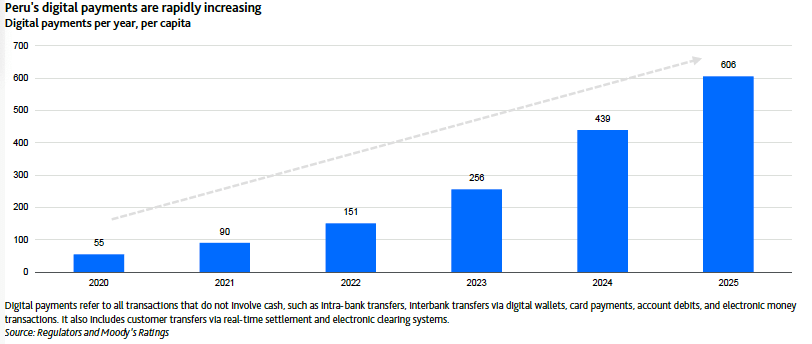
Peru, December 6, 2025 – The Central Reserve Bank of Peru (BCRP) published its updated rulebook for payments in the official gazette, strengthening its compliance framework and fostering transparency through data requirements, including new cyber-security rules, as the banking system rapidly accelerates digitalization of its operations. The new rules mandate that payment fees be nondiscriminatory, cost-based, and subject to an annual review by the regulators. The new rulebook is effective 1 April (replacing the 2010 version) and is credit positive for Peru’s financial system because it promotes competition, supporting the continued expansion of digital payments (see exhibit) and increased credit volumes by enhancing efficiencies across the banking sector.

Currently, low-value digital payments (less than PEN15,000 or $5,000) in Peru are largely controlled by banks, with interbank transfers comprising 66% of this total in the first half of 2025 (H1 2025), in accordance with data available in the BCRP’s September 2025 National Payments Systems Report. The updated rulebook will encourage new payment solutions and require interoperability among new systems, cementing the 2023 Payment Services Interoperability Regulation aimed mainly for digital wallets, enabling users to transfer funds regardless of provider or account type. This shift will initially reduce debit and credit card and current account revenue for Peru’s banks, which comprised on average about 8% of net revenues of the four largest banks as of September 2025. In addition, greater use of digital payments can drive growth in banking services, leading to larger deposit inflows and an expanded addressable market.

Instant payments accounted for 11% of low-value payments in H1 2025 and were dominated by two digital wallets: Yape, managed by the country’s largest bank Banco de Crédito del Perú (BCP, Baa1 stable, baa11), with 82% market share, and Plin, with 18%, a joint venture between next three largest banks in Peru, Banco BBVA Perú (Baa1 stable, baa2), Scotiabank Perú S.A.A. (Baa1 stable, baa2), and Banco Internacional del Perú S.A.A. (Baa1/Baa1 stable, baa2).

Competition for payments is poised to increase in Peru with the BCRP’s late 2026 planned introduction of its national digital payments platform, which is similar to Brazil’s PIX, Colombia’s Bre-B, or India’s UPI. However, Yape is already gearing up for competition, diversifying revenue streams beyond transaction fees, offering small installment loans and insurance brokerage, accelerating its path to the monetization of its client base. Payments are still the dominant contributor to Yape’s revenues, at 53%, followed by lending at 20%, as of September 2025.

As more customers adopt digital payments, electronic transactions through bank accounts increase. The shift allows banks to reduce their costs for cash transport and security – expenses that are particularly high in Peru, where many communities face limited access to financial services because of the country’s complex geography.

Credit Outlook: 15 December 2025. Pg. 14

Moody’s Investors Service

Corporates

BHP’s minority stake sale strengthens liquidity and supports growth

Australia, December 9, 2025 – Australian resources company BHP Group Limited (A1 stable) announced it has entered into a binding agreement with Global Infrastructure Partners (GIP), a part of BlackRock, regarding BHP’s share of the Western Australia Iron Ore (WAIO) inland power network. Under the agreement, a trust entity will be established, 51% owned and controlled by BHP, with GIP providing $2 billion in funding for a 49% minority stake. BHP will pay the entity a tariff linked to its share of WAIO’s inland power over a 25-year period. Importantly, BHP retains full operational control of WAIO and its inland power infrastructure, and the agreement does not affect existing joint venture arrangements or asset ownership.

BHP announced that the net proceeds will be incorporated into and evaluated in accordance with its capital allocation framework.

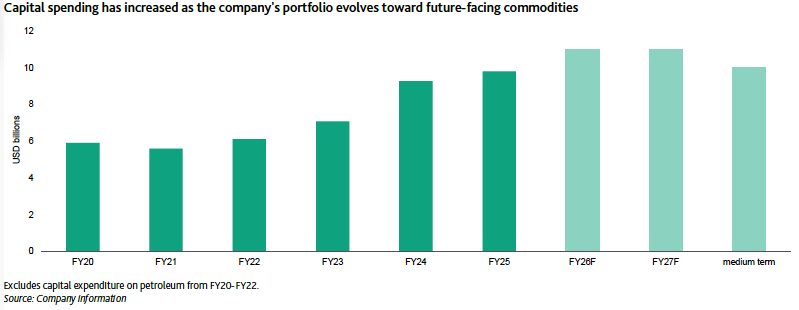
We expect the proceeds from the minority stake sale to increase liquidity and support the high capital spending requirements of the company in the medium term. BHP’s capital spending has increased as the company’s portfolio evolves toward future-facing commodities such as copper and potash. The company expects capital and exploration spending of around $11 billion annually in fiscal 2026 (ending June 2026) and fiscal 2027, with a planned reduction to around $10 billion a year on average from fiscal 2028 through to fiscal 2030 (see exhibit).

We regard the minority stake sale as equity in nature. Our understanding is that there is no mechanism for GIP to achieve preset target returns.

It is our expectation that BHP will fully consolidate the trust entity and that the cash outflow related to the tariff payments will represent less than 1% of the overall group’s earnings. Given BHP’s robust earnings generation capacity, these payments are immaterial and are not expected to have a meaningful impact on the group’s credit metrics or overall credit quality. We expect BHP’s track record of conservative credit metrics, excellent liquidity position, clearly articulated financial policies and flexible dividends to support its current growth phase while retaining credit metrics in line with our parameters for its ratings.

Credit Outlook: 15 December 2025. Pg. 10

Moody’s Investors Service

Countries

Fitch Upgrades Spain to ‘A’; Outlook Stable

Spain, September 26, 2025 – FitchRatings has upgraded Spain’s Long-Term Foreign-Currency Issuer Default Rating (IDR) to ‘A’ from ‘A-‘. The Outlook is Stable. Fitch has also upgraded Spain’s Short-Term IDR to ‘F1+’ from ‘F1’.

Key Rating DriversThe upgrade of Spain’s IDRs reflects the following key rating drivers and their relative weights:

High

Economic Outperformance: Spain’s economic performance has exceeded expectations and significantly outpaced other major eurozone economies. Economic growth is supported by large migration inflows and strong, increasingly diversified services exports. Recent productivity gains, moderate wage growth and relatively low energy prices have boosted external competitiveness and strengthened private external balance sheets. Fitch expects the economy to remain resilient, helped by limited exposure to US tariffs and ongoing net external deleveraging.

Growth Exceeds Expectations: We have raised our real GDP growth forecast for Spain to 2.7% in 2025 and 2.0% in 2026, reflecting stronger-than-expected quarterly growth in 1H25. Growth has been broad, with the services sector strengthening due to a rebound in tourism (with higher off-season inflows and quality upgrades) and solid performance in non-tourism services such as information communication technology and professional services. Business and consumer sentiment indicators are positive. The manufacturing sector (11% of gross value added) has benefited from increased solar and wind generation, which has helped lower electricity prices to well below the eurozone average.

Favourable Growth Prospects: Fitch has revised Spain’s potential growth estimate to 2% from 1.4%, mainly due to rapid expansion in labour inputs and supported by higher total factor productivity. Strong labour force growth reflects significant migration inflows, mostly from Latin America, while recent reforms and a shared language have supported labour market integration. Labour productivity growth has risen to over 1% annually from 2022 to 2024, compared with 0.3% between 2014 and 2021, although further improvements are needed to lift GDP per capita growth, which remains below headline growth.

Labour Market Supports Growth: Labour market conditions have strengthened significantly, with activity and employment rates reaching record highs, bolstering economic growth. Temporary employment has fallen to historical lows, supported by the 2022 labour market reform. The unemployment rate remains the highest in the euro area, at about 10.4% as of July, despite recent progress in reducing it.

Medium

Reduced External Vulnerabilities: Net external indebtedness continues to fall, extending the trend that began after the eurozone crisis and was interrupted only briefly by the pandemic. Net external debt declined to 44% of GDP at end-2024, down from a peak of 95% in 2013, driven by improving private external balance sheets and ongoing current account surpluses. The current account balance improved to 3.1% of GDP in 2024, supported by a stronger service surplus from tourism and diversification into non-tourism exports deficit. The primary and secondary income balance remain highly negative due to large remittance outflows and Recovery and Resilience Facility grants.

Fitch expects current account surpluses to average 2.6% of GDP between 2025 and 2027 (relative to an average deficit of 0.5% for the ‘A’ rated median), with net external debt falling below 40% of GDP, reaching 37% by 2027, gradually closing the gap to the net creditor position of the peer median of 6.1%.

Spain’s ‘A’ IDRs also reflect the following key rating drivers:

Rating Fundamentals: The ratings are supported by governance indicators consistent with the ‘A’ rating category and eurozone membership supporting institutional stability. These strengths are balanced against a still high public debt ratio.

Political Deadlock: Spain’s centre-left minority government increasingly struggles to secure parliamentary support, including for the passage of budgets since 2023, from smaller parties, including from the Catalan separatist party. Prime Minister Sánchez faces mounting pressure from corruption allegations involving the Socialist Party and family members, while political and regional fragmentation impedes progress on crucial reforms, including housing supply solutions and the development of a coherent fiscal consolidation strategy. Parliamentary elections are not due until 2027.

Moderate Fiscal Deficits: We forecast the general government deficit will fall to 2.6% of GDP in 2025 from 3.1% in 2024, driven by the absence of one-off expenses and continued revenue growth offsetting a gradual increase in interest costs. Spain will meet its NATO defence spending target of 2% of GDP this year, up from 1.4% in 2024, with a limited impact on the deficit due to spending reallocations and reclassifications. We forecast a deficit of 2.4% of GDP in 2026, reflecting the phase-out of flood relief measures, rising to 2.5% in 2027 as elections approach and interest expenses increase. This is slightly below the ‘A’ rated peer median of 3.1% in 2026 and 2.9% in 2027.

Fiscal Uncertainties: Pro-active fiscal consolidation efforts have been limited, in Fitch’s view, and fiscal improvement has been driven mostly by the phasing out of temporary measures and strong revenue growth supported by a solid labour market and robust GDP growth. Political fragmentation raises uncertainty about parliamentary approval of the 2026 budget, and Fitch expects the 2023 budget to be rolled over for a third consecutive year, with new measures likely passed on a law by law throughout the year.

Fiscal uncertainty extends to the medium term due to the lack of a credible fiscal strategy. The government targets a deficit of 1.5% of GDP and a debt/GDP ratio of 94.8% by 2029 under its seven-year adjustment plan, but the plan lacks detailed measures and faces challenges from the absence of a budget and political majority for consolidation.

High Debt, Gradual Reduction: Fitch projects the general government debt ratio will fall from 101.6% of GDP in 2024 to 100.7% by 2027, and below 100% thereafter, supported by sound nominal GDP growth. This is high relative to the ‘A’ category median of 53.7%. However, we expect debt will temporarily increase in the short term, even as fiscal deficits narrow, due to Recovery and Resilience Facility funds and cash-to-accrual accounting adjustments totalling 3.6% of GDP in 2025-2026.

ESG – Governance: Spain has an ESG Relevance Score (RS) of ‘5[+]’ for Political Stability and Rights and the Rule of Law, Institutional and Regulatory Quality and Control of Corruption. These scores reflect the high weight that the World Bank Governance Indicators (WBGI) have in our proprietary Sovereign Rating Model. Spain has a high WBGI ranking at 74, reflecting its long record of stable and peaceful political transitions, well-established rights for participation in the political process, strong institutional capacity, effective rule of law and a low level of corruption.

Source: Fitch Ratings