Corporates

BHP’s minority stake sale strengthens liquidity and supports growth

Australia, December 9, 2025 – Australian resources company BHP Group Limited (A1 stable) announced it has entered into a binding agreement with Global Infrastructure Partners (GIP), a part of BlackRock, regarding BHP’s share of the Western Australia Iron Ore (WAIO) inland power network. Under the agreement, a trust entity will be established, 51% owned and controlled by BHP, with GIP providing $2 billion in funding for a 49% minority stake. BHP will pay the entity a tariff linked to its share of WAIO’s inland power over a 25-year period. Importantly, BHP retains full operational control of WAIO and its inland power infrastructure, and the agreement does not affect existing joint venture arrangements or asset ownership.

BHP announced that the net proceeds will be incorporated into and evaluated in accordance with its capital allocation framework.

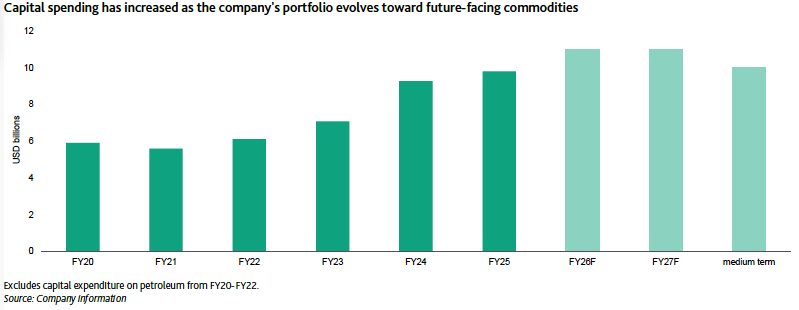
We expect the proceeds from the minority stake sale to increase liquidity and support the high capital spending requirements of the company in the medium term. BHP’s capital spending has increased as the company’s portfolio evolves toward future-facing commodities such as copper and potash. The company expects capital and exploration spending of around $11 billion annually in fiscal 2026 (ending June 2026) and fiscal 2027, with a planned reduction to around $10 billion a year on average from fiscal 2028 through to fiscal 2030 (see exhibit).
We regard the minority stake sale as equity in nature. Our understanding is that there is no mechanism for GIP to achieve preset target returns.

It is our expectation that BHP will fully consolidate the trust entity and that the cash outflow related to the tariff payments will represent less than 1% of the overall group’s earnings. Given BHP’s robust earnings generation capacity, these payments are immaterial and are not expected to have a meaningful impact on the group’s credit metrics or overall credit quality. We expect BHP’s track record of conservative credit metrics, excellent liquidity position, clearly articulated financial policies and flexible dividends to support its current growth phase while retaining credit metrics in line with our parameters for its ratings.

Credit Outlook: 15 December 2025. Pg. 10

Moody’s Investors Service

Corporates

Impact of US Tariffs on Auto Industry: Key Insights

United States, February 10, 2025 – The recently announced US tariffs on imports from Mexico and Canada, if eventually implemented, could put pressure on the credit metrics of some global automakers. However, automakers plan to take various mitigating measures, which could offset the impact of the tariffs on their credit profiles.

On 1 February, the US announced a 25% tariff on most imports from Mexico and Canada (and a 10% tariff on China). The day before these measures were due to take effect, agreements with Mexico and Canada were reached to pause them for one month for negotiations on such subjects as migration, border security and trade. It is unclear what will emerge from the US-Mexico and US-Canada negotiations and how far the US is prepared to revise its proposals.

The potential 25% tariffs on Mexico would have the most significant implications for global automakers due to large exports of vehicles produced in the country to the US, followed by the proposed measures against Canada. The additional tariffs against China are likely to have a limited impact on the sector due to decoupling from the country’s supply chains in previous years.

Potential implications of the tariffs are likely to vary by company and will depend on the direct exposure to exports from Mexico and Canada to the US and the ability to pass tariffs on to customers, cut costs, increase prices on other vehicles to spread the costs of the tariffs, reroute shipments or implement other mitigating measures. It is not expected any material changes in the production footprints of supply chains until there is clarity about the tariff implementation.

Honda, General Motors, Nissan and Stellantis have the highest exposure to the US tariffs in a rated portfolio of original equipment manufacturers due to the high share of vehicles imported to the US from Mexico and Canada in their global sales.

Issuers with adequate or ample rating headroom will have greater flexibility to withstand the impact of the US tariffs than those with tight headroom. The Negative Outlooks on Nissan and Stellantis reflect weak performance in North America, which led to a drop in the companies’ profitability and cash flows even before the tariffs were announced.

Potential implications in this sector will be assessed based on prospects for the tariffs being implemented in full, whether they are likely to be temporary, retaliatory measures and corporates’ mitigating strategies.

Source: Fitch Ratings

Corporates

Gol files for Chapter 11, a credit negative for Abra and certain ABS deals, neutral for Avianca

Brazil, January 25, 2024 – Gol Linhas Aereas Inteligentes S.A. (Ca negative) filed for voluntary protection under the US Chapter 11 financial reorganization process. Gol’s reorganization process increases liquidity risks for its parent company, Abra Group Limited (Caa3 negative), and the possibility of rental cash flow disruption for certain asset-backed securities (ABS) deals with significant exposure to aircraft leased to Gol.

As part of the filing for Chapter 11, Gol was granted an automatic stay for all debt obligations, including the secured notes due 2028, which are the main source of cash to Abra to cover its own interest payments. The uncertainties regarding the continuity of interest payments and management fees from Gol to Abra increase Abra’s credit risk and could lead to liquidity squeezes, which led us to downgrade Abra’s ratings to Caa3 from Caa1.

At the end of January 2024, Abra had $86 million in cash. Abra’s main source of cash relates to the cash payments from Gol’s secured notes due 2028, and management fees from Gol and Avianca Group International Limited (B2 stable), which provides coverage for the cash interest payment at Abra. We estimate that Abra’s sources of cash excluding the payments from Gol cover its cash interest expense by only 0.4x-0.5x, compared with 1.5x-2x with Gol’s interest payments and management fees. Abra’s main cash outflows relate to its notes interest payments ($60 million-$70 million per year) and annual expenses at the holding level of approximately $20 million per year. With this liquidity profile, Abra could absorb up to two years with no cash inflow from Gol before consuming all of its cash position and potentially entering into a debt restructure with its own creditors.

Gol secured $950 million in a debtor-in-possession (DIP) financing to continue operating during the reorganization process, granted by creditors of Abra. The DIP could lead to continued interest payments for Abra, however the final decision is subject to court hearings as part of Gol’s reorganization process. Before Gol filed for Chapter 11, Abra signed a forbearance agreement with its creditors to avoid the exercise of the rights and remedies with respect to specified defaults as a result of Gol’s filing.

Under Chapter 11, Gol will continue renewing its fleet, returning older aircraft that are grounded and receiving new-generation aircraft. The airline will maintain the timetable to receive new aircraft that were delayed in 2023 and ones that are scheduled for delivery in 2024.

Out of the eight aircraft lease ABS that we have rated since 2021, five have exposure to aircraft1 leased to Gol. These transactions benefit from lessee diversity, with exposure to Gol in these transactions ranging from approximately 2% to 22% of the most recently reported adjusted base value. Certain ABS deals may experience some fluctuations in rent cash flow collections in the coming months as Gol undergoes reorganization. However, liquidity facilities, performance triggers, and deleveraging among other structural features, will help shield senior bondholders from risk. In the event that lease negotiations fail2, deals will likely lose rent cash flow related to the Gol lease until lessors can repossess and re-lease or sell these aircraft. Given the current aircraft shortage in the market, lessors could potentially release these aircraft at favorable lease rates or sell for a premium with shorter downtime.

For Avianca, the potential contagion channels of Gol’s filing for Chapter 11 are contained. Avianca’s post-bankruptcy exit financing contains restrictive covenants, including, among others, debt incurrence limitations, limitations on restricted payments and investments and limitations on related party transactions. Pursuant to the covenants, Avianca’s ability to distribute cash or lend funds to Abra would be very limited. These restrictions serve to insulate Avianca from the financial distress of Gol or any contagion effect on Abra.

The Chapter 11 filing is a result of an accumulated cash burn and high financial leverage for Gol derived from high interest rates, the grounding of the Boeing MAX aircraft in 2019 and the pandemic, which led to weakening liquidity. We downgraded Gol’s ratings to Ca to reflect our view of some prospect for recovery for existing secured and unsecured creditors and will subsequently withdraw the rating. With the Chapter 11, Gol expects to strengthen its financial position, while maintaining the current size of its operations.

Credit Outlook: 1 February 2024. Pg. 6
Moody’s Investors Service

Corporates

Buenaventura’s sale of its stake in Yanacocha is credit positive

Peru, February 8, 2022 – Compania de Minas Buenaventura S.A.A. (Buenaventura, B1 stable) announced that it reached an agreement to sell its 43.65% stake in Minera Yanacocha S.R.L (Yanacocha) to Newmont Corporation (Baa1 stable) for $300 million net of payments and additional $100 million contingent to increases in gold and copper prices. Additionally, Newmont will transfer its ownership interest in La Zanja and contribute $45 million related to closure costs.

The transaction is credit positive because the company will use net proceeds, together with $100 million in dividends received from its 19.58% stake in Sociedad Minera Cerro Verde S.A.A. (Cerro Verde), to prepay its $275 million syndicated facility and fund growth capex.

In July 2021, Buenaventura issued $550 million in senior unsecured notes that were used to pay in full the Peruvian Tax Authority (SUNAT’s) tax claim. The additional debt combined with operational disruptions pushed Moody’s adjusted leverage to a 8.9 times peak in December 2020. Upon the announced debt repayment, we expect leverage to be around 4.7 times by 2022, which is still high for the ratings category. The company has publicly committed to reduce leverage and the B1 rating incorporates our expectation that Buenaventura will continue its deleveraging trend through a combination of operational improvements during 2022 and debt reduction.

The growth capex, estimated between $80 million and $120 million in 2022, will be used to fund San Gabriel project, although it would start contributing significant EBITDA from only 2023-24 onward. San Gabriel has an estimated annual production capacity of 120,000-150,000 ounces of gold. Buenaventura has faced a number of operational challenges and disruptions including lower ore grades, lower recoveries, limited availability of transportation vehicles and reduced workforce because of the pandemic. Additionally, in September 2021, Buenaventura announced that the local community surrounding the Uchucchacua mine started a strike. Uchucchacua generates negative EBITDA and free cash flow and we expect this to be the case through 2023.

Upon debt repayment the company’s capital structure will comprise the $550 million senior unsecured bond due in 2026 and other bank facilities totaling $813 million, from $1,109 million at year-end 2021. Buenaventura’s liquidity will be adequate, supported by the company’s around $288 million in cash as of September 2021, net proceeds from the proposed transaction and dividends from its affiliate, Cerro Verde. These funds positively compare with the company’s expected negative free cash flow at around $30 million which includes $250 million of total capex, no dividends and no material debt amortization.

Headquartered in Lima, Peru, Buenaventura is a mining company engaged in the exploration, mining and processing of gold, silver, copper, zinc and lead in Peru. Following this transaction, Buenaventura has five wholly owned and two majority-owned mines, as well as a 19.58% stake in Cerro Verde, one of the world’s largest copper mines and a 40.1% stake in Coimolache, which owns the Tantahuatay gold mine that Buenaventura operates. Buenaventura is controlled by the Benavides family (27% of the voting stock), and is listed on the New York Stock Exchange and the Lima Stock Exchange. For the 12 months that ended September 2021, the company generated $883 million in revenue and Moody’s adjusted leverage was 5.4x.

Credit Outlook: 14 February 2022. Pg. 6
Moody’s Investors Service

Corporates

America Movil’s sale of Panama unit will benefit buyer C&W and its local peers

Panama, September 15, 2021 – Cable & Wireless Communications Limited (C&W, Ba3 negative) and America Movil, S.A.B. de C.V. (AMX, A3 negative) announced plans for AMX to sell its Claro Panama S.A. unit to C&W for $200 million. This transaction is positive for all participants, including the three remaining telecom competitors in Panama – C&W, Cable Onda, S.A. (Ba2 stable) and Digicel Group Holdings Limited (Caa2 stable) – because the deal would take AMX out of the Panama market, and allow a more rational competition.

The sale would also allow each competitor to hold more 5G cellular capacity, although a 5G auction date has yet to be set. AMX’s sale of Claro Panama would consolidate C&W as one of the largest operators in Panama.

The transaction has no material effect on the operators’ credit metrics, but it is credit positive for C&W, helping the company to consolidate its competitive position in Panama, C&W’s main market. C&W will generate 27% of its revenue in Panama, up from 22% today, and the new assets will represent around 6% of C&W’s consolidated revenue and around 4.4% of its EBITDA, as per our own estimates.

C&W plans to finance the acquisition using incremental borrowings and C&W own cash, which totaled $534 million as of June 2021. While the additional debt won’t be material, C&W’s debt/EBITDA ratio of 5.3x as of June 2021, including our standard adjustments, is high for the Ba3 rating category. We expect the company it to gradually return to pre-pandemic levels in 2022-23, although risks remain high.

The transaction will give C&W an improved market position in Panama with roughly half of the market share. We expect that the consolidated company will generate an EBITDA margin in the high-30 percent range, improving as it extracts synergies and improves its leverage.

Buying Claro Panama effectively gives C&W 760,000 more subscribers in Panama, on top of its roughly 1.6 million only in Panama, and 3.3 million subscribers, on a consolidated basis, as of June 2021.

Increasing competition since 2018 and later the coronavirus pandemic, have hampered C&W’s performance in recent years, costing the company some of its prepaid subscribers and reducing its average monthly revenue from subscriptions. A new marketing campaign in 2019 and continued upgrades to its network helped C&W’s curb its subscriber losses. But Panama’s restrictions on movement in 2020 because of the pandemic, which the government relaxed throughout the year but then reinstated in the first quarter of 2021, hurt C&W’s average revenue per user and its EBITDA. Those results came despite the company’s efforts to contain expenses and its addition of 61,100 mobile subscribers in the first quarters of 2021.

The transaction also benefits AMX, giving the Mexican telecom conglomerate $200 million that it plans to use to repay debt and further advance toward its net leverage ratio target of 1.50x from 1.64x as of June 2021. Claro Panama currently represents less than 1% of AMX’s consolidated revenue. AMX will retain the Claro Panama towers but plans to spin them off, along with most of its roughly 35,000 towers in Latin America, probably by early 2022.

C&W’s purchase of Claro Panama follows a pattern of telecom consolidation in Panama. In 2019 Cable Onda acquired Telefonica Moviles Panama, then the country’s mobile market leader. Panama fast-growing economy, with one of the largest growth rates per capita in the region, offers telecom operators there good opportunities for growth in a very competitive market.

Credit Outlook: 20 September 2021. Pg. 6
Moody’s Investors Service