News

Corporates

Vivo and TIM’s joint acquisition of Oi mobile assets is credit positive for whole sector

Brazil, March 10, 2020 – Brazil’s telecom operators Telefonica Brasil S.A. (Vivo, Ba1 stable) and TIM S.A., the local subsidiary of Telecom Italia S.p.A. (Ba1 negative), announced a joint plan to acquire the mobile business of Oi S.A., their competitor now operating under bankruptcy protection.
The potential transaction, whose terms remain undisclosed, would benefit the entire Brazilian telecom industry by excluding Oi from the market, thereby enabling the remaining three mobile operators to increase profits.

Oi, which filed for judicial recovery in 2016, is the most aggressively priced operator in Brazil’s mobile telecom market. Its removal would make Brazil’s competitive environment more rational and profitable. An increase in profitability would allow the three remaining mobile competitors to invest more easily in infrastructure, better service quality and balance-sheet deleveraging.
Vivo and TIM jointly intend to acquire Oi’s mobile business, as a whole or in parts. Each company would receive a portion of Oi’s mobile business, but TIM would probably get the largest part to avoid excessive market concentration with Vivo. An outsized increase in Vivo’s market share would likely have more trouble winning approval from CADE, the Brazilian federal antitrust authority. Vivo leads the mobile market in Brazil with 33% market share, followed by TIM and Claro with 24% each, and Oi with 16% as of January 2020.
Even without details yet about the market value of Oi’s mobile business or how Vivo and TIM would finance their acquisition, Vivo’s balance sheet is strong enough to support a debt-financed acquisition without significant stress on its credit metrics. Vivo had a of 0.7x total adjusted debt/EBITDA ratio at the end of 2019, and a 20.7% free cash flow/debt ratio.
The proposal marks a relatively rare opportunity in Brazil’s telecom market, whose M&A opportunities are limited; unless Oi sells its assets, there are no other significant acquisitions remaining. Claro, the local subsidiary of America Movil S.A.B. de C.V. (A3 stable), acquired Nextel Brazil in March 2019 for around $900 million. The move strengthened the Mexican group’s mobile business in Brazil, particularly in the populous states of Rio de Janeiro and São Paulo, and gave Claro valuable spectrum in Brazil.
The Vivo-TIM deal would benefit Claro as well, leaving only three operators competing in the 5G auction slated for December 2020, implying more capacity for each company just as Brazil has relaxed its spectrum licensing rules.

Under a new telecom bill approved in 2019, Brazilian telecom operators can renew mobile spectrum licenses more than once, giving them longer term visibility. Previously, an operator could only renew its license once, and had to go through the bidding process after the first renewal.

Credit Outlook: 16 March 2020. Pg. 31
Moodys

Banking

Costa Rican state-owned banks’ planned sale of BICSA is credit negative

Costa Rica, February 10, 2020 – The Government of Costa Rica (B2 stable) Ministry of Finance announced a series of measures to reduce the country’s fiscal deficit, including plans to sell Banco Internacional de Costa Rica, S.A. (BICSA, B1 stable b11).
The sale would be credit negative for BICSA, a Panamanian wholesale bank owned by Costa Rican state-owned Banco de Costa Rica (BCR, B2 stable b2), which holds 51% of its capital; and Banco Nacional de Costa Rica (BNCR, B2 stable, b2), which holds 49% of its capital. The sale creates uncertainty about BICSA’s future direction and whether it will remain focused on providing corporate and correspondent banking services for Costa Rican and Panamanian export companies. Management may also take a more cautious approach to growth during the transition period, which would negatively affect business volume, revenue generation and profitability.
As a wholesale bank, BICSA is highly dependent on market funding. As of September 2019, market funds accounted for 46.4% of total banking assets. Most of the bank’s liabilities are short term, with more than 60% expiring in less than a year. BICSA is also 67% funded by foreign investors, making it more vulnerable to refinancing and repricing risk that could increase funding costs and adversely affect its profitability.
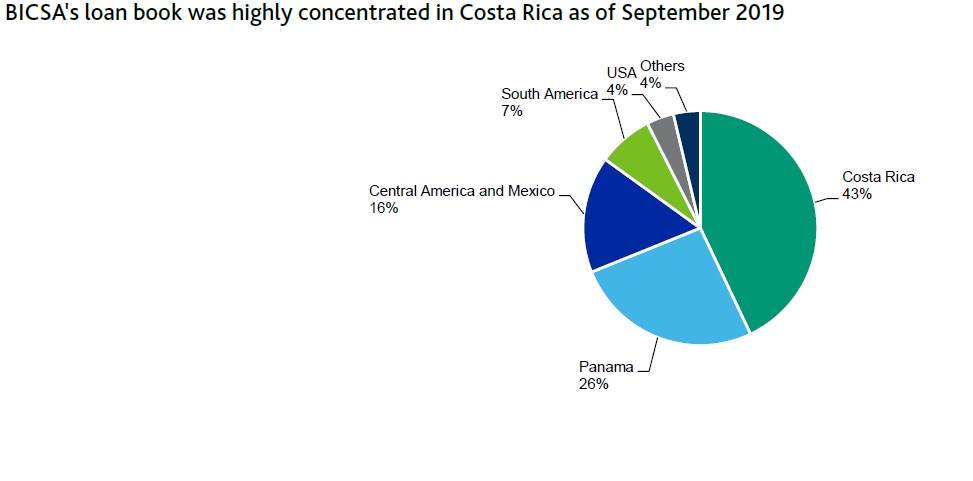
Given BICSA’s relatively small market share and its niche presence in Panama and Central America, the links and relationships between BICSA, BCR and BNCR are essential for its business development and franchise growth. As of September 2019, BICSA’s loan book was 43% concentrated in Costa Rica (see exhibit), which is its main market with significant presence in the corporate sector. In addition, in recent months, and supported by its shareholders, BICSA started to operate in Costa Rica’s leasing segment.

Source: BICSA

According to the Minister of Finance of Costa Rica, BICSA’s sale value could reach 0.04% of the country’s GDP, which is approximately $300 million. The sale of the bank could take several months if it were to require changes in laws that need congressional approval.

Credit Outlook: 17 February 2020. Pg. 22
Moodys

Banking

BNDES sells 9.9% Petrobras stake, allowing resource allocation to sustainable projects, a credit positive

Brazil, February 5, 2020 – Banco Nacional de Desenvolvimento Econômico e Social (BNDES, Ba2 stable, ba21) sold its 9.9% stake in oil giant Petróleo Brasileiro S.A. – Petrobras (Petrobras, Ba2 stable), raising BRL22 billion. The divestiture will reduce BNDES’ volatility in capital and earnings, a credit positive.
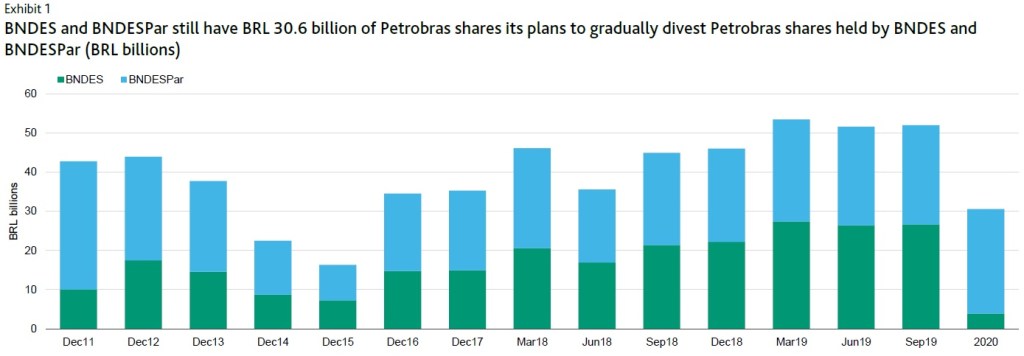
The sale does not include Petrobras preferred shares that BNDES and its investment subsidiary BNDES Participações – BNDESPar (Ba2 stable) hold. BNDES and BNDESPar also have BRL30.6 billion of voting and preferred Petrobras shares that it plans to divest within the next three years (Exhibit 1), subject to market conditions. BNDES could divest another BRL70 billion of other equity in the same time frame, depending on market conditions. To accommodate its goal, BNDES cut the value at risk limit for variable income securities in its equity portfolio to BRL600 million as of 2019 from BRL3 billion as of 2018.

Source: BNDES

Divestment proceeds will be primarily allocated to sustainable projects with relevant social and environmental impact. This strategy will support BNDES’ focus on smaller companies and having a key role within fintech and digital transformation, in addition to its preeminent position supporting infrastructure projects. Structuring and advising projects mainly related to the government’s agenda for privatizations and public-and-private partnerships also have traction in the bank’s business strategy.
A portion of the divestment proceeds will likely be used to pay additional dividends to the Government of Brazil (Ba2 stable) to alleviate the government deficit. This practice, used 2009-13, declined after a new dividend policy that limited dividend distribution to a maximum of 60% of adjusted net income. While the bank distributed a dividend equating to 25% of adjusted net income between 2017 and 2018, in 2019, it has already anticipated dividends of 60% of adjusted net income (Exhibit 2).

Source: BNDES

We estimate that the distribution of 60% of the net gains from the sale of its Petrobras stake will not have a material effect on the bank’s capitalization because BNDES’ (Moody’s-adjusted) tangible common equity2 to risk-weighted assets ratio (TCE to RWA) should decline to 15.8%, from 17% in June 2019. BNDES has improved its capitalization since 2016, with sharply lower dividend distributions to the Government of Brazil and steady loan contraction.

Source: BNDES

For B3 S.A. – Brasil, Bolsa, Balcao (Ba1 stable), Brazil`s stock market operator, the size of secondary offering is also credit positive given that the amount traded with it is approximately 19% of the total of initial and secondary offerings that occurred in 2019. The issuance of these Petrobras shares will enable B3 to gain additional trading and post trading revenues at a time when it continues to report record levels of earnings.

Credit Outlook: 10 February 2020. Pg. 34
Moodys

Countries

Argentina Local Currency Ratings Lowered To ‘SD’ On Distressed Debt Exchange; ‘CCC-/C’ Foreign Currency Ratings Affirmed

Argentina, January 20, 2020 – The administration of President Alberto Fernandez launched and concluded an exchange on its peso-denominated short-term debt on Jan. 20, 2020. This followed the Dec. 19, 2019, unilateral extension (until August 2020) of U.S. dollar-denominated short-term paper held by private-sector market participants. We classify this peso-debt exchange as a distressed exchange, which constitutes a default under our criteria, and we are lowering our local currency sovereign credit ratings on Argentina to ‘SD/SD’ from ‘CCC-/C’. We are also affirming our long-term foreign currency sovereign credit rating at ‘CCC-‘, and the outlook remains negative. The negative outlook reflects prospects for a further restructuring of sovereign debt as the administration holds dialogues with bondholders, financial intermediaries, and official creditors on its policy priorities, economic strategy, and re-profiling plans.

Rating Action: On Jan. 21, 2020, S&P Global Ratings lowered its local currency sovereign credit ratings on Argentina to ‘SD/SD’ from ‘CCC-/C’ (our criteria do not distinguish between short term and long term when there is a default). We affirmed the foreign currency sovereign credit ratings at ‘CCC-/C’. The outlook on the long-term foreign currency sovereign credit rating remains negative. We also took the following rating actions:

  • We lowered the long-term local currency-denominated issue ratings to ‘CC’ from ‘CCC-‘;
  • We affirmed the long-term foreign currency issue ratings at ‘CCC-‘;
  • We affirmed our ‘B-‘ transfer and convertibility assessment on Argentina; and
  • We lowered our national scale rating on Argentina to ‘SD’ from ‘raCCC-‘.

Outlook: The negative outlook on the long-term foreign currency rating reflects the downside risks to timely and full payment of debt over the short term amid stressed economic and financial market dynamics. The sovereign’s access to liquidity is likely to remain constrained as the Fernandez Administration outlines its economic policies while engaging in dialogue with bondholders, bankers, and the International Monetary Fund. We could lower the foreign currency ratings if the government finalizes terms with bondholders for a potential debt restructuring that is characterized as a distressed debt exchange based on our methodology. Such a restructuring could entail an extension of maturities, which will not be compensated by the issuer, or a reduction in the face value of debt. Additionally, we could lower the ratings if economic and financial stresses further threaten timely debt service or the sovereign misses a debt payment. We could raise the ratings following implementation of a debt restructuring if policy signals and execution start to successfully turn around or stabilize private-sector confidence, market turbulence subsides, and the government regains access to market financing.

S&P Global Ratings, January 21, 2020

Countries

Falling consumer confidence is credit negative for Spanish ABS

Spain, January 7, 2020 – Centro de Investigaciones Sociológicas (Center for Sociological Research, or CIS) reported that Spain’s consumer confidence index had plunged to 77.7 in December 2019, 13 points below the levels in December 2018 and the lowest level since 2013. The significant decline in consumer confidence, consistent with other negative data reported in recent days, is credit negative for asset-backed securitisations (ABS) collateralised by Spanish consumer loans. Consumer confidence data provide a forward indicator that asset risks will increase and consequently weaken the performance of securitised loans. Falling consumer confidence somewhat correlates to weaker future performance in consumer credit, as the exhibit shows. Indeed, consumer confidence plunged in mid-2007 before Spanish consumer nonperforming loan (NPL) ratios surged.

The sharp decrease in consumer confidence during the second half of 2019 reflects an increasing concern among Spanish consumers about the national economy and employment. We expect that borrowers will face more challenges repaying their consumer loans because of a gradual moderation in the growth performance of the Spanish economy: we expect GDP growth of 1.8% for 2020 compared to 3% growth in 2016-17. The decline in consumer confidence is consistent with other negative data reported in recent days, including a 4.8% drop in 2019 car registrations, according to data from Spain’s associations of auto manufactures (Anfac), dealers (Faconauto) and vendors (Ganvam). The drop is the first in Spain since 2012.
Adding to these challenges is that consumer lending continues rising despite indications of economic deceleration. The overall stock of household debt in 2019 was relatively flat compared with 2018, but there were different trends when comparing secured lending and unsecured lending. According to the Bank of Spain, the stock of consumer loans in 2019 increased 4% from a year earlier (November 2019 data), doubling GDP growth, while the stock of mortgage debt fell 1% over the same period, suggesting the mortgage market is adapting to a decelerating economy.
The combination of the decline in consumer confidence and an increase in unsecured debt will continue to put pressure on Spanish ABS. However, the effect will not be the same for all types of consumer loans. We expect that auto-loan ABS will perform better owing to these borrowers’ higher quality. But consumer loans with no specific purpose are often used by borrowers facing financial troubles in household economies, and they will likely be most negatively affected. Still, the performance of Spanish consumer-loan ABS is better than the national average of consumer NPL given the stronger eligibility criteria applied to Spanish securitisations.

Credit Outlook: 13 January 2020. Pg. 19
Moodys