Banking

Brazil will finance small and midsize companies’ payrolls to mitigate credit risk from coronavirus

Brazil, Mar 27, 2020 –  President Jair Bolsonaro announced that the Tesouro Nacional, the national treasury, will transfer BRL40 billion ($7.8 billion) to development bank Banco Nac. Desenv. Economico e Social – BNDES (Ba2/(P)Ba2 stable, ba21) for a new credit line that will finance payroll expenses of small and midsize companies (SMEs) during the next two months. The measure will alleviate cash flow pressure in companies affected by the partial shutdown of economic activity related to the coronavirus emergency.

BNDES will manage the credit line and lend the resources to financial institutions, which, in turn, will finance wages paid by companies eligible for the funding. The companies eligible for the credit line have annual sales of BRL360,000-BRL10 million. BNDES, on behalf of the treasury, will contribute 85% of the loans, while banks will bear the risk of the remaining 15%. BNDES will act as a mere conduit for the Tesouro Nacional, transferring funds to financial institutions at an interest rate of 3.75% per year, the same as the benchmark policy rate (SELIC). Banks, in turn, will finance companies’ payroll. As a result, BNDES will not incur in credit risk.

Even if available for two months only, the payroll relief will help companies navigate this economically stressed period, which will alleviate the growing credit risk in banks’ loan portfolios, particularly for specialized SME lenders such as Banco Fibra S.A. (B3/(P)B3 stable, b3) and Banco Sofisa S.A. (Ba2 stable, ba2). Payrolls account for up to 40% of companies’ operating expenses in Brazil. In the absence of normal revenue inflow, companies will likely have limited cash to honor outstanding loans, which are usually short-term working capital finance operations with their banks.
The credit line conditions include a grace period of six months and a total maturity of 36 months. It is mandatory that banks lend the resources at a rate of 3.75% per year. The credit line will be available only for companies that commit to keeping their staff employed for the next two months and will be available only for salary payments. The government, acting through the financial system, will cap the financing at twice the minimum wage per employee; while companies will cover any additional costs, if needed.
The government aid to payroll expenses responds to companies’ complaints that banks cut credit lines and raised interest charged in loan renegotiations over the past two weeks, despite BRL1.2 trillion of additional liquidity that earlier central bank measures provided.

Credit Outlook: 2 April 2020. Pg. 7
Moodys
Banking

Costa Rican state-owned banks’ planned sale of BICSA is credit negative

Costa Rica, February 10, 2020 – The Government of Costa Rica (B2 stable) Ministry of Finance announced a series of measures to reduce the country’s fiscal deficit, including plans to sell Banco Internacional de Costa Rica, S.A. (BICSA, B1 stable b11).
The sale would be credit negative for BICSA, a Panamanian wholesale bank owned by Costa Rican state-owned Banco de Costa Rica (BCR, B2 stable b2), which holds 51% of its capital; and Banco Nacional de Costa Rica (BNCR, B2 stable, b2), which holds 49% of its capital. The sale creates uncertainty about BICSA’s future direction and whether it will remain focused on providing corporate and correspondent banking services for Costa Rican and Panamanian export companies. Management may also take a more cautious approach to growth during the transition period, which would negatively affect business volume, revenue generation and profitability.
As a wholesale bank, BICSA is highly dependent on market funding. As of September 2019, market funds accounted for 46.4% of total banking assets. Most of the bank’s liabilities are short term, with more than 60% expiring in less than a year. BICSA is also 67% funded by foreign investors, making it more vulnerable to refinancing and repricing risk that could increase funding costs and adversely affect its profitability.
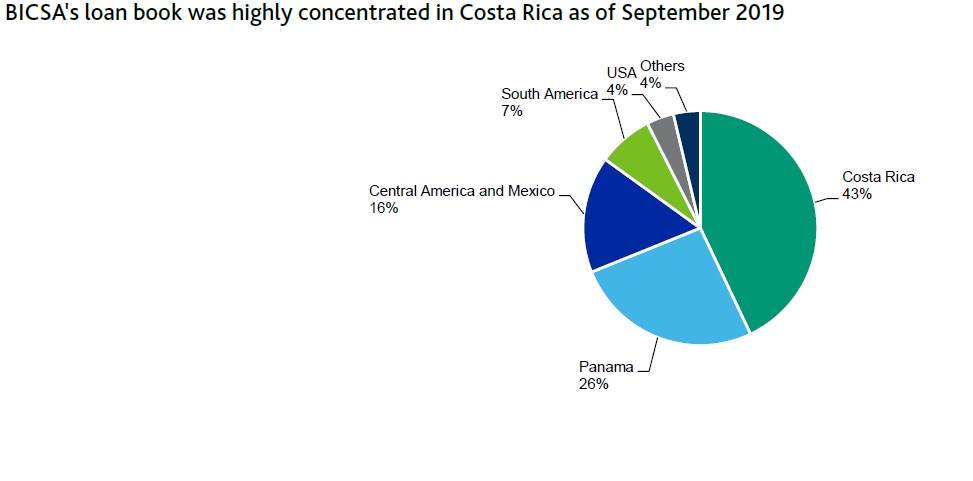
Given BICSA’s relatively small market share and its niche presence in Panama and Central America, the links and relationships between BICSA, BCR and BNCR are essential for its business development and franchise growth. As of September 2019, BICSA’s loan book was 43% concentrated in Costa Rica (see exhibit), which is its main market with significant presence in the corporate sector. In addition, in recent months, and supported by its shareholders, BICSA started to operate in Costa Rica’s leasing segment.

Source: BICSA

According to the Minister of Finance of Costa Rica, BICSA’s sale value could reach 0.04% of the country’s GDP, which is approximately $300 million. The sale of the bank could take several months if it were to require changes in laws that need congressional approval.

Credit Outlook: 17 February 2020. Pg. 22
Moodys

Banking

BNDES sells 9.9% Petrobras stake, allowing resource allocation to sustainable projects, a credit positive

Brazil, February 5, 2020 – Banco Nacional de Desenvolvimento Econômico e Social (BNDES, Ba2 stable, ba21) sold its 9.9% stake in oil giant Petróleo Brasileiro S.A. – Petrobras (Petrobras, Ba2 stable), raising BRL22 billion. The divestiture will reduce BNDES’ volatility in capital and earnings, a credit positive.
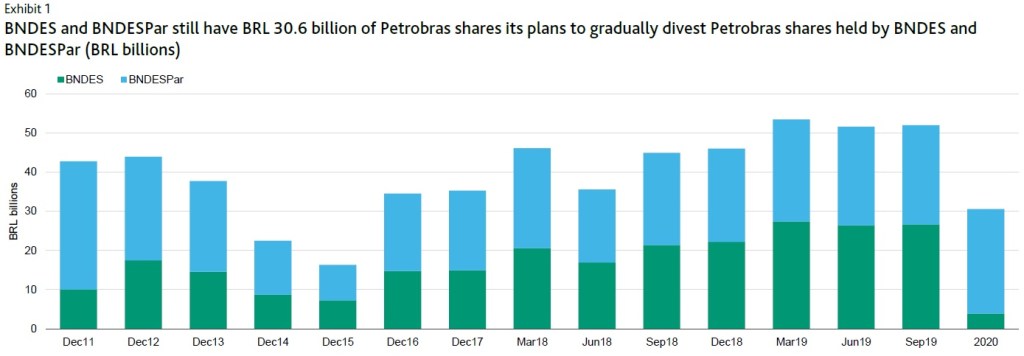
The sale does not include Petrobras preferred shares that BNDES and its investment subsidiary BNDES Participações – BNDESPar (Ba2 stable) hold. BNDES and BNDESPar also have BRL30.6 billion of voting and preferred Petrobras shares that it plans to divest within the next three years (Exhibit 1), subject to market conditions. BNDES could divest another BRL70 billion of other equity in the same time frame, depending on market conditions. To accommodate its goal, BNDES cut the value at risk limit for variable income securities in its equity portfolio to BRL600 million as of 2019 from BRL3 billion as of 2018.

Source: BNDES

Divestment proceeds will be primarily allocated to sustainable projects with relevant social and environmental impact. This strategy will support BNDES’ focus on smaller companies and having a key role within fintech and digital transformation, in addition to its preeminent position supporting infrastructure projects. Structuring and advising projects mainly related to the government’s agenda for privatizations and public-and-private partnerships also have traction in the bank’s business strategy.
A portion of the divestment proceeds will likely be used to pay additional dividends to the Government of Brazil (Ba2 stable) to alleviate the government deficit. This practice, used 2009-13, declined after a new dividend policy that limited dividend distribution to a maximum of 60% of adjusted net income. While the bank distributed a dividend equating to 25% of adjusted net income between 2017 and 2018, in 2019, it has already anticipated dividends of 60% of adjusted net income (Exhibit 2).

Source: BNDES

We estimate that the distribution of 60% of the net gains from the sale of its Petrobras stake will not have a material effect on the bank’s capitalization because BNDES’ (Moody’s-adjusted) tangible common equity2 to risk-weighted assets ratio (TCE to RWA) should decline to 15.8%, from 17% in June 2019. BNDES has improved its capitalization since 2016, with sharply lower dividend distributions to the Government of Brazil and steady loan contraction.

Source: BNDES

For B3 S.A. – Brasil, Bolsa, Balcao (Ba1 stable), Brazil`s stock market operator, the size of secondary offering is also credit positive given that the amount traded with it is approximately 19% of the total of initial and secondary offerings that occurred in 2019. The issuance of these Petrobras shares will enable B3 to gain additional trading and post trading revenues at a time when it continues to report record levels of earnings.

Credit Outlook: 10 February 2020. Pg. 34
Moodys

Banking

Banco Sabadell sells its asset management unit, a credit positive

Spain, January 21, 2020 – Banco Sabadell, S.A. (Baa2/Baa3 stable, ba2) announced that it had reached an agreement to sell its 100% interest in asset management unit Sabadell Asset Management, S.A. S.G.I.I.C., Sociedad Unipersonal (SabAM), to Amundi Asset Management for €430 million. As part of the agreement, Banco Sabadell and Amundi entered a 10-year partnership. The transaction is credit positive for Banco Sabadell because it will generate a capital gain of €351 million and will improve the bank’s regulatory capital metrics.
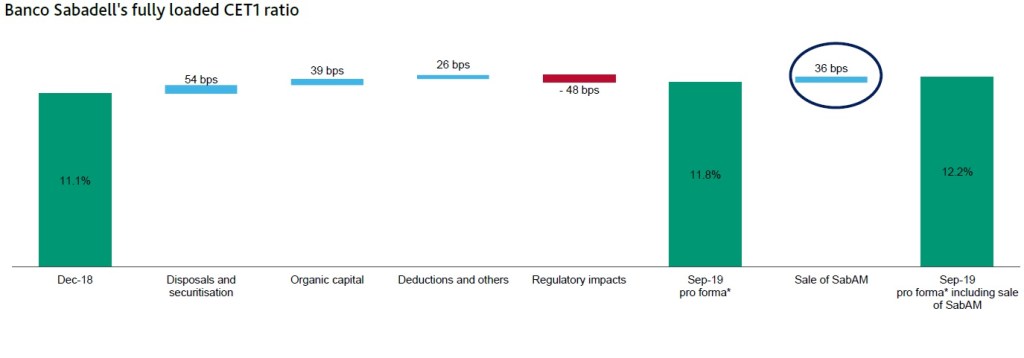
Upon the closing of the transaction, which the parties expect will occur in third-quarter 2020, Banco Sabadell estimates that its fully loaded Common Equity Tier 1 (CET1) ratio will increase 36 basis points (bps) from the pro forma fully loaded CET 1 ratio of 11.8% reported at the end of September 2019. Banco Sabadell expects an additional seven-basis-point increase related to specific guarantees in effect over the length of the distribution agreement that will be accrued proportionally over the next 10 years. This disposal is concurrent with Banco Sabadell’s strategy of divesting noncore assets and raising its fully loaded CET1 ratio to around 12%. (see exhibit)

The sale of this unit will have a relatively modest effect on the group’s profitability. Banco Sabadell disclosed that SabAM had an estimated net profit of €34 million as of year-end 2019, including, among other things, €65 million of net fee and commission income and €17 million of operating expenses. SabAM’s net profit constitutes around 4% of the bank’s annualized net income as of the end of September 2019 (net of the €135 million extraordinary gains from the Solvia disposal).

In the current environment of low interest rates and decelerating economic growth in Spain, the loss of this revenue source risks putting an additional strain on the bank’s earnings generation capacity. The sale of SabAM limits the potential growth of fee and commission income that could help ongoing challenges to Banco Sabadell’s net interest income. However, these downside risks should be broadly offset by cost savings derived from the de-risking of the bank’s balance sheet and the cost-efficiency plan, while the bank expects its subsidiary TSB Bank plc (Baa2 negative, baa2) to generate profit starting in 2020. Banco Sabadell also expects to benefit from increased distribution fees as a result of the partnership with Amundi.

Credit Outlook: 27 January 2020. Pg. 26
Moodys

Banking

Banco de Crédito e Inversiones’ continued appetite for real estate exposure is credit negative

Chile, September 27, 2019 – Chile-based Banco de Crédito e Inversiones (Bci, A2/A2 stable, baa11) announced that its South Florida-based subsidiary, City National Bank of Florida (CNB), plans to acquire Executive National Bank, a small Miami bank focused on real estate financing. The planned acquisition is credit negative for Bci because it reflects the bank’s willingness to further increase its exposure to the real estate market in Florida while maintaining a moderate ratio of tangible common equity (TCE) to risk weighted assets (RWA).
This acquisition follows the bank’s 2018 acquisitions of another Miami-based bank, TotalBank, and five of Walmart’s Chilean financial services subsidiaries. It also comes amid Bci’s ongoing effort to place itself in the forefront of Chile’s shifting credit card acquiring business, initiatives, which combined, risk straining the bank’s management.
Although Executive National Bank’s $455 million assets equal about 3% of CNB’s $15.1 billion of assets, it is CNB’s second acquisition in Miami in as many years and follows an aggressive organic expansion of that franchise. Bci’s 2015 acquisition of CNB increased Bci’s exposure to South Florida real estate to 120% of its TCE (see Exhibit 1). Bci’s South Florida real estate exposure has continued to increase since then as a result of organic growth of around 20% between 2015 and 2018, and Bci’s acquisition of TotalBank (about $3 billion in assets), which is also focused on real estate financing in the region.

Slower loan growth to more sustainable levels, would alleviate pressure building in Bci’s capitalization stemming from continued aggressive expansion in Florida real estate, a market that has historically proven to be unstable. We estimate that Bci’s South Florida real estate exposure will now equal approximately 170% of TCE, up from 116% in 2017.
Following its various acquisitions, Bci has committed to maintaining a stable Tier 1 ratio of at least 10%. However, our estimated ratio of Bci’s TCE to adjusted RWA of 9.5% as of June 2019 is moderate compared with the 15.1% median for global banks with similar credit risk. It is also below the 10.3% average for Banco Santander-Chile (A1/A1 stable, a3) and Banco de Chile (A1/A1 stable, a3), Bci’s main competitors in Chile.
Although CNB will acquire Executive National Bank for $75 million in a cash transaction, the acquisition will reduce Bci’s own TCE-to- RWA ratio by 10-12 basis points, which will further distance the bank’s capitalization from our expectation of a 10% capital ratio as a result of earnings retention and growth. Nevertheless, we do not expect a major deterioration of Bci’s other consolidated key metrics, given Executive National Bank’s adequate fundamentals (see Exhibit 2). Moreover, CNB has exhibited conservative underwriting standards despite its high growth. CNB’s loan-to-value ratio as of June averaged a low 52%. Over the next year, CNB also plans to moderate its loan growth to about 10%, which will partly mitigate asset risks associated with its higher exposure to real estate sector.

Bci’s management is also busy on other fronts. The bank is undergoing a major venture to establish itself at the forefront of the shifting payments business in Chile. In May, Bci established a 10-year joint venture with EVO Payments International, LLC (B2 negative), a payment technology and services provider, to complement the bank’s mobile payment solution MACH, which started in 2017 and provides peer-to-peer payments for over one million subscribers. Following a September 2018 ruling by the Tribunal for the Defense of Free Competition, the Chilean market is shifting from a business controlled by Transbank S.A. to one with multiple participants with increased product offerings for businesses and individuals, and more competition.
Bci also plans to jump start a new Peruvian bank, to be named Banco Bci Perú, which will begin operations following regulatory approvals in 2021 with a $60 million capital investment. In its announcement, Bci said its application for a branch license in Peru focused on commercial lending. Banco Bci Perú will cater to large Peruvian corporates and the substantial number of Chilean companies with operations in Peru. Nevertheless, Banco Bci Perú will remain small. Over the next 10 years, Banco Bci Perú will not exceed 5% of Bci’s $45.7 billion gross loans as of June 2019.

Credit Outlook: 30 September 2019. Pg. 10
Moodys