Countries

Fitch Upgrades Spain to ‘A’; Outlook Stable

Spain, September 26, 2025 – FitchRatings has upgraded Spain’s Long-Term Foreign-Currency Issuer Default Rating (IDR) to ‘A’ from ‘A-‘. The Outlook is Stable. Fitch has also upgraded Spain’s Short-Term IDR to ‘F1+’ from ‘F1’.

Key Rating DriversThe upgrade of Spain’s IDRs reflects the following key rating drivers and their relative weights:

High

Economic Outperformance: Spain’s economic performance has exceeded expectations and significantly outpaced other major eurozone economies. Economic growth is supported by large migration inflows and strong, increasingly diversified services exports. Recent productivity gains, moderate wage growth and relatively low energy prices have boosted external competitiveness and strengthened private external balance sheets. Fitch expects the economy to remain resilient, helped by limited exposure to US tariffs and ongoing net external deleveraging.

Growth Exceeds Expectations: We have raised our real GDP growth forecast for Spain to 2.7% in 2025 and 2.0% in 2026, reflecting stronger-than-expected quarterly growth in 1H25. Growth has been broad, with the services sector strengthening due to a rebound in tourism (with higher off-season inflows and quality upgrades) and solid performance in non-tourism services such as information communication technology and professional services. Business and consumer sentiment indicators are positive. The manufacturing sector (11% of gross value added) has benefited from increased solar and wind generation, which has helped lower electricity prices to well below the eurozone average.

Favourable Growth Prospects: Fitch has revised Spain’s potential growth estimate to 2% from 1.4%, mainly due to rapid expansion in labour inputs and supported by higher total factor productivity. Strong labour force growth reflects significant migration inflows, mostly from Latin America, while recent reforms and a shared language have supported labour market integration. Labour productivity growth has risen to over 1% annually from 2022 to 2024, compared with 0.3% between 2014 and 2021, although further improvements are needed to lift GDP per capita growth, which remains below headline growth.

Labour Market Supports Growth: Labour market conditions have strengthened significantly, with activity and employment rates reaching record highs, bolstering economic growth. Temporary employment has fallen to historical lows, supported by the 2022 labour market reform. The unemployment rate remains the highest in the euro area, at about 10.4% as of July, despite recent progress in reducing it.

Medium

Reduced External Vulnerabilities: Net external indebtedness continues to fall, extending the trend that began after the eurozone crisis and was interrupted only briefly by the pandemic. Net external debt declined to 44% of GDP at end-2024, down from a peak of 95% in 2013, driven by improving private external balance sheets and ongoing current account surpluses. The current account balance improved to 3.1% of GDP in 2024, supported by a stronger service surplus from tourism and diversification into non-tourism exports deficit. The primary and secondary income balance remain highly negative due to large remittance outflows and Recovery and Resilience Facility grants.

Fitch expects current account surpluses to average 2.6% of GDP between 2025 and 2027 (relative to an average deficit of 0.5% for the ‘A’ rated median), with net external debt falling below 40% of GDP, reaching 37% by 2027, gradually closing the gap to the net creditor position of the peer median of 6.1%.

Spain’s ‘A’ IDRs also reflect the following key rating drivers:

Rating Fundamentals: The ratings are supported by governance indicators consistent with the ‘A’ rating category and eurozone membership supporting institutional stability. These strengths are balanced against a still high public debt ratio.

Political Deadlock: Spain’s centre-left minority government increasingly struggles to secure parliamentary support, including for the passage of budgets since 2023, from smaller parties, including from the Catalan separatist party. Prime Minister Sánchez faces mounting pressure from corruption allegations involving the Socialist Party and family members, while political and regional fragmentation impedes progress on crucial reforms, including housing supply solutions and the development of a coherent fiscal consolidation strategy. Parliamentary elections are not due until 2027.

Moderate Fiscal Deficits: We forecast the general government deficit will fall to 2.6% of GDP in 2025 from 3.1% in 2024, driven by the absence of one-off expenses and continued revenue growth offsetting a gradual increase in interest costs. Spain will meet its NATO defence spending target of 2% of GDP this year, up from 1.4% in 2024, with a limited impact on the deficit due to spending reallocations and reclassifications. We forecast a deficit of 2.4% of GDP in 2026, reflecting the phase-out of flood relief measures, rising to 2.5% in 2027 as elections approach and interest expenses increase. This is slightly below the ‘A’ rated peer median of 3.1% in 2026 and 2.9% in 2027.

Fiscal Uncertainties: Pro-active fiscal consolidation efforts have been limited, in Fitch’s view, and fiscal improvement has been driven mostly by the phasing out of temporary measures and strong revenue growth supported by a solid labour market and robust GDP growth. Political fragmentation raises uncertainty about parliamentary approval of the 2026 budget, and Fitch expects the 2023 budget to be rolled over for a third consecutive year, with new measures likely passed on a law by law throughout the year.

Fiscal uncertainty extends to the medium term due to the lack of a credible fiscal strategy. The government targets a deficit of 1.5% of GDP and a debt/GDP ratio of 94.8% by 2029 under its seven-year adjustment plan, but the plan lacks detailed measures and faces challenges from the absence of a budget and political majority for consolidation.

High Debt, Gradual Reduction: Fitch projects the general government debt ratio will fall from 101.6% of GDP in 2024 to 100.7% by 2027, and below 100% thereafter, supported by sound nominal GDP growth. This is high relative to the ‘A’ category median of 53.7%. However, we expect debt will temporarily increase in the short term, even as fiscal deficits narrow, due to Recovery and Resilience Facility funds and cash-to-accrual accounting adjustments totalling 3.6% of GDP in 2025-2026.

ESG – Governance: Spain has an ESG Relevance Score (RS) of ‘5[+]’ for Political Stability and Rights and the Rule of Law, Institutional and Regulatory Quality and Control of Corruption. These scores reflect the high weight that the World Bank Governance Indicators (WBGI) have in our proprietary Sovereign Rating Model. Spain has a high WBGI ranking at 74, reflecting its long record of stable and peaceful political transitions, well-established rights for participation in the political process, strong institutional capacity, effective rule of law and a low level of corruption.

Source: Fitch Ratings

Countries

US corporate default tally in 2023 was highest since pandemic, with more to come this year

United States, January 31, 2024

  • Elevated defaults point to rising tide in early 2024 before easing by year-end. Nonfinancial corporate family defaults nearly tripled to 92 in 2023 from 31 in 2022, the highest annual default tally since 2020. Our 12-month trailing issuer-weighted default rate wrapped the year at 5.6%, and is set to peak at 5.8% in early 2024, before slowly reverting to its historic average by June 2024 and then moderating further to around 4% by year-end. Although Q.o.Q. defaults were unchanged at 20 in Q4, levels remain elevated.
  • Private equity (PE) backed companies lead Q4 defaults. In contrast to public counterparts, defaulted PE-owned companies affected more loans than bonds, with about $7.8 billion versus $5.0 billion, respectively. Given the high incidence of senior secured loan-only LBOs among distressed issuers, leveraged loans will continue to experience higher defaults than high yield bonds. Majority of Q4 DEs involved amend-and-extend transactions, including loan maturity extensions, interest rate conversions to PIK.
  • Half of Q4 defaults were repeat defaulters, with 70% of these having a PE backer. Most re-defaulters were companies which completed at least one round of DEs in the past, followed by another out-of-court restructuring during the last three months of the year. Many were companies which had undergone one or two rounds of DEs previously and ultimately sought Chapter 11 protection or missed debt payments. We expect this trend to persist through most of next year, as the default rate is set to remain above average through the first half of the year.
  • Media sector stood out in Q4 with three defaults, completed as distressed exchanges (DEs) . However, the total defaulted debt for this group was small relative to the largest defaults in the telecommunications, retail, services, healthcare and packaging sectors. Looking ahead, the telecommunications and durable consumer goods sectors will face the highest default rates projected for 2024.
  • Credit risks remain high for lower-rated segment of spec-grade universe. The distressed subset of the B3N List, Caa2-PD and lower rated companies rose to 97, up from 87 in the previous quarter and 82 a year earlier. Many of these weaker private companies will succumb to default as liquidity conditions for those in the leveraged loan market deteriorates in the months ahead.

Credit Outlook: 1 February 2024. Pg. 35
Moody’s Investors Service

Countries

Spain’s first budget since 2018 will facilitate deployment of EU funds

Spain, December 3, 2020 – Spain’s lower chamber of parliament passed a 2021 budget, the first budget to be approved since 2018. The bill must still be approved by the upper house before returning to the lower chamber for a final vote, which is expected by the end of the year. However, we anticipate limited amendments. The budget, which targets a general government deficit of 7.7% of GDP for next year, will facilitate the deployment of EU recovery funds key to Spain’s longer-term economic recovery – 2.1% of GDP of which are allocated in 2021 – and introduces several new structural revenue measures.

The budget bill passed at first reading with 188 votes in favour in the 350-seat Parliament. While this strengthens the position of the PSOE-Podemos minority coalition government, the reliance on a constellation of regional parties (nine in total) and the failure to obtain the backing of the centrist Ciudadanos will make it challenging to replicate stable parliamentary support in the future.

In recent years, the lack of a majority government and increased political fragmentation have prevented the passing of a budget and hindered the implementation of reforms to address Spain’s structural challenges. Hence, in 2019 and 2020, the government has had to operate on the previous administration’s 2018 budget after having been unable to find sufficient parliamentary support for a budget of its own. Before that, both the 2017 and 2018 budgets had only been adopted in the middle of the year. Under the Spanish budgetary provisions, the government can roll over the budget and is able to approve revenue and spending measures through decree. However, new taxes require parliamentary approval, and a new budget is a prerequisite to effectively implement the investment projects under the EU recovery funds.

The budget is predicated on relatively optimistic macroeconomic assumptions, with growth expected to rebound strongly in 2021 after this year’s coronavirus-induced shock – reaching 7.2% when excluding the impact of EU funds, and 9.8% when they are included. We project a more modest recovery of 6% (European Commission: 5.4%; IMF: 7.2%) after a projected contraction of 11.4% this year, given the large degree of uncertainty surrounding the recovery path across Europe and the global economy. In addition, we project uneven improvements across sectors – particularly tourism and high-contact services, important ones for Spain – as pandemic worries persist. Given our weaker growth outlook, we also forecast a more moderate narrowing in the budget deficit next year than the government’s expectation, to 8.6% of GDP as many of the pandemic-related support measures tail off and revenues start to recover.

The successful absorption of EU funds will be key to Spain’s longer-term recovery. The budget accounts for the use of around €26.6 billion (2.1% of GDP) in grants next year to strengthen investment, the largest part of which will be directed at projects relating to the green energy transition and digitalisation. The government estimates that the usage of the funds will add 2.6 percentage points to growth annually between 2021 and 2023, but much will depend on their effective implementation. While Spain is well placed to take advantage of the “green transformation” part of the EU’s recovery fund, the needed coordination between the central government and the regional administrations – an inevitability given Spain’s very decentralised system of government – is likely to be one of the main challenges to the funds’ execution. Also key will be the ability to allocate the funds toward high-quality investment projects that raise future productivity and potential growth.

Regarding the outlook for public finances, the 2021 budget includes a series of measures on revenues and spending. New structural revenue measures mark a step toward broadening Spain’s tax revenue base, one of the lowest across large euro area economies (35.4% of GDP in 2019, more than six percentage points below the euro area average of 41.6% of GDP). The measures, which include new taxes on digital companies and financial transactions as well as new steps to fight against tax fraud, are projected by the fiscal council AIReF to yield additional revenues of around €4 billion per year, equivalent to 0.3% of GDP. We expect any future consolidation to come largely through the revenue side given the political orientation of the coalition parties.

Sources: Eurostat, Moody’s Investors Service
Sources: Intervencion General de la Admin del Estado.

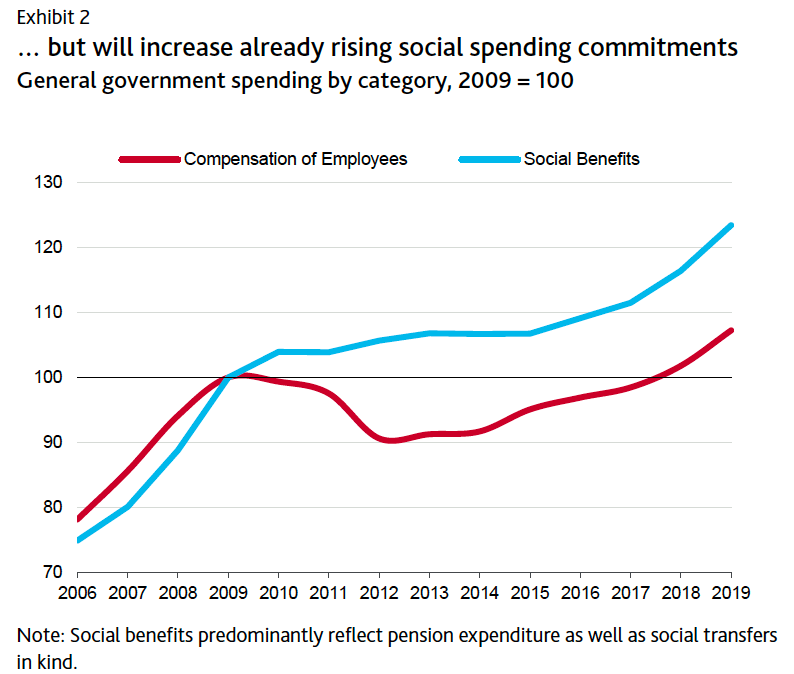
On the spending side, the budget will again increase social spending commitments, in particular through the relinking of pensions to inflation and higher public-sector wages. The public sector wage bill (around a quarter of total general government spending) and social benefits have increased strongly in recent years, in part reversing the consolidation efforts made in the aftermath of the global financial crisis and reducing budget flexibility. The budget also reflects the full-year impact of the new nationwide minimum income scheme, which will cost 0.2% of GDP.

Restoring the public finances to their 2019 level will be a protracted process. We expect Spain’s public debt ratio to rise above 120% of GDP by the end of 2021, an increase of around 25 percentage points from 2019, above the average across the largest advanced economies. Under our baseline assumptions, Spain’s public debt ratio will only stabilise near that level in the following years, leaving the country’s public debt among the highest in the world. That said, the very favourable funding environment and improvements in debt affordability will remain an important mitigating factor for the large increase in Spain’s debt burden.

Despite this year’s much higher issuance of government bonds, the government’s debt interest burden continues to decline as costlier debt is refinanced at lower rates; as of December, the average interest rate on the central government’s debt was 1.86% (from 3.11% in 2015) versus an average cost at issuance of just 0.21%.

Credit Outlook: 7 December 2020. Pg. 23
Moodys

Countries

ASEAN-5 responses mitigate COVID-19 economic damage but are unlikely to offset rising credit risk

Asia, June 25, 2020 – The ASEAN-5 economies – Malaysia (A3 stable), the Philippines (Baa2 stable), Indonesia (Baa2 stable), Vietnam (Ba3 negative) and Thailand (Baa1 stable) – have taken steps to mitigate the economic damage of the coronavirus outbreak. The support packages vary in scale and scope, and are largely contingent in nature. While they will broadly help reduce some of the negative effects of the crisis, they will not offset the rising recessionary or credit risks for most sectors.

  • Policy measures will provide a degree of support, but the confluence of shocks will weigh on growth prospects. The growth slowdown in the region will be significant relative to previous crisis episodes, but will still be moderate compared to other regions. Nonetheless, the ASEAN-5 are negatively impacted by sharp falls in external trade flows, sluggish commodity prices that weigh on the fiscal revenues of commodity exporters, and financial market volatility that can trigger capital outflows.
  • Policy measures will have significant fiscal costs. Government revenue across the region will decline and spending will rise as countries try to mitigate the effects of the crisis. Fiscal costs of support measures will be significant, with debt burdens only stabilising from 2021 for most economies. However, the ASEAN-5 countries had adequate fiscal buffers before the pandemic that gives them fiscal space to respond to the crisis.
  • Credit risks for banks have increased, despite policy support. Policy measures have mostly focused on providing liquidity to banks to support new lending, and through credit restructuring such as debt moratoriums. As moratoriums are lifted, banks’ problem loans will likely increase.
  • Few corporate sectors will benefit directly from government support. Strategically important state-owned enterprises will likely take priority in receiving direct financial support. Privately owned companies will get some support from broader policy measures such as temporary tax relief and lower interest rates.
  • Infrastructure sector will get limited policy support but essentiality of services may help shore up demand for some companies. With the exception of Indonesia, few countries in the region have taken steps to support utilities and other infrastructure companies. Governments have instead shifted some of the burden related to policy support to the utilities and other infrastructure providers.

Credit Outlook: 29 June 2020. Pg. 37
Moodys

Countries

Airline sector unlikely to fully recover before 2023, faces deep structural change

United States, June 04, 2020

  • Air passenger demand will remain severely depressed in 2021, will not see a substantial recovery before 2023. Health concerns, changes in corporate travel policies, potential restrictions on international arrivals, and lower discretionary spending because of weaker GDP and higher unemployment will constrain air passenger demand into 2022. Demand in 2023 could approach that of 2019, but the uncertain timing of the coronavirus receding on a more permanent basis makes forecasting a challenge.
  • Many airlines have improved liquidity, but at the cost of rising debt burdens. Stronger and state-supported airlines have significantly improved liquidity since March. Rated airlines have sufficient liquidity to survive on average for about 450 days at current low activity levels. For weaker airlines, this may be insufficient if groundings persist into 2021.
  • We model two scenarios assuming a recovery by 2023 or later years. Most airlines will carry substantially more debt
    in 2023
    . Our faster and slower recovery cases assume 2023 passenger volumes recover to around 95% and 85% of 2019 levels, respectively. The airlines we rate will carry on average 20%-30% more debt in 2023 compared with 2019, with leverage on average 0.5x-1.5x higher.
  • We have downgraded 13 airlines since 25 May 2020, and confirmed six. We placed ratings for 22 airlines on review for downgrade in March. The sufficiency of liquidity, and the potential for individual companies to retire the debt incurred to restore credit metrics through 2023 were key considerations in resolving the reviews.
  • The industry will undergo substantial permanent structural changes. Potential for failures of weaker airlines and government intervention to leave fewer, larger companies, polarised between more efficient operators and strategic state-supported airlines. Health screening and risks of denied boarding will affect travelers potentially beyond the pandemic. Corporate travel is likely to be impaired into 2023. Governments may require deeper carbon emissions reductions from airlines.
  • There will be deep repercussions across related sectors, particularlycommercial aerospace manufacturers and suppliers, airports, travel distributors and airline service companies. Providers of jet fuel and aircraft lessors will also be deeply affected. By contrast, carbon dioxide emissions will reduce by 750-900 million tonnes over 2020-21.

Credit Outlook: 8 June 2020. Pg. 35
Moodys