Countries

Tightening financial conditions will increase Latin American sovereigns’ funding costs, weaken debt affordability

Latin America, May 11, 2020 – Sovereigns in Latin America (LatAm) are facing the coronavirus shock with higher debt and interest burdens and less overall fiscal space than they had during the 2015-16 commodity price shock. At the same time, investor risk perceptions toward emerging markets have deteriorated, rendering financing conditions less favorable.
LatAm sovereigns will face increased funding challenges this year as they post larger deficits amid higher health-related spending, lower tax revenue intake as economies contract, and countercyclical fiscal measures, which include higher spending and tax payment delays in some cases. With access to the global financial markets affected by higher risk perceptions, persistent volatility and higher crossborder funding costs, sovereigns in the region will likely rely on alternative sources of funding (e.g., multilateral funding, local markets, fiscal buffers) to cover the anticipated increase in their borrowing needs.


» Fiscal metrics will deteriorate across the region as debt and interest burdens rise. We expect LatAm sovereigns to come out of the coronavirus crisis with weaker fiscal metrics. As the region’s economies contract and governments post wider fiscal deficits this year, debt burdens will rise by seven percentage points of GDP on average, with the median LatAm debt burden reaching 54% of GDP. And as debt stocks grow and borrowing costs rise, the median interest-to-revenue ratio in LatAm will increase to 13.7% in 2020 – almost two percentage points higher than in 2019.


» Risk differentiation by investors have led to uneven changes in relative borrowing costs across LatAm compared to prior episodes of financial volatility. Since March, spreads have widened more than in previous episodes of market volatility, including the 2013-14 “taper tantrum” period. But this time around, there is significant risk differentiation between lower rated sovereigns.
Although the benchmark US treasury rate has been declining, the average LatAm sovereign’s borrowing costs are almost 200 basis points higher than at the beginning of the year.


» Funding strategies to cover coronavirus response will be influenced by market conditions. Higher yields reflecting increased sovereign credit risk premiums will influence funding mix decisions through the rest of the year. We expect governments to rely more extensively on multilateral financing, local borrowing and other funding sources to cover wider fiscal deficits. Because governments will likely gravitate toward funding mixes that minimize interest costs for borrowings, this can partially mitigate the deterioration we anticipate in debt affordability.

Credit Outlook: 14 May 2020. Pg. 36
Moodys

Countries

Staggering surge in unemployment will likely be temporary

United States, April 13, 2020 – Incoming data in the US (Aaa stable) is beginning to capture the extent to which the coronavirus shock is likely to weigh on the economy. But this rapidly unfolding recession, particularly the way in which it is impacting the economy, is qualitatively different from past business cycle downturns. Unlike previous economic downturns, this shock has its roots outside the economy. The contraction in economic activity is driven by public health policy measures that are aimed at limiting the scale of human suffering from to the spread of the disease. This has resulted in an almost overnight shutting down of a large number of ways in which individuals engage with one another in the economy.
The massive economic consequences are becoming more clear with every incoming data print, particularly with regards to the labor market. Unlike past recessions, where the repercussions to firms’ earnings and to households’ incomes materialized over several quarters, this time around the income and employment shocks are upfront and immediate.
The unusual nature of this shock and the damage it is causing to the economy is particularly evident in labor market data. The latest establishment survey shows that in just one month, from February to March, payroll employment was slashed by 701,000. (By comparison, during the last recession, which accelerated after Lehman Brothers collapsed in September 2007, job losses only started to mount in February 2008 and took five consecutive months to reach a similar level of job losses on a cumulative basis.) As a result, the unemployment rate increased to 4.4% in March from 3.5% in February as per the household survey. However, the precipitous rise in new weekly jobless claims since the week of 16 March (after the March establishment and household surveys were completed) shows an unprecedented 16.8 million job losses in a matter of just three weeks. This amounts to a staggering unemployment rate of 14%, from the 4.4% in March.
It is very likely that job losses will continue to mount through April as thousands of businesses struggling to keep afloat relieve workers in an attempt to cut costs. However, fiscal support and incentives for businesses to maintain payroll will likely slow the pace of layoffs in coming weeks, 1 April 2020.

Most job losses are in the services sector and are temporary for now. A closer look at these early labor market indicators reveals that a large proportion of the layoffs are temporary, which means that many businesses expect to rehire once demand picks up again (see Exhibit 1). Furthermore, most of the workers facing job losses are in low paying jobs on hourly wages, or engaged in temporary work. We expect that government support to households and businesses would partially mitigate the income and job losses, particularly if the economy restarts and businesses begin to reopen after this brief second quarter pause due to the stay-at-home measures. Although there is a risk of uneven benefit distributions resulting in permanent job losses in some sectors, the economic costs would magnify with a longer lasting shutdown.

Source: Bureau of Labor Statistics

Of the 701,000 payroll job losses in the March establishment survey, 650,000 were in the services sector. And in the services sector, leisure and hospitality were the worst affected as this was the first sector to see a compression in demand (see Exhibit 2 and 3). The wave of job losses since mid-March, which will be captured in the April non-farm payroll data, are likely to show increasing layoffs in other services sectors as well, such as retail and construction.

Source: Bureau of Labor Statistics

Longer-term labor market outcomes will depend on the duration of quarantines and the effectiveness of fiscal and monetary policy measures. With layoffs surging across industries, as many as 20 million individuals could lose their jobs in a matter for weeks. In addition, many are likely to see their hours curtailed. And while most of the job losses have so far been among low paid workers, high paid workers will likely experience pay cuts the longer it takes for the economy to restart.

If stay-at-home measures and other efforts to contain the virus are effective enough to allow for a relaxation of social distancing measures, businesses will likely gradually resume normal operations in the third quarter. Under this scenario, which underpins our growth forecasts, individuals could return to their jobs, especially where layoffs are temporary. However, the pace of rehiring will likely be slow, as the fear of a renewed spread of the coronavirus is bound to linger for some time without a cure or a vaccine. We believe that the significant fiscal and monetary policy stimulus measures will provide a cushion to the economy in the interim period. In particular, measures aimed at limiting the damage to the balance sheets of households and firms would help jump-start the economy once the social distancing restrictions are lifted.

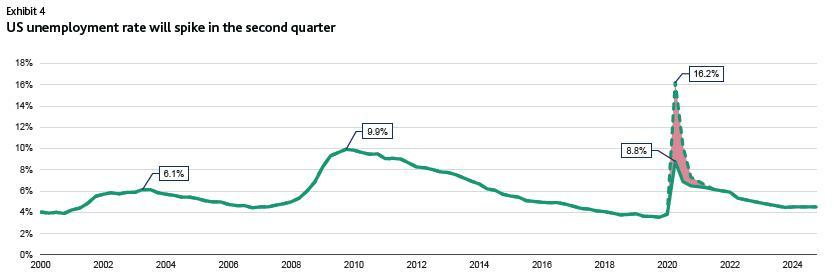
We expect the US unemployment rate to shoot up in the second quarter and to average anywhere between 8.8% and 16.2%, because of the scaling back of work and business closures in response to a sharp pullback in consumer demand (see Exhibit 4). The wide range indicates a significant likelihood of larger layoffs and furloughs in the coming weeks in sectors such as retail, transportation and construction, in addition to hospitality and leisure, which would push the unemployment rate to the high end of the range. In addition, we expect the unemployment rate to peak in the second quarter, and gradually climb down in subsequent months with a gradual resumption of normal economic activity.

We expect some of the job losses to be permanent for two reasons. First, some businesses, particularly small businesses, are unlikely to recover from this shock despite the substantial policy support. As a result, under our baseline forecast, unemployment will average around 6.5% by the end of the year.
Our expectation that the unemployment rate will peak in the second quarter is based on the significant fiscal and monetary stimulus measures being undertaken to support the economy (see Exhibit 5). The stimulus will also support households’ purchasing power and aid a gradual resumption of consumer spending in the third and fourth quarters.

There are downside risks to our growth forecasts if the economy remains shut beyond the second quarter. If that were to happen, the unemployment rate will increase further in the third quarter and many of the job losses that we are currently treating as temporary losses will likely become permanent. This would be additionally damaging, not only in terms of household income, but also as a loss of human capital, which takes time to build.

Credit Outlook: 16 April 2020. Pg. 35
Moodys

Countries

Industries That Thrive During Recessions

United States, Mar 25, 2020 – The U.S. economy is falling rapidly into a recession due to the expanding COVID-19 crisis. Since we will only know what industries weathered this recession best when it’s over, we looked back to the last recession for some guidance. During 2008, during the Great Recession, only 34 stocks out of the S&P 500 had positive returns. There are many reasons why these particular stocks increased, and the impact of every economic recession is different. However, looking at which stocks did well can still show broad patterns as to what kinds of stocks may do better in economic downturns.

Discount Retailers

The stock that beat all other S&P 500 stocks during 2008 was Dollar General, rising more than 60% that year, almost double the second highest-returning stock. In fact, the only industry to come up twice in the top 10 best-performing stocks of 2008 was discount stores, with Walmart in 6th place.

This makes intuitive sense as recessions reduce consumers’ income. When consumers’ incomes go down, they can either substitute cheaper goods or buy fewer items. Since there is a minimum of how many staple goods like food and basic household supplies you need to buy, you can’t just cut them from your budget like you could with a new videogame. That means that to save money on them, you will turn to cheaper alternatives. As a result, discount retailers are likely to do well in a recession.

Health Care

If you group together all companies related to the health care industry, there are three in the top 10, more than discount retailers. Furthermore, there are a total of 7 different health care related companies among the 34 that had positive returns in 2008.

The reasoning behind this is clear. You need health care to live and therefore are much less likely to skimp on it even when your income declines. The technical term for this is price inelasticity. Not all health care companies are created equal, and recessions are likely to hurt those companies with more debt and less cash flow. These enterprises have less ability to absorb losses and service their debt at the same time. Therefore, it may be prudent to stick to health care stocks that have low debt-to-equity ratios and avoid biotech startups that are still in their early phases.

Food and Restaurants

Similar to health care, people need food and can only cut spending by so much. Besides discount stores like Dollar Tree and Walmart, which are major grocers, also on the list are a diverse group of stocks. They include packaged food company General Mills, Inc., grocery store chain Kroger Co. (KR), and also restaurant chains McDonalds Corp. (MCD) and Darden Restaurants,Inc. (DRI) (owners of Olive Garden and other casual dining chains). All of these are relatively inexpensive food options, as people tend to purchase inexpensive items like cereal and switch to less expensive restaurants when they dine out.

Freight and Logistics

Goods need to be moved, recession or no. While personal travel for vacations declines during recessions, there is still a need to move goods to stock store shelves. Old Dominion Freight, Westinghouse Air Brake Technologies (WAB), and C.H. Robinson Worldwide (CHRW) all had positive returns in 2008. All of these companies either move freight or make products that help move freight, in the case of Westinghouse. So freight companies are often safe bets during recessions.

DIY and Repairs

When times are tight, one way to cut costs is to repair what you own rather than replace it, and to do routine maintenance yourself. That may be the reason for the strong 2008 performance from auto parts retailer AutoZone Inc. (AZO), and also from home and garden improvement retailers Tractor Supply Co. (TSCO) and Sherwin-Williams Co. (SHW). During a recession, consumers are more likely to repair their cars rather than buy a new one, as well as do home improvement and garden work themselves.

The Bottom Line

The above list isn’t exhaustive, as investing during an economic downturn is an enormous topic. Other areas that are traditional defensive investments are utilities (people always need water and heat), and personal storage (a place to put things when downsizing). That said, this should give you a good place to start looking for how to invest during a recession. Good things to keep in mind are what goods and services people and business can easily live without and what ones are essential. In addition, keep in mind what businesses people may patronize more if their income decreases.

As mentioned, it’s important to remember that each recession is different, and so will the stocks that do well during them. For example, a lot of biotechcompanies are rising at the moment due to the widespread COVID-19 crisis. Financial firms were devastated in the 2008 recession, because it stemmed from a financial crisis, but it’s energy companies in 2020 are among the worst performers due to the current oil price war.

One final reminder is that stocks and industries that do well during a recession may not always do well when the economy recovers. So you will need to change your investment strategy when the good times return. Keep that in mind when building your portfolio

http://www.investopedia.com/articles/stocks/08/industries-thrive-on-recession.asp

Countries

Oil price shock weakens outlook for Mexico's federal transfers to regional and local governments, a credit negative

Mexico, March 12, 2020 – Global benchmark oil prices plunged for the second time in a week on concern about a price war stemming from Saudi Arabia’s plan to increase output despite signs of flagging global demand. The benchmark Mexican price (Mezcla Mexicana) declined to $23.58 per barrel, a 34% drop since the end of the previous week that left the price well below the $49 per barrel price embedded in Mexico’s 2020 federal budget assumptions. The price shock will weaken growth in certain federal transfers to Mexican regional and local governments (RLGs) that are funded in part with oil revenue, a credit negative. Nonetheless, the sector will benefit from contingency funds and hedging contracts in 2020, softening the financial effect in the sector through the end of the year.
Non-earmarked federal transfers (participaciones) account for slightly more than a third of total revenue among Mexican states, and while these transfers are mostly funded with federal tax collections, they also rely on oil revenue that flows into Mexico’s Oil Fund for Stability and Development. Without a global oil price recovery, and given expectations that production will not rise significantly this year, oil revenue will likely decline in 2020, creating modest financial pressure for RLGs as slowing economic growth creates other headwinds in the sector.
After Mexico’s GDP contracted 0.1% in 2019, we expect GDP will rise just 0.9% in 2020 and that slow growth will weaken other tax collections that also fund federal transfers. Even before the oil price shock, the government projected just 3.9% nominal growth in participaciones in 2020, well below the 8.5% average growth rate during the previous five years.
We estimate that in a scenario in which prices fail to recover throughout the year, growth in participaciones would be lower than the 3.9% rise projected in the budget, though certain offsetting factors will help limit the shortfall. For one, dependence on oil revenue among Mexican RLGs has declined in recent years. Between 2012 and 2014, for example, oil revenue accounted for 29% on average of total revenue that funded participaciones, versus 12% on average between 2017 and 2019.
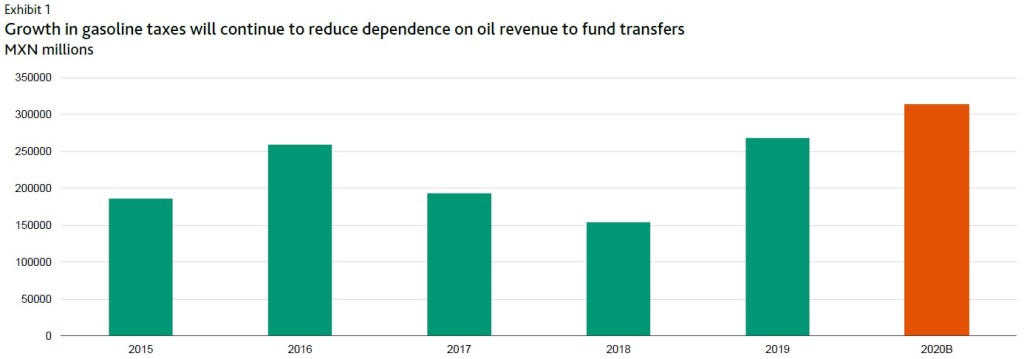
In addition, lower oil prices will give Mexico more flexibility to eliminate for the rest of the year a fiscal stimulus that previously applied to a federal excise tax on gasoline sales (IEPS)1 – another revenue source that funds participaciones – which will help offset the drop in oil revenue2. In periods where rising oil prices lead to increases in the price of refined fuels, the government has applied a stimulus that effectively subsidizes the IEPS tax with the goal of smoothing price increases for consumers. Conversely, when oil prices fall the government is able to reduce the subsidy, resulting in a rise in IEPS collections. The government’s budget projects a 17% increase in the IEPS tax on gasoline in 2020 (see Exhibit 1).

Source: Secretaria de Hacienda y Credito Publico, 2020 revenue law

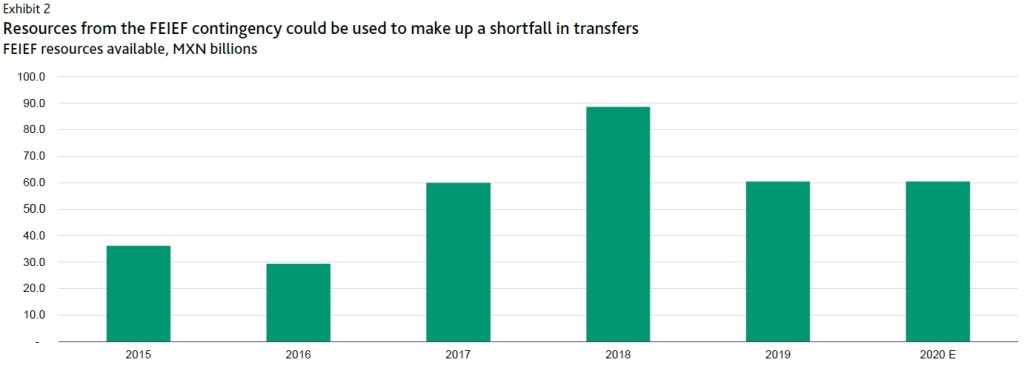
Although we anticipate slow growth in participaciones from lower oil prices, Mexican RLGs will nonetheless benefit from the Fondo de Estabilización para los Ingresos de las Entidades Federativas (FEIEF), a contingency fund, which will make up for any shortfall between budgeted and actual participaciones in 2020. This will help alleviate stress for RLGs this year, but would leave a smaller buffer to absorb future shocks (see Exhibit 2). The FEIEF currently has enough resources to absorb up to a 6.4% decline in participaciones from the levels budgeted for 2020.

Sources: Secretaria de Hacienda y Credito Publico, quarterly reports to Congress

Finally, other federal transfers that are earmarked primarily for infrastructure projects will likely benefit from the federal government’s hedging contracts, which on average provide coverage against a drop below $49 per barrel. These hedges will insulate the federal government’s budget overall from the oil price shock, allowing it to continue sending the earmarked transfers, which accounted for approximately 12% of total revenue among Mexican RLGs last year. Stability in these transfers will help limit financial stress for RLGs. Nonetheless, revenue provided by the hedging contracts does not cover participaciones, which are only funded with tax and oil revenues, and therefore wouldn’t benefit from any gains from a hedging contract.

Credit Outlook: 16 March 2020. Pg. 46
Moodys

Countries

Argentina Local Currency Ratings Lowered To ‘SD’ On Distressed Debt Exchange; ‘CCC-/C’ Foreign Currency Ratings Affirmed

Argentina, January 20, 2020 – The administration of President Alberto Fernandez launched and concluded an exchange on its peso-denominated short-term debt on Jan. 20, 2020. This followed the Dec. 19, 2019, unilateral extension (until August 2020) of U.S. dollar-denominated short-term paper held by private-sector market participants. We classify this peso-debt exchange as a distressed exchange, which constitutes a default under our criteria, and we are lowering our local currency sovereign credit ratings on Argentina to ‘SD/SD’ from ‘CCC-/C’. We are also affirming our long-term foreign currency sovereign credit rating at ‘CCC-‘, and the outlook remains negative. The negative outlook reflects prospects for a further restructuring of sovereign debt as the administration holds dialogues with bondholders, financial intermediaries, and official creditors on its policy priorities, economic strategy, and re-profiling plans.

Rating Action: On Jan. 21, 2020, S&P Global Ratings lowered its local currency sovereign credit ratings on Argentina to ‘SD/SD’ from ‘CCC-/C’ (our criteria do not distinguish between short term and long term when there is a default). We affirmed the foreign currency sovereign credit ratings at ‘CCC-/C’. The outlook on the long-term foreign currency sovereign credit rating remains negative. We also took the following rating actions:

  • We lowered the long-term local currency-denominated issue ratings to ‘CC’ from ‘CCC-‘;
  • We affirmed the long-term foreign currency issue ratings at ‘CCC-‘;
  • We affirmed our ‘B-‘ transfer and convertibility assessment on Argentina; and
  • We lowered our national scale rating on Argentina to ‘SD’ from ‘raCCC-‘.

Outlook: The negative outlook on the long-term foreign currency rating reflects the downside risks to timely and full payment of debt over the short term amid stressed economic and financial market dynamics. The sovereign’s access to liquidity is likely to remain constrained as the Fernandez Administration outlines its economic policies while engaging in dialogue with bondholders, bankers, and the International Monetary Fund. We could lower the foreign currency ratings if the government finalizes terms with bondholders for a potential debt restructuring that is characterized as a distressed debt exchange based on our methodology. Such a restructuring could entail an extension of maturities, which will not be compensated by the issuer, or a reduction in the face value of debt. Additionally, we could lower the ratings if economic and financial stresses further threaten timely debt service or the sovereign misses a debt payment. We could raise the ratings following implementation of a debt restructuring if policy signals and execution start to successfully turn around or stabilize private-sector confidence, market turbulence subsides, and the government regains access to market financing.

S&P Global Ratings, January 21, 2020