
Argentina, November 25, 2019 – Argentina’s Energy Secretariat announced an additional deferral on a tariff increase for gas distribution and transport margins that was to take effect in October 2019. The deferral is credit negative for regulated gas utilities because it will continue to erode their revenue amid rising costs related to Argentina’s very high inflation rates. Additionally, the deferral adds to the uncertainty about the future consistency of Argentina’s regulatory framework.
According to an integral tariff review (RTI), the adjustment, which was postponed until 1 February 2020, corresponds to the six-month period that ended August 2019 and should follow Argentina’s wholesale price index (IPIM) at almost 30% (see Exhibit 1).
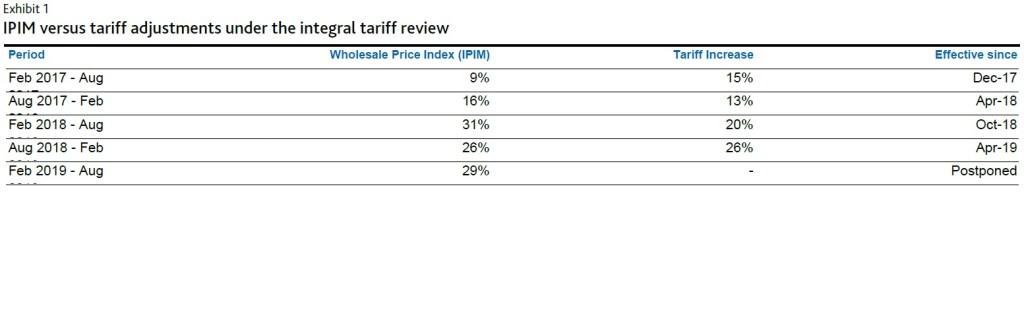
The tariff increase corresponding to February/August 2018 follows the average between IPIM, construction cost index (ICC) and salary variation index (IVS), in order to include in the adjustment variations related to activity levels, salaries and retirement plans among others.
Sources: INDEC and Moody’s Investors Service
Argentina’s regulatory framework and the sufficiency of future regulated rates has become more uncertain in the context of the ongoing government transition and the arrival of a new administration with yet unclear policy orientation in the sector. While most companies have low leverage and other strong credit metrics, rising costs amid very high inflation rates, constrained market access and tight liquidity increases the risk that they will take measures such as delaying payments to suppliers to continue operations.
The regulatory environment for utilities in Argentina historically has been evolving.(1) During the 12 years under Argentina’s previous leadership, regulated tariffs remained almost frozen despite high inflation and utilities’ increased costs. As a result, utilities did not have enough cash to spend on capital investments and the quality of service deteriorated significantly. By passing the RTI the current administration ended with the 12 year tariff freeze, a credit positive; however, the government postponed the second-half 2019 tariff adjustment because of increased consumer criticism and political opposition.
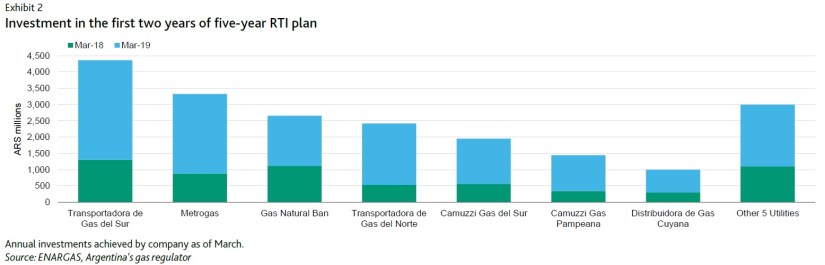
If there were to be no adjustment to utilities’ tariffs, the improvements since RTI’s implementation would reverse and negatively affect their revenue. Moreover, under the RTI, companies committed to a five-year mandatory investment plan to expand coverage and improve their service quality and standards. Without the additional funds derived from the now-deferred tariff, utilities would find it difficult to fulfill these commitments.(2) Exhibit 2 shows the level of investments in years one and two of the five-year plan that companies were able to achieve because of the RTI plan that began in 2017.
Endnotes
1. See Argentine legislation to revoke tariff increase is credit negative for regulated utilities, 4 June 2018.
2. Along with the tariff increase deferral, the ministry enables gas utilities to ask for a reduction of their investment requirements by an amount equal to the effect of the tariff adjustment deferral
Credit Outlook: 2 December 2019. Pg. 14
Moodys


