Countries

Industries That Thrive During Recessions

United States, Mar 25, 2020 – The U.S. economy is falling rapidly into a recession due to the expanding COVID-19 crisis. Since we will only know what industries weathered this recession best when it’s over, we looked back to the last recession for some guidance. During 2008, during the Great Recession, only 34 stocks out of the S&P 500 had positive returns. There are many reasons why these particular stocks increased, and the impact of every economic recession is different. However, looking at which stocks did well can still show broad patterns as to what kinds of stocks may do better in economic downturns.

Discount Retailers

The stock that beat all other S&P 500 stocks during 2008 was Dollar General, rising more than 60% that year, almost double the second highest-returning stock. In fact, the only industry to come up twice in the top 10 best-performing stocks of 2008 was discount stores, with Walmart in 6th place.

This makes intuitive sense as recessions reduce consumers’ income. When consumers’ incomes go down, they can either substitute cheaper goods or buy fewer items. Since there is a minimum of how many staple goods like food and basic household supplies you need to buy, you can’t just cut them from your budget like you could with a new videogame. That means that to save money on them, you will turn to cheaper alternatives. As a result, discount retailers are likely to do well in a recession.

Health Care

If you group together all companies related to the health care industry, there are three in the top 10, more than discount retailers. Furthermore, there are a total of 7 different health care related companies among the 34 that had positive returns in 2008.

The reasoning behind this is clear. You need health care to live and therefore are much less likely to skimp on it even when your income declines. The technical term for this is price inelasticity. Not all health care companies are created equal, and recessions are likely to hurt those companies with more debt and less cash flow. These enterprises have less ability to absorb losses and service their debt at the same time. Therefore, it may be prudent to stick to health care stocks that have low debt-to-equity ratios and avoid biotech startups that are still in their early phases.

Food and Restaurants

Similar to health care, people need food and can only cut spending by so much. Besides discount stores like Dollar Tree and Walmart, which are major grocers, also on the list are a diverse group of stocks. They include packaged food company General Mills, Inc., grocery store chain Kroger Co. (KR), and also restaurant chains McDonalds Corp. (MCD) and Darden Restaurants,Inc. (DRI) (owners of Olive Garden and other casual dining chains). All of these are relatively inexpensive food options, as people tend to purchase inexpensive items like cereal and switch to less expensive restaurants when they dine out.

Freight and Logistics

Goods need to be moved, recession or no. While personal travel for vacations declines during recessions, there is still a need to move goods to stock store shelves. Old Dominion Freight, Westinghouse Air Brake Technologies (WAB), and C.H. Robinson Worldwide (CHRW) all had positive returns in 2008. All of these companies either move freight or make products that help move freight, in the case of Westinghouse. So freight companies are often safe bets during recessions.

DIY and Repairs

When times are tight, one way to cut costs is to repair what you own rather than replace it, and to do routine maintenance yourself. That may be the reason for the strong 2008 performance from auto parts retailer AutoZone Inc. (AZO), and also from home and garden improvement retailers Tractor Supply Co. (TSCO) and Sherwin-Williams Co. (SHW). During a recession, consumers are more likely to repair their cars rather than buy a new one, as well as do home improvement and garden work themselves.

The Bottom Line

The above list isn’t exhaustive, as investing during an economic downturn is an enormous topic. Other areas that are traditional defensive investments are utilities (people always need water and heat), and personal storage (a place to put things when downsizing). That said, this should give you a good place to start looking for how to invest during a recession. Good things to keep in mind are what goods and services people and business can easily live without and what ones are essential. In addition, keep in mind what businesses people may patronize more if their income decreases.

As mentioned, it’s important to remember that each recession is different, and so will the stocks that do well during them. For example, a lot of biotechcompanies are rising at the moment due to the widespread COVID-19 crisis. Financial firms were devastated in the 2008 recession, because it stemmed from a financial crisis, but it’s energy companies in 2020 are among the worst performers due to the current oil price war.

One final reminder is that stocks and industries that do well during a recession may not always do well when the economy recovers. So you will need to change your investment strategy when the good times return. Keep that in mind when building your portfolio

http://www.investopedia.com/articles/stocks/08/industries-thrive-on-recession.asp
Countries

Oil price shock weakens outlook for Mexico's federal transfers to regional and local governments, a credit negative

Mexico, March 12, 2020 – Global benchmark oil prices plunged for the second time in a week on concern about a price war stemming from Saudi Arabia’s plan to increase output despite signs of flagging global demand. The benchmark Mexican price (Mezcla Mexicana) declined to $23.58 per barrel, a 34% drop since the end of the previous week that left the price well below the $49 per barrel price embedded in Mexico’s 2020 federal budget assumptions. The price shock will weaken growth in certain federal transfers to Mexican regional and local governments (RLGs) that are funded in part with oil revenue, a credit negative. Nonetheless, the sector will benefit from contingency funds and hedging contracts in 2020, softening the financial effect in the sector through the end of the year.
Non-earmarked federal transfers (participaciones) account for slightly more than a third of total revenue among Mexican states, and while these transfers are mostly funded with federal tax collections, they also rely on oil revenue that flows into Mexico’s Oil Fund for Stability and Development. Without a global oil price recovery, and given expectations that production will not rise significantly this year, oil revenue will likely decline in 2020, creating modest financial pressure for RLGs as slowing economic growth creates other headwinds in the sector.
After Mexico’s GDP contracted 0.1% in 2019, we expect GDP will rise just 0.9% in 2020 and that slow growth will weaken other tax collections that also fund federal transfers. Even before the oil price shock, the government projected just 3.9% nominal growth in participaciones in 2020, well below the 8.5% average growth rate during the previous five years.
We estimate that in a scenario in which prices fail to recover throughout the year, growth in participaciones would be lower than the 3.9% rise projected in the budget, though certain offsetting factors will help limit the shortfall. For one, dependence on oil revenue among Mexican RLGs has declined in recent years. Between 2012 and 2014, for example, oil revenue accounted for 29% on average of total revenue that funded participaciones, versus 12% on average between 2017 and 2019.
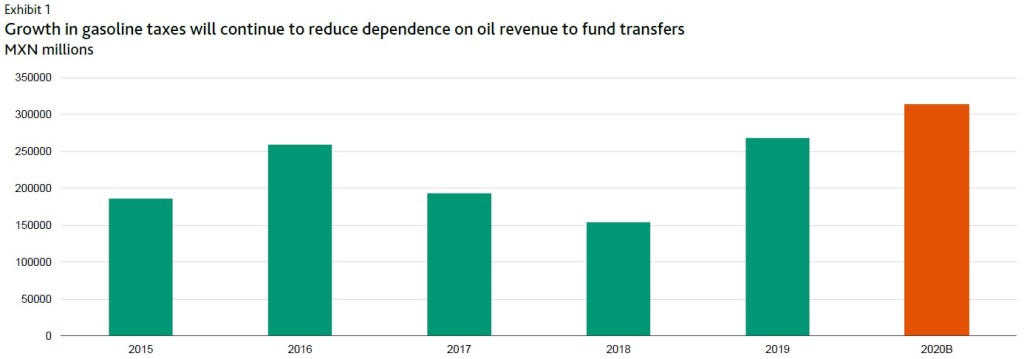
In addition, lower oil prices will give Mexico more flexibility to eliminate for the rest of the year a fiscal stimulus that previously applied to a federal excise tax on gasoline sales (IEPS)1 – another revenue source that funds participaciones – which will help offset the drop in oil revenue2. In periods where rising oil prices lead to increases in the price of refined fuels, the government has applied a stimulus that effectively subsidizes the IEPS tax with the goal of smoothing price increases for consumers. Conversely, when oil prices fall the government is able to reduce the subsidy, resulting in a rise in IEPS collections. The government’s budget projects a 17% increase in the IEPS tax on gasoline in 2020 (see Exhibit 1).

Source: Secretaria de Hacienda y Credito Publico, 2020 revenue law

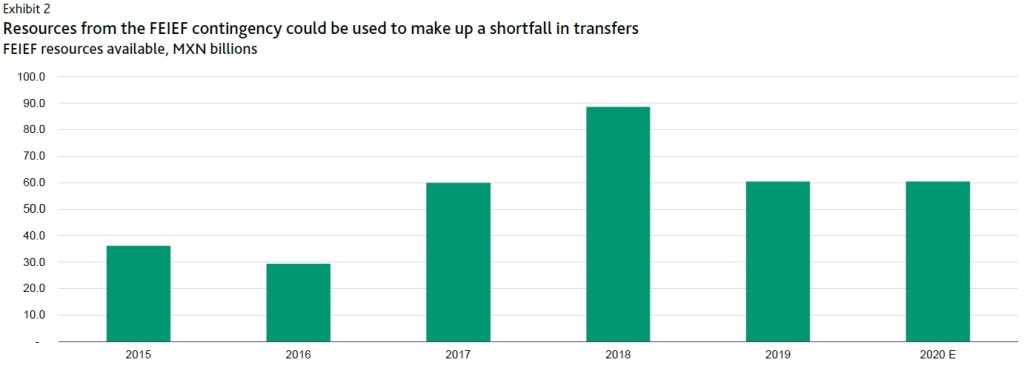
Although we anticipate slow growth in participaciones from lower oil prices, Mexican RLGs will nonetheless benefit from the Fondo de Estabilización para los Ingresos de las Entidades Federativas (FEIEF), a contingency fund, which will make up for any shortfall between budgeted and actual participaciones in 2020. This will help alleviate stress for RLGs this year, but would leave a smaller buffer to absorb future shocks (see Exhibit 2). The FEIEF currently has enough resources to absorb up to a 6.4% decline in participaciones from the levels budgeted for 2020.

Sources: Secretaria de Hacienda y Credito Publico, quarterly reports to Congress

Finally, other federal transfers that are earmarked primarily for infrastructure projects will likely benefit from the federal government’s hedging contracts, which on average provide coverage against a drop below $49 per barrel. These hedges will insulate the federal government’s budget overall from the oil price shock, allowing it to continue sending the earmarked transfers, which accounted for approximately 12% of total revenue among Mexican RLGs last year. Stability in these transfers will help limit financial stress for RLGs. Nonetheless, revenue provided by the hedging contracts does not cover participaciones, which are only funded with tax and oil revenues, and therefore wouldn’t benefit from any gains from a hedging contract.

Credit Outlook: 16 March 2020. Pg. 46
Moodys

Corporates

Vivo and TIM’s joint acquisition of Oi mobile assets is credit positive for whole sector

Brazil, March 10, 2020 – Brazil’s telecom operators Telefonica Brasil S.A. (Vivo, Ba1 stable) and TIM S.A., the local subsidiary of Telecom Italia S.p.A. (Ba1 negative), announced a joint plan to acquire the mobile business of Oi S.A., their competitor now operating under bankruptcy protection.
The potential transaction, whose terms remain undisclosed, would benefit the entire Brazilian telecom industry by excluding Oi from the market, thereby enabling the remaining three mobile operators to increase profits.

Oi, which filed for judicial recovery in 2016, is the most aggressively priced operator in Brazil’s mobile telecom market. Its removal would make Brazil’s competitive environment more rational and profitable. An increase in profitability would allow the three remaining mobile competitors to invest more easily in infrastructure, better service quality and balance-sheet deleveraging.
Vivo and TIM jointly intend to acquire Oi’s mobile business, as a whole or in parts. Each company would receive a portion of Oi’s mobile business, but TIM would probably get the largest part to avoid excessive market concentration with Vivo. An outsized increase in Vivo’s market share would likely have more trouble winning approval from CADE, the Brazilian federal antitrust authority. Vivo leads the mobile market in Brazil with 33% market share, followed by TIM and Claro with 24% each, and Oi with 16% as of January 2020.
Even without details yet about the market value of Oi’s mobile business or how Vivo and TIM would finance their acquisition, Vivo’s balance sheet is strong enough to support a debt-financed acquisition without significant stress on its credit metrics. Vivo had a of 0.7x total adjusted debt/EBITDA ratio at the end of 2019, and a 20.7% free cash flow/debt ratio.
The proposal marks a relatively rare opportunity in Brazil’s telecom market, whose M&A opportunities are limited; unless Oi sells its assets, there are no other significant acquisitions remaining. Claro, the local subsidiary of America Movil S.A.B. de C.V. (A3 stable), acquired Nextel Brazil in March 2019 for around $900 million. The move strengthened the Mexican group’s mobile business in Brazil, particularly in the populous states of Rio de Janeiro and São Paulo, and gave Claro valuable spectrum in Brazil.
The Vivo-TIM deal would benefit Claro as well, leaving only three operators competing in the 5G auction slated for December 2020, implying more capacity for each company just as Brazil has relaxed its spectrum licensing rules.

Under a new telecom bill approved in 2019, Brazilian telecom operators can renew mobile spectrum licenses more than once, giving them longer term visibility. Previously, an operator could only renew its license once, and had to go through the bidding process after the first renewal.

Credit Outlook: 16 March 2020. Pg. 31
Moodys

Banking

Costa Rican state-owned banks’ planned sale of BICSA is credit negative

Costa Rica, February 10, 2020 – The Government of Costa Rica (B2 stable) Ministry of Finance announced a series of measures to reduce the country’s fiscal deficit, including plans to sell Banco Internacional de Costa Rica, S.A. (BICSA, B1 stable b11).
The sale would be credit negative for BICSA, a Panamanian wholesale bank owned by Costa Rican state-owned Banco de Costa Rica (BCR, B2 stable b2), which holds 51% of its capital; and Banco Nacional de Costa Rica (BNCR, B2 stable, b2), which holds 49% of its capital. The sale creates uncertainty about BICSA’s future direction and whether it will remain focused on providing corporate and correspondent banking services for Costa Rican and Panamanian export companies. Management may also take a more cautious approach to growth during the transition period, which would negatively affect business volume, revenue generation and profitability.
As a wholesale bank, BICSA is highly dependent on market funding. As of September 2019, market funds accounted for 46.4% of total banking assets. Most of the bank’s liabilities are short term, with more than 60% expiring in less than a year. BICSA is also 67% funded by foreign investors, making it more vulnerable to refinancing and repricing risk that could increase funding costs and adversely affect its profitability.
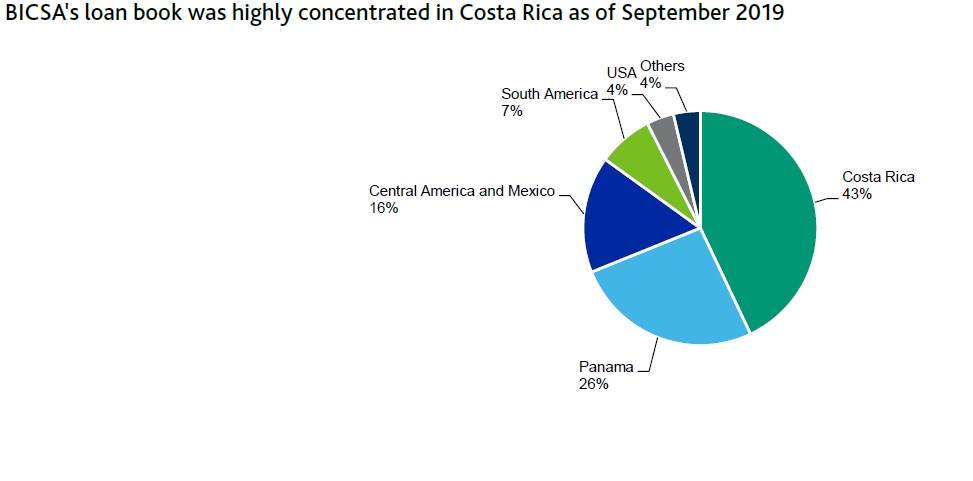
Given BICSA’s relatively small market share and its niche presence in Panama and Central America, the links and relationships between BICSA, BCR and BNCR are essential for its business development and franchise growth. As of September 2019, BICSA’s loan book was 43% concentrated in Costa Rica (see exhibit), which is its main market with significant presence in the corporate sector. In addition, in recent months, and supported by its shareholders, BICSA started to operate in Costa Rica’s leasing segment.

Source: BICSA

According to the Minister of Finance of Costa Rica, BICSA’s sale value could reach 0.04% of the country’s GDP, which is approximately $300 million. The sale of the bank could take several months if it were to require changes in laws that need congressional approval.

Credit Outlook: 17 February 2020. Pg. 22
Moodys

Banking

BNDES sells 9.9% Petrobras stake, allowing resource allocation to sustainable projects, a credit positive

Brazil, February 5, 2020 – Banco Nacional de Desenvolvimento Econômico e Social (BNDES, Ba2 stable, ba21) sold its 9.9% stake in oil giant Petróleo Brasileiro S.A. – Petrobras (Petrobras, Ba2 stable), raising BRL22 billion. The divestiture will reduce BNDES’ volatility in capital and earnings, a credit positive.
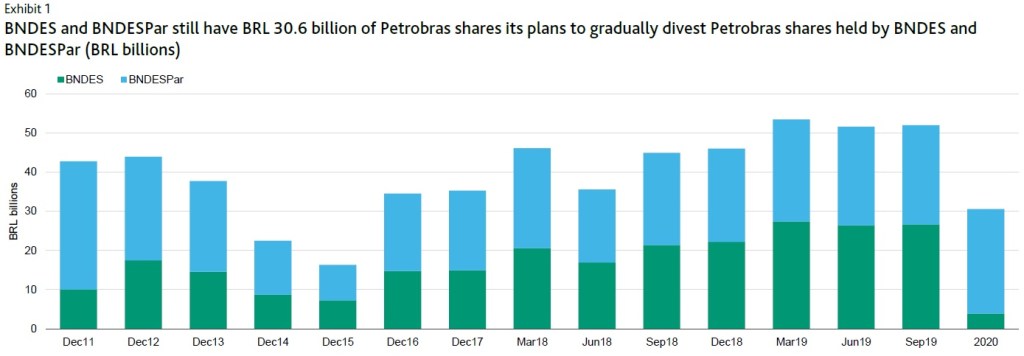
The sale does not include Petrobras preferred shares that BNDES and its investment subsidiary BNDES Participações – BNDESPar (Ba2 stable) hold. BNDES and BNDESPar also have BRL30.6 billion of voting and preferred Petrobras shares that it plans to divest within the next three years (Exhibit 1), subject to market conditions. BNDES could divest another BRL70 billion of other equity in the same time frame, depending on market conditions. To accommodate its goal, BNDES cut the value at risk limit for variable income securities in its equity portfolio to BRL600 million as of 2019 from BRL3 billion as of 2018.

Source: BNDES

Divestment proceeds will be primarily allocated to sustainable projects with relevant social and environmental impact. This strategy will support BNDES’ focus on smaller companies and having a key role within fintech and digital transformation, in addition to its preeminent position supporting infrastructure projects. Structuring and advising projects mainly related to the government’s agenda for privatizations and public-and-private partnerships also have traction in the bank’s business strategy.
A portion of the divestment proceeds will likely be used to pay additional dividends to the Government of Brazil (Ba2 stable) to alleviate the government deficit. This practice, used 2009-13, declined after a new dividend policy that limited dividend distribution to a maximum of 60% of adjusted net income. While the bank distributed a dividend equating to 25% of adjusted net income between 2017 and 2018, in 2019, it has already anticipated dividends of 60% of adjusted net income (Exhibit 2).

Source: BNDES

We estimate that the distribution of 60% of the net gains from the sale of its Petrobras stake will not have a material effect on the bank’s capitalization because BNDES’ (Moody’s-adjusted) tangible common equity2 to risk-weighted assets ratio (TCE to RWA) should decline to 15.8%, from 17% in June 2019. BNDES has improved its capitalization since 2016, with sharply lower dividend distributions to the Government of Brazil and steady loan contraction.

Source: BNDES

For B3 S.A. – Brasil, Bolsa, Balcao (Ba1 stable), Brazil`s stock market operator, the size of secondary offering is also credit positive given that the amount traded with it is approximately 19% of the total of initial and secondary offerings that occurred in 2019. The issuance of these Petrobras shares will enable B3 to gain additional trading and post trading revenues at a time when it continues to report record levels of earnings.

Credit Outlook: 10 February 2020. Pg. 34
Moodys