Banking

Banco Sabadell sells its asset management unit, a credit positive

Spain, January 21, 2020 – Banco Sabadell, S.A. (Baa2/Baa3 stable, ba2) announced that it had reached an agreement to sell its 100% interest in asset management unit Sabadell Asset Management, S.A. S.G.I.I.C., Sociedad Unipersonal (SabAM), to Amundi Asset Management for €430 million. As part of the agreement, Banco Sabadell and Amundi entered a 10-year partnership. The transaction is credit positive for Banco Sabadell because it will generate a capital gain of €351 million and will improve the bank’s regulatory capital metrics.
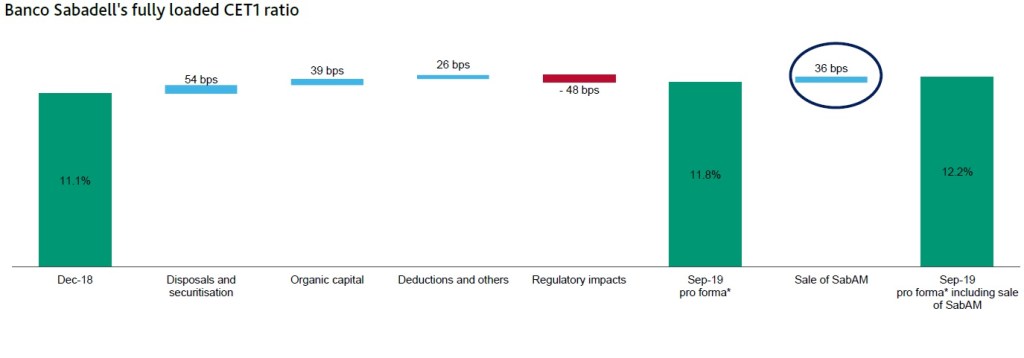
Upon the closing of the transaction, which the parties expect will occur in third-quarter 2020, Banco Sabadell estimates that its fully loaded Common Equity Tier 1 (CET1) ratio will increase 36 basis points (bps) from the pro forma fully loaded CET 1 ratio of 11.8% reported at the end of September 2019. Banco Sabadell expects an additional seven-basis-point increase related to specific guarantees in effect over the length of the distribution agreement that will be accrued proportionally over the next 10 years. This disposal is concurrent with Banco Sabadell’s strategy of divesting noncore assets and raising its fully loaded CET1 ratio to around 12%. (see exhibit)

The sale of this unit will have a relatively modest effect on the group’s profitability. Banco Sabadell disclosed that SabAM had an estimated net profit of €34 million as of year-end 2019, including, among other things, €65 million of net fee and commission income and €17 million of operating expenses. SabAM’s net profit constitutes around 4% of the bank’s annualized net income as of the end of September 2019 (net of the €135 million extraordinary gains from the Solvia disposal).

In the current environment of low interest rates and decelerating economic growth in Spain, the loss of this revenue source risks putting an additional strain on the bank’s earnings generation capacity. The sale of SabAM limits the potential growth of fee and commission income that could help ongoing challenges to Banco Sabadell’s net interest income. However, these downside risks should be broadly offset by cost savings derived from the de-risking of the bank’s balance sheet and the cost-efficiency plan, while the bank expects its subsidiary TSB Bank plc (Baa2 negative, baa2) to generate profit starting in 2020. Banco Sabadell also expects to benefit from increased distribution fees as a result of the partnership with Amundi.

Credit Outlook: 27 January 2020. Pg. 26
Moodys

Infrastructure

Deferral of Argentina’s gas tariff increase is credit negative for regulated gas utilities

Argentina, November 25, 2019 – Argentina’s Energy Secretariat announced an additional deferral on a tariff increase for gas distribution and transport margins that was to take effect in October 2019. The deferral is credit negative for regulated gas utilities because it will continue to erode their revenue amid rising costs related to Argentina’s very high inflation rates. Additionally, the deferral adds to the uncertainty about the future consistency of Argentina’s regulatory framework.

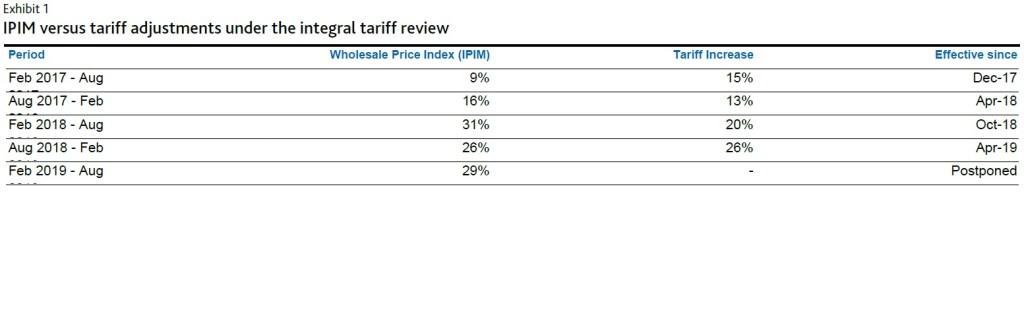
According to an integral tariff review (RTI), the adjustment, which was postponed until 1 February 2020, corresponds to the six-month period that ended August 2019 and should follow Argentina’s wholesale price index (IPIM) at almost 30% (see Exhibit 1).

The tariff increase corresponding to February/August 2018 follows the average between IPIM, construction cost index (ICC) and salary variation index (IVS), in order to include in the adjustment variations related to activity levels, salaries and retirement plans among others.
Sources: INDEC and Moody’s Investors Service

Argentina’s regulatory framework and the sufficiency of future regulated rates has become more uncertain in the context of the ongoing government transition and the arrival of a new administration with yet unclear policy orientation in the sector. While most companies have low leverage and other strong credit metrics, rising costs amid very high inflation rates, constrained market access and tight liquidity increases the risk that they will take measures such as delaying payments to suppliers to continue operations.

The regulatory environment for utilities in Argentina historically has been evolving.(1) During the 12 years under Argentina’s previous leadership, regulated tariffs remained almost frozen despite high inflation and utilities’ increased costs. As a result, utilities did not have enough cash to spend on capital investments and the quality of service deteriorated significantly. By passing the RTI the current administration ended with the 12 year tariff freeze, a credit positive; however, the government postponed the second-half 2019 tariff adjustment because of increased consumer criticism and political opposition.

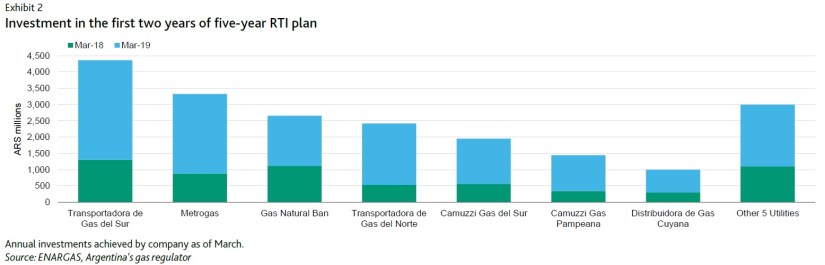
If there were to be no adjustment to utilities’ tariffs, the improvements since RTI’s implementation would reverse and negatively affect their revenue. Moreover, under the RTI, companies committed to a five-year mandatory investment plan to expand coverage and improve their service quality and standards. Without the additional funds derived from the now-deferred tariff, utilities would find it difficult to fulfill these commitments.(2) Exhibit 2 shows the level of investments in years one and two of the five-year plan that companies were able to achieve because of the RTI plan that began in 2017.

Endnotes
1. See Argentine legislation to revoke tariff increase is credit negative for regulated utilities, 4 June 2018.
2. Along with the tariff increase deferral, the ministry enables gas utilities to ask for a reduction of their investment requirements by an amount equal to the effect of the tariff adjustment deferral

Credit Outlook: 2 December 2019. Pg. 14
Moodys

Infrastructure

Repsol’s new oil and gas price scenario leads to €4.8 billion post-tax impairment in 2019

Spain, December 2, 2019 – Repsol S.A. (Baa1 stable) announced that it aims to achieve net zero emissions by 2050. It also said that in this context it assumes a new oil and gas price scenario consistent with the Paris Agreement’s climate goals, which is lower than the company’s previous scenario, in particular for the gas prices that are currently under pressure. The updated price scenario implies a lower value of some assets, leading to a post-tax impairment charge of €4.8 billion, which will be reflected in 2019 results. The impairment is credit negative.

The value of the impairment equals roughly 8% of Repsol’s total assets and around 15% of its total equity as of the end of September 2019. Pro forma for the impairment, Repsol’s total debt/capital ratio (as adjusted by Moody’s), which is one of the main ratios of our global integrated oil and gas rating methodology, deteriorates by around 4% from roughly 35% as of the end of September 2019. The ratio remains broadly in line with the current rating.

However, the impairment comes at a time when Repsol’s key credit metrics have deteriorated from fairly healthy levels in 2018 in a comparatively weaker pricing environment in 2019. For instance, the company’s Moody’s-adjusted retained cash flow (RCF)/net debt ratio has declined to low 20s in percentage terms for the 12 months to September 2019 from around 30% in 2018. We expect an improvement of the ratio back toward 30% in the next 12-18 months, supported by growth in earnings in the upstream business, but also owing to potential benefits in the downstream business coming from the IMO 2020 regulation, for which the company is well positioned. We forecast the improvement despite the roughly €1 billion extraordinary share buyback for 2020 announced in July this year, which Repsol justified by its expectation of better cash flow generation compared to its original business plan for 2018-2020.

Notwithstanding the impairment we note positively the company’s strengthened commitment towards reducing its carbon footprint, which is becoming an increasingly important credit consideration. With its new 2050 carbon neutrality objective, Repsol also sets new goals for the reduction of its carbon intensity indicator from a 2016 baseline: 10% by 2025, 20% by 2030 and 40% by 2040. Additionally, it defines concrete steps for all of its businesses to achieve those goals, which, among others, include biofuels, recycling, natural carbon sinks and low-carbon energy.

Specifically, low-carbon energy is playing an increasingly important role for Repsol. Within its current business plan for 2018-2020 Repsol plans to invest €11 billion as a core portfolio capital spending during those three years. On top of that, the company budgets €4 billion during the same period to expand its downstream operations (roughly €1.5 billion) and develop its low-carbon energy business (roughly €2.5 billion). With the new 2050 carbon neutrality objective, Repsol also increases its target for low-carbon electricity generation capacity by 3 GW to 7.5 GW by 2025, and will begin to expand into new markets to become a leading international player in renewable energies. Repsol currently has almost 3 GW in operation and around 1.1 GW under development.

Credit Outlook: 9 December 2019. Pg. 4
Moodys

Corporates

LATAM’s partnership with Delta Air Lines is credit positive

Chile, September 27, 2019 – Delta Air Lines, Inc. (Baa3 stable) and LATAM Airlines Group S.A. (LATAM, Ba3 stable) announced that they had entered a strategic partnership in which Delta will acquire 20% of LATAM’s shares for $1.9 billion through a secondary public tender offer for $16 per share. The partnership also includes Delta investing $350 million in LATAM to support the creation of the partnership. Additionally, Delta will purchase four Airbus A350-900 aircraft that LATAM operates and assume LATAM’s purchase commitments for 10 A350s scheduled for delivery between 2020 and 2025. Delta will be represented on LATAM’s board of directors as one of the company’s largest shareholders.
We view the announced partnership as credit positive for LATAM because it will create a complementary route connecting the Americas that, according to the airlines, will be the strongest airline route network between North and South America. The partnership will also provide strategic, operational and financial benefits for LATAM.
The $350 million investment will not increase LATAM’s liquidity because it will largely be used to create the partnership. But the acquisition of the four A350-900 aircraft and the assumption of the commitments for the 10 A350s scheduled for delivery will improve LATAM’s free cash flow generation and reduce its forecasted debt by over $2 billion by 2025, which is around 20% of the company’s gross indebtedness that totaled $10.6 billion at the end of June 2019. There will be no immediate effect on the company’s credit metrics because the commitments are scheduled to be delivered between 2020 and 2025.
LATAM will withdraw from the oneworld global airline alliance. Presumably, a large portion of the $350 million investment in the partnership will fund LATAM’s oneworld exit. American Airlines, Inc. (Ba3 stable), a oneworld member, in a 26 September press release, noted that the Chilean Supreme Court had ruled against an application for American and LATAM’s to form a joint business arrangement, which influenced the decision for American and LATAM to part ways.
Delta’s $1.9 billion purchase price for the equity stake values LATAM’s equity at $9.5 billion, which compares with a pre-announcement market cap of about $5.5 billion, or a per share price of about $9.00. The tender offer will be at $16.00 per share, an almost 80% premium to LATAM’s average share price over the past 30 days.
Delta and LATAM’s transactions are subject to regulatory approvals, and regulatory risk remains given the Chilean Supreme Court’s ruling against the proposed joint business arrangement between American and LATAM. However, in the case of Delta and LATAM, there is minimal overlap today between the airlines’ capacity, which was not the case with LATAM and American.
LATAM is a Chile-based airline holding company formed by the business combination of LAN Airlines S.A. of Chile and TAM S.A. of Brazil in June 2012. LATAM is the largest airline group in South America, with a local presence for domestic passenger services in Brazil, Chile, Peru, Ecuador, Argentina and Colombia. The company also provides intra-regional and international passenger services, and has a cargo operation using the belly space on passenger flights and dedicated freighter service. For the 12 months that ended June 2019, LATAM generated $9.75 billion in net revenue and carried 71.1 million passengers and 900,000 tons of cargo.
With an industry-leading global network, Delta and the Delta Connection carriers offer service to more than 300 destinations in more than 50 countries on six continents. Headquartered in Atlanta, Delta had over 88,000 full-time equivalent employees and operated a fleet of more than 1,200 aircraft in 2018. The company reported $44.4 billion of revenue in 2018.

Credit Outlook: 30 September. Pg. 4
Moodys

Banking

Banco de Crédito e Inversiones’ continued appetite for real estate exposure is credit negative

Chile, September 27, 2019 – Chile-based Banco de Crédito e Inversiones (Bci, A2/A2 stable, baa11) announced that its South Florida-based subsidiary, City National Bank of Florida (CNB), plans to acquire Executive National Bank, a small Miami bank focused on real estate financing. The planned acquisition is credit negative for Bci because it reflects the bank’s willingness to further increase its exposure to the real estate market in Florida while maintaining a moderate ratio of tangible common equity (TCE) to risk weighted assets (RWA).
This acquisition follows the bank’s 2018 acquisitions of another Miami-based bank, TotalBank, and five of Walmart’s Chilean financial services subsidiaries. It also comes amid Bci’s ongoing effort to place itself in the forefront of Chile’s shifting credit card acquiring business, initiatives, which combined, risk straining the bank’s management.
Although Executive National Bank’s $455 million assets equal about 3% of CNB’s $15.1 billion of assets, it is CNB’s second acquisition in Miami in as many years and follows an aggressive organic expansion of that franchise. Bci’s 2015 acquisition of CNB increased Bci’s exposure to South Florida real estate to 120% of its TCE (see Exhibit 1). Bci’s South Florida real estate exposure has continued to increase since then as a result of organic growth of around 20% between 2015 and 2018, and Bci’s acquisition of TotalBank (about $3 billion in assets), which is also focused on real estate financing in the region.

Slower loan growth to more sustainable levels, would alleviate pressure building in Bci’s capitalization stemming from continued aggressive expansion in Florida real estate, a market that has historically proven to be unstable. We estimate that Bci’s South Florida real estate exposure will now equal approximately 170% of TCE, up from 116% in 2017.
Following its various acquisitions, Bci has committed to maintaining a stable Tier 1 ratio of at least 10%. However, our estimated ratio of Bci’s TCE to adjusted RWA of 9.5% as of June 2019 is moderate compared with the 15.1% median for global banks with similar credit risk. It is also below the 10.3% average for Banco Santander-Chile (A1/A1 stable, a3) and Banco de Chile (A1/A1 stable, a3), Bci’s main competitors in Chile.
Although CNB will acquire Executive National Bank for $75 million in a cash transaction, the acquisition will reduce Bci’s own TCE-to- RWA ratio by 10-12 basis points, which will further distance the bank’s capitalization from our expectation of a 10% capital ratio as a result of earnings retention and growth. Nevertheless, we do not expect a major deterioration of Bci’s other consolidated key metrics, given Executive National Bank’s adequate fundamentals (see Exhibit 2). Moreover, CNB has exhibited conservative underwriting standards despite its high growth. CNB’s loan-to-value ratio as of June averaged a low 52%. Over the next year, CNB also plans to moderate its loan growth to about 10%, which will partly mitigate asset risks associated with its higher exposure to real estate sector.

Bci’s management is also busy on other fronts. The bank is undergoing a major venture to establish itself at the forefront of the shifting payments business in Chile. In May, Bci established a 10-year joint venture with EVO Payments International, LLC (B2 negative), a payment technology and services provider, to complement the bank’s mobile payment solution MACH, which started in 2017 and provides peer-to-peer payments for over one million subscribers. Following a September 2018 ruling by the Tribunal for the Defense of Free Competition, the Chilean market is shifting from a business controlled by Transbank S.A. to one with multiple participants with increased product offerings for businesses and individuals, and more competition.
Bci also plans to jump start a new Peruvian bank, to be named Banco Bci Perú, which will begin operations following regulatory approvals in 2021 with a $60 million capital investment. In its announcement, Bci said its application for a branch license in Peru focused on commercial lending. Banco Bci Perú will cater to large Peruvian corporates and the substantial number of Chilean companies with operations in Peru. Nevertheless, Banco Bci Perú will remain small. Over the next 10 years, Banco Bci Perú will not exceed 5% of Bci’s $45.7 billion gross loans as of June 2019.

Credit Outlook: 30 September 2019. Pg. 10
Moodys