News

Banking

Mexico’s central bank extends pandemic-related liquidity and credit measures, a credit positive for banks

Mexico, September 15, 2020 – Banco de México (Banxico), Mexico’s central bank, announced that it will extend until February 2021 pandemic related liquidity and credit measures implemented in April and which were to expire 30 September. By renewing these support measures, the government is maintaining facilities aimed at softening the negative economic and market effects of the coronavirus pandemic, which have strained bank operating conditions and investor and consumer confidence. Mexico’s economy remains weak, reflecting uncertainty about domestic policy and the US economic recovery, its largest export partner.

In Mexico, coronavirus-related measures mostly focus on liquidity, funding and some temporary rescheduling of payments, and less on subsidized credit programs or household income support, as in other countries in the region. Because Mexico’s coronavirus infection numbers are still high, risks of extended social distancing rules threaten to delay economic recovery, limit the recovery of employment and maintain low corporate earnings, which will weigh on credit conditions for at least the next 24 months.

Since 21 April, Banxico has made MXN750 billion ($35 billion) available as part of its pandemic-related relief measures (see exhibit), those now extended until February 2021. The central bank has also opened its discount window to a wider range of corporate and government securities (a measure also available to development banks), lowered banks’ reserve requirements, offered secured financing at low rates and asset swaps to small and midsize enterprises (SMEs). The credit facilities directed to the SME segment most affected by the pandemic totaled MXN350 billion, a relatively small amount versus other Latin American governments’ credit lines.

Source: Banxico

Although the size and reach of the government’s package are more limited than sponsored programs implemented in other large economies in the region, the extension points to the government’s preventative stance against prevailing risks and uncertainties associated with the pandemic. The size of the measures also reflects the current administration’s commitment to fiscal austerity.

The Mexican financial system’s exposure to the SME segment, which has been most vulnerable during the economic downturn, is low and limits the need for government-sponsored aid to the sector. As of June 2020, Mexico’s systemwide loan book had about a 7% exposure to SME loans, versus 18% for Brazil and 24% for Peru. Mexican banks’ loans to large corporations, a segment with a healthier liquidity position than that of SMEs, comprised 60% of gross loans. Additionally, corporates withdrew from banks’ committed credit facilities at the outset of the pandemic, particularly in March and April, when there was a sudden drop in economic activity and heightened market volatility.

At the same time, the government has already announced that it is finalizing the regulatory framework to extend other pandemic related credit forbearance measures, including the waiver on provisioning requirement for renegotiated loans, which will support a second round of relief programs to be offered by banks to customers that continue to struggle to recover repayment capacity amid the deep economic recession.

Credit Outlook: 21 September 2020. Pg. 11
Moodys

Infrastructure

Brazil’s enhanced regulation will spur natural gas market growth

Brazil, September 1, 2020 – the lower house of Brazil’s (Ba2 stable) national congress approved law 6407/2013, also known as the “Natural Gas Bill,” an important step in the modernization of the natural gas industry in the country.

The bill provides an enhanced regulatory and contractual framework that will foster competition and spur up to BRL80 billion in annual investments along the gas supply chain, according to Brazil’s Ministry of Finance (FIRJAN). Natural gas prices will potentially decline around 40% with increased production rates over the next decade, which will lead to lower production costs for electro-intensive industries, a credit positive. The greater availability of natural gas will also contribute to a sustained diversification of Brazil energy matrix as gas-fired thermal power plants become more competitive in future energy auctions. The bill still needs Senate approval for take effect, a process that we expect to conclude within this month.

Approval of the new legislation follows several years of in-depth discussion among regulators and stakeholders, which gained momentum after the government launched the Gas for Growth (Gás para Crescer) program in 2016. The current administration revamped the program in July 2019 and Petroleo Brasileiro SA’s (PETROBRAS, Ba2 stable) asset divestment strategy are gradually reducing market concentration in the production, transmission, storage and distribution of natural gas. The anticipated development growth in offshore pre-salt oil reserves with multiple and independent exploration and production (E&P) companies will double the net supply of natural gas over the next 10 years from the 51 million cubic meters per day in 2019. A significantly larger supply will drive prices lower and reduce the reliance on natural gas sourced from Bolivia (B1 negative).

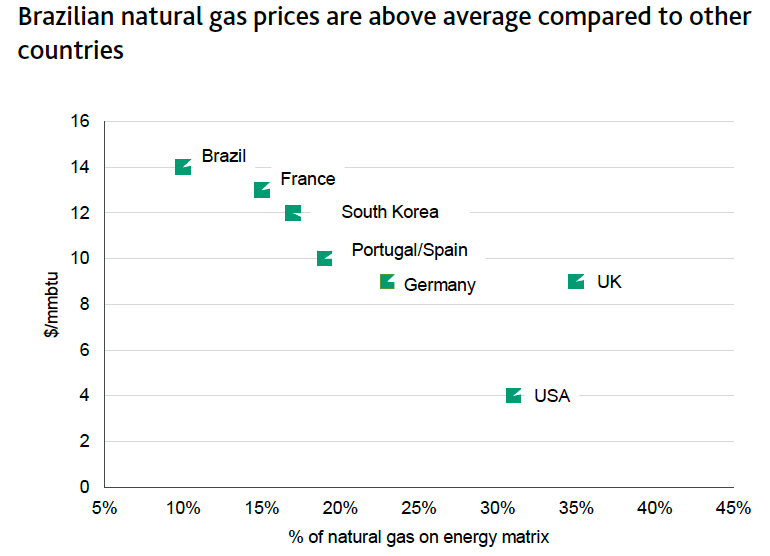
Prices paid by industrial end-users in Brazil have averaged over $14/million British thermal unit (MMBtu), while in Europe the same prices have averaged $7/MMBtu and in the US averaged $4/MMBtu (see Exhibit 1). In the context of possibly lower prices and easier procurement of natural gas, industrial demand will grow. The regulatory changes provide transparency and open access to the natural gas market, which could drive incremental demand growth of around 30% from those industries through 2029, according to Brazil’s energy research company, Empresa de Pesquisa Energética (EPE) (see Exhibit 2).

Exhibit 1
Exhibit 2

Brazil’s energy system will also benefit from greater availability of natural gas through a sustained reduction in prices and improved supply infrastructure. EPE estimates that the current installed capacity of gas-fired thermal power plants in the Brazilian energy matrix can reach 36.2 gigawatts (GW) by 2029, up from 12.9 GW in 2019. Natural gas-fueled thermal power plants can be a reliable alternative to tackle the intermittence of renewable energy generation and replace higher carbon emission sources like coal and oil.

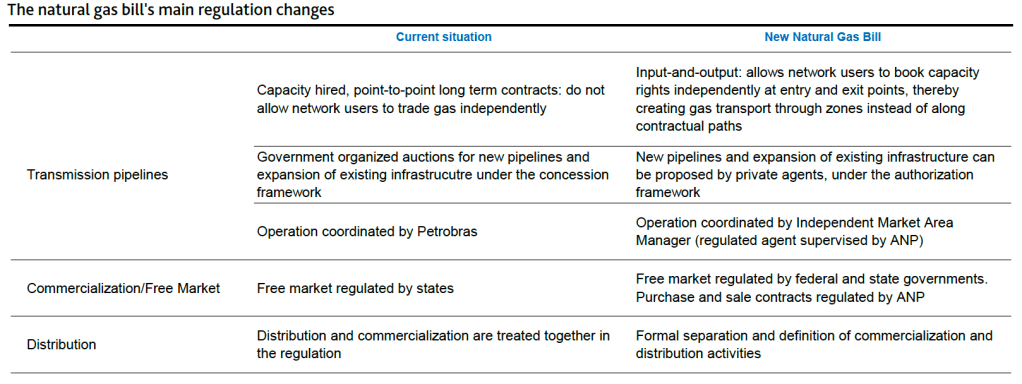
The new legal framework includes provisions to replace the concession system for development of new gas pipelines and commercialization units with an authorization permit procedure, subject to the regulatory oversight of the federal oil agency, Agência Nacional do Petróleo (ANP), which is expected to accelerate the investment rate for end users. It will also ensure open access to the transportation infrastructure (pipelines), which will benefit large industrial consumers of natural gas by allowing for procurement processes that do not depend entirely on the local distribution companies. Nonetheless, the regulation at the state level needs to advance in tandem with federal regulation, clarifying the compensation mechanisms for gas utilities and revenue tax charges (see Exhibit 3).

Exhibit 3

Credit Outlook: 7 September 2020. Pg. 11
Moodys

Banking

Record consumer indebtedness and rising delinquencies are credit negative for Brazilian banks

Brazil, July 28, 2020 – Brazil’s Confederação Nacional do Comércio de Bens, Serviços e Turismo (the national confederation of commerce of goods, services and tourism or CNC) published its July survey which showed that consumer indebtedness had reached record levels and that delinquency pressures have intensified. The rise in household indebtedness is credit negative for Brazilian banks with significant consumer lending exposures, mainly large retail banks, because it will lead to higher asset risk on banks’ balance sheets and be reflected in rising problem loan levels as well as renegotiations and restructurings. The increase also illustrates the challenges Brazilian consumers face in managing their loan exposures.

The record level of indebtedness is particularly credit negative for Brazilian banks with large exposures to unsecured consumer lending. Such banks include Caixa Economica Federal (Ba2 stable, ba31), Banco do Brasil S.A. (Ba2/(P)Ba2 stable, ba2), Banco Bradesco S.A. (Ba2 stable, ba2), Itau Unibanco S.A. (Ba2 stable, ba2) and Banco Santander (Brasil) S.A. (Ba1 stable, ba2), which combined account for the lion’s share of consumer lending in Brazil.

Higher indebtedness indicates rising asset risk, particularly amid challenging economic conditions in Brazil because of the coronavirus pandemic. We expect Brazil’s economy to contract by 6.2% this year, with high unemployment negatively affecting household income. Since the onset of pandemic, banks’ problem loans ticked up to 3.3% in April from 2.9% in December 2019, driven largely by rising problem loans for consumers, which rose to 4.1% in April from 3.6% in December 2019 (see Exhibit 1). However, 90-day problem loans have since ticked down to 2.9% for the system as of June 2020 and to 3.6% for consumer loans as banks began renegotiating their loan exposures amid rising asset risk.

Source: Central Bank of Brazil

Based on available central bank data, BRL594 billion of loans were renegotiated and received loan payment extensions due to the pandemic between 16 March and 29 May, which equates to about 16.5% of total systemwide loans as of June 2020. Loans to households and small and midsize enterprises (SMEs) comprised 91% of these renegotiated loans. The payments were deferred for of up to 180 days and equal 11% of the sum of all renegotiated contracts (principal plus interest), most of which supported SMEs and households.

At the onset of the coronavirus crisis, the central bank eased provisioning requirements for any accruing loans being renegotiated until September 2020. The measures that postpone provisioning will likely delay credit losses, requiring banks to reinforce reserve coverage levels during the third and fourth quarters. In this context, rising household indebtedness to a record level in July is a sign that asset risk pressures will continue to build on banks’ balance sheets

The results of CNC’s survey showed that 67.4% of all Brazilian families have debt outstanding, the highest level on record since 2010. The levels of indebtedness were driven by lower income households, defined by those who earn up to 10x the minimum wage, of which 69% of families were indebted. For households earning over 10x the minimum wage, the level was at 59% as of July, elevated compared with historical levels (see Exhibit 2).

Source: Confederação Nacional do Comércio de Bens, Serviços e Turismo

The CNC survey also showed that the percentage of families in the lower income group with debt payments in arrears rose 260 basis points from a year ago to 29.7%, while for higher income groups the level was 11.2% versus 10.6%, indicating rising delinquency pressures. The percentage of households unable to pay off their debts also rose in July across both income levels – up 240 basis points to 13.7% for lower income households and up 150 basis points to 4.9% for higher income households.

For indebted households, 21.6% have more than 50% of their monthly earnings dedicated to debt service, and the largest type of exposure is credit card debt, according to the survey. Following that category is payment by installments via booklets. Both categories are unsecured consumer loan classes, highlighting that banks are particularly susceptible to a deterioration in borrower repayment capacity.

Credit Outlook: 3 August 2020. Pg. 16
Moodys

Corporates

VTR Finance’s acquisition of Telefónica assets strengthens Costa Rican business for parent LLA

Costa Rica, July 30, 2020 – Liberty Latin America Ltd. (LLA), the parent of VTR Finance N.V. (Ba3 stable), announced a $500 million deal to acquire Telefónica S.A.’s (Baa3 stable) subsidiary Telefónica Costa Rica. LLA intends to include Telefónica Costa Rica in the VTR credit pool, which will also include Cabletica, LLA’s existing fixed-line business in Costa Rica. Pending regulatory approvals, VTR expects the acquisition to close in the first half of 2021. LLA will increase its market share in Costa Rica, and cost synergies will improve the combined group’s EBITDA margin in the next two to three years, credit positives for LLA.

The all-cash transaction implies a $500 million enterprise value for Telefónica Costa Rica on a cash- and debt-free basis, equivalent to a 6.0x EBITDA multiple based on Telefónica Costa Rica’s 2019 EBITDA, including projected annual run-rate synergies. But LLA also intends to finance the acquisition with some borrowing from local lenders and from VTR Finance N.V. The deal’s credit implications for the VTR credit pool will depend in part on how much new debt it takes on for the transaction.

The acquisition of Telefónica Costa Rica and its combination with Cabletica will create an integrated telecom operator that will provide a full suite of fixed and mobile services. Buying Telefónica Costa Rica would give LLA ownership of Costa Rica’s second-largest mobile operator, with a market share of around 24%, on top of its number-two fixed-services operator, with Cabletica’s roughly 20% market share for broadband and 25% for pay TV.

We expect that the combination will also result in cost synergies, improving the combined group’s EBITDA margin during the next two to three years. The synergies that LLA expects to generate will effectively reduce the EBITDA multiple of the purchase price to 6.0x from 7.4x based on 2019 data, or an improvement in the target’s EBITDA to about $80 million, including synergies, from $68 million in 2019.

In addition to borrowings in Costa Rica and at VTR Finance N.V., LLA would finance the remainder using its own liquidity and other sources of capital. Although LLA has not confirmed the exact funding mix, the group said that it is targeting about 4x debt on the acquired asset’s EBITDA including synergies, according to LLA’s calculations, implying about $300 million of incremental debt at VTR.

VTR’s Ba3 rating already reflects the contribution of Cabletica, which LLA anticipated to take place in the first quarter of 2021, and an adjusted gross debt/EBITDA ratio that will decline to close to 4x by the end of 2021 from 4.6x in 2019. Once the funding mix is confirmed and more data become available about Telefónica Costa Rica’s contribution to VTR, we will assess whether the deleveraging trend for VTR remains in line with what we had expected before this acquisition.

Telefónica Costa Rica is Costa Rica’s second largest mobile service provider. As of 30 June 2020, the business had 2.3 million subscribers, and its mobile network currently has approximately 90% LTE population coverage.

Cabletica, which LLA acquired in 2018, is a leading fixed-line operator in Costa Rica, offering broadband, Pay TV and fixed telephony services, with about 600,000 homes passed and 430,000 revenue generating units as of March 2020, and revenue of CRC77 billion ($130 million) in 2019.

VTR provides broadband and wireless communications services in Chile and is a wholly owned subsidiary of LLA. As of March 2020, VTR’s network passed 3.72 million homes and served about 2.97 million fixed revenue generating units. The company also served around 304,900 mobile subscribers as a mobile virtual network operator. The company reported revenue of CLP663 billion (around $800 million) for the 12 months to March 2020.

Credit Outlook: 3 August 2020. Pg. 10
Moodys

Countries

ASEAN-5 responses mitigate COVID-19 economic damage but are unlikely to offset rising credit risk

Asia, June 25, 2020 – The ASEAN-5 economies – Malaysia (A3 stable), the Philippines (Baa2 stable), Indonesia (Baa2 stable), Vietnam (Ba3 negative) and Thailand (Baa1 stable) – have taken steps to mitigate the economic damage of the coronavirus outbreak. The support packages vary in scale and scope, and are largely contingent in nature. While they will broadly help reduce some of the negative effects of the crisis, they will not offset the rising recessionary or credit risks for most sectors.

  • Policy measures will provide a degree of support, but the confluence of shocks will weigh on growth prospects. The growth slowdown in the region will be significant relative to previous crisis episodes, but will still be moderate compared to other regions. Nonetheless, the ASEAN-5 are negatively impacted by sharp falls in external trade flows, sluggish commodity prices that weigh on the fiscal revenues of commodity exporters, and financial market volatility that can trigger capital outflows.
  • Policy measures will have significant fiscal costs. Government revenue across the region will decline and spending will rise as countries try to mitigate the effects of the crisis. Fiscal costs of support measures will be significant, with debt burdens only stabilising from 2021 for most economies. However, the ASEAN-5 countries had adequate fiscal buffers before the pandemic that gives them fiscal space to respond to the crisis.
  • Credit risks for banks have increased, despite policy support. Policy measures have mostly focused on providing liquidity to banks to support new lending, and through credit restructuring such as debt moratoriums. As moratoriums are lifted, banks’ problem loans will likely increase.
  • Few corporate sectors will benefit directly from government support. Strategically important state-owned enterprises will likely take priority in receiving direct financial support. Privately owned companies will get some support from broader policy measures such as temporary tax relief and lower interest rates.
  • Infrastructure sector will get limited policy support but essentiality of services may help shore up demand for some companies. With the exception of Indonesia, few countries in the region have taken steps to support utilities and other infrastructure companies. Governments have instead shifted some of the burden related to policy support to the utilities and other infrastructure providers.

Credit Outlook: 29 June 2020. Pg. 37
Moodys