Infrastructure

Air traffic restrictions until September are credit negative for Aeropuertos Argentina 2000

Argentina, April 27, 2020 – Argentina’s aviation agency Administración Nacional de Aviación Civil (Argentina) or ANAC, announced that all commercial air traffic, international and local, will remain restricted until 1 September. The restriction is credit negative for Aeropuertos Argentina 2000 S.A. (AA2000, Caa3 negative) because it will receive no passenger revenue until September and the prolonged restriction comes in the middle of an exchange offer process that AA2000 initiated on 21 April to extend its 2020 debt amortization payments until May 2021.
ANAC’s resolution does not mean that there will be no flights through September, but instead flights will be pre-approved by ANAC on a case-by-case basis. We expect flights through September to be very limited.
AA2000 is working on several cost-saving measures to preserve its cash position, including lowering capital expenditures to a minimum and suspending all pending construction works, among others, in addition to the additional liquidity relief the company is seeking to obtain through its debt exchange offer.
Air traffic in Argentina continued operating normally until mid-March when the transportation ministry suspended all commercial air traffic, in line with government-mandated national movement restrictions in response to coronavirus. Pre-coronavirus AA2000 traffic trends were solid. Total traffic growth in 2019 was at 9% over the previous year, but the company now expects traffic to drop as much as 48% for 2020 (see Exhibit 1).

Sources: AA2000 and Moody’s Investors Service

AA2000 offered to exchange its outstanding $350 million 6.875% senior secured notes due in 2027 for newly issued 6.875% cash/9.375% payment-in-kind (PIK) Class I Series 2020 additional senior secured notes due in 2027.
Terms of the Series 2020 additional notes will be largely identical to the existing notes, but the quarterly interest payment originally scheduled to be paid in cash on 1 May 2020 will be paid in cash in the form of an interest premium or by a PIK by increasing the principal amount of the additional notes to be issued on the settlement date. Furthermore, quarterly interest payments originally scheduled to be paid in cash on the existing notes on 1 August and 1 November 2020 and 1 February 2021 will be by PIK at a rate of 9.375% per year (see Exhibits 2 and 3). Quarterly amortization payments originally scheduled for 1 May 2020 through 1 February 2021 will be deferred to begin 1 May 2021 and continue under a new principal amortization schedule until maturity. The Series 2020 additional notes and the existing notes will be secured by the same collateral on a pro rata and pari passu basis in accordance with the Indenture and the related collateral documents.
It is a condition of the exchange offer, among others, that at least 80% of the existing notes’ outstanding principal amount is validly tendered for exchange and not withdrawn. The company does not expect to modify the offer terms despite the traffic suspension.

Source: AA2000

AA2000 was incorporated in 1998 after winning the national and international bid for the concession rights for 35 airports that handle more than 90% of Argentina’s arriving and departing passengers and include the three airports that serve the capital city of Buenos Aires – Ezeiza (EZE), Aeroparque (AEP) and Palomar (EPA) Airports.

Credit Outlook: 4 May 2020. Pg. 8
Moodys
Infrastructure

Deferral of Argentina’s gas tariff increase is credit negative for regulated gas utilities

Argentina, November 25, 2019 – Argentina’s Energy Secretariat announced an additional deferral on a tariff increase for gas distribution and transport margins that was to take effect in October 2019. The deferral is credit negative for regulated gas utilities because it will continue to erode their revenue amid rising costs related to Argentina’s very high inflation rates. Additionally, the deferral adds to the uncertainty about the future consistency of Argentina’s regulatory framework.

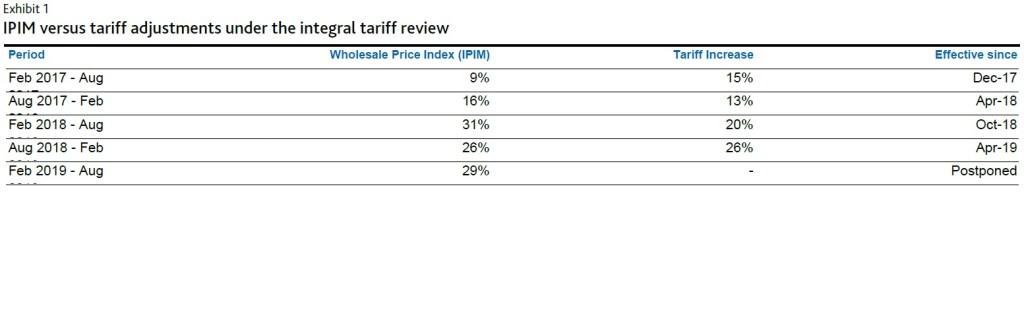
According to an integral tariff review (RTI), the adjustment, which was postponed until 1 February 2020, corresponds to the six-month period that ended August 2019 and should follow Argentina’s wholesale price index (IPIM) at almost 30% (see Exhibit 1).

The tariff increase corresponding to February/August 2018 follows the average between IPIM, construction cost index (ICC) and salary variation index (IVS), in order to include in the adjustment variations related to activity levels, salaries and retirement plans among others.
Sources: INDEC and Moody’s Investors Service

Argentina’s regulatory framework and the sufficiency of future regulated rates has become more uncertain in the context of the ongoing government transition and the arrival of a new administration with yet unclear policy orientation in the sector. While most companies have low leverage and other strong credit metrics, rising costs amid very high inflation rates, constrained market access and tight liquidity increases the risk that they will take measures such as delaying payments to suppliers to continue operations.

The regulatory environment for utilities in Argentina historically has been evolving.(1) During the 12 years under Argentina’s previous leadership, regulated tariffs remained almost frozen despite high inflation and utilities’ increased costs. As a result, utilities did not have enough cash to spend on capital investments and the quality of service deteriorated significantly. By passing the RTI the current administration ended with the 12 year tariff freeze, a credit positive; however, the government postponed the second-half 2019 tariff adjustment because of increased consumer criticism and political opposition.

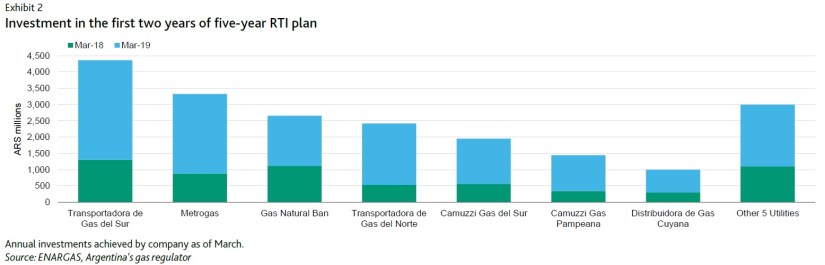
If there were to be no adjustment to utilities’ tariffs, the improvements since RTI’s implementation would reverse and negatively affect their revenue. Moreover, under the RTI, companies committed to a five-year mandatory investment plan to expand coverage and improve their service quality and standards. Without the additional funds derived from the now-deferred tariff, utilities would find it difficult to fulfill these commitments.(2) Exhibit 2 shows the level of investments in years one and two of the five-year plan that companies were able to achieve because of the RTI plan that began in 2017.

Endnotes
1. See Argentine legislation to revoke tariff increase is credit negative for regulated utilities, 4 June 2018.
2. Along with the tariff increase deferral, the ministry enables gas utilities to ask for a reduction of their investment requirements by an amount equal to the effect of the tariff adjustment deferral

Credit Outlook: 2 December 2019. Pg. 14
Moodys

Infrastructure

Repsol’s new oil and gas price scenario leads to €4.8 billion post-tax impairment in 2019

Spain, December 2, 2019 – Repsol S.A. (Baa1 stable) announced that it aims to achieve net zero emissions by 2050. It also said that in this context it assumes a new oil and gas price scenario consistent with the Paris Agreement’s climate goals, which is lower than the company’s previous scenario, in particular for the gas prices that are currently under pressure. The updated price scenario implies a lower value of some assets, leading to a post-tax impairment charge of €4.8 billion, which will be reflected in 2019 results. The impairment is credit negative.

The value of the impairment equals roughly 8% of Repsol’s total assets and around 15% of its total equity as of the end of September 2019. Pro forma for the impairment, Repsol’s total debt/capital ratio (as adjusted by Moody’s), which is one of the main ratios of our global integrated oil and gas rating methodology, deteriorates by around 4% from roughly 35% as of the end of September 2019. The ratio remains broadly in line with the current rating.

However, the impairment comes at a time when Repsol’s key credit metrics have deteriorated from fairly healthy levels in 2018 in a comparatively weaker pricing environment in 2019. For instance, the company’s Moody’s-adjusted retained cash flow (RCF)/net debt ratio has declined to low 20s in percentage terms for the 12 months to September 2019 from around 30% in 2018. We expect an improvement of the ratio back toward 30% in the next 12-18 months, supported by growth in earnings in the upstream business, but also owing to potential benefits in the downstream business coming from the IMO 2020 regulation, for which the company is well positioned. We forecast the improvement despite the roughly €1 billion extraordinary share buyback for 2020 announced in July this year, which Repsol justified by its expectation of better cash flow generation compared to its original business plan for 2018-2020.

Notwithstanding the impairment we note positively the company’s strengthened commitment towards reducing its carbon footprint, which is becoming an increasingly important credit consideration. With its new 2050 carbon neutrality objective, Repsol also sets new goals for the reduction of its carbon intensity indicator from a 2016 baseline: 10% by 2025, 20% by 2030 and 40% by 2040. Additionally, it defines concrete steps for all of its businesses to achieve those goals, which, among others, include biofuels, recycling, natural carbon sinks and low-carbon energy.

Specifically, low-carbon energy is playing an increasingly important role for Repsol. Within its current business plan for 2018-2020 Repsol plans to invest €11 billion as a core portfolio capital spending during those three years. On top of that, the company budgets €4 billion during the same period to expand its downstream operations (roughly €1.5 billion) and develop its low-carbon energy business (roughly €2.5 billion). With the new 2050 carbon neutrality objective, Repsol also increases its target for low-carbon electricity generation capacity by 3 GW to 7.5 GW by 2025, and will begin to expand into new markets to become a leading international player in renewable energies. Repsol currently has almost 3 GW in operation and around 1.1 GW under development.

Credit Outlook: 9 December 2019. Pg. 4
Moodys

Infrastructure

Moody’s Affirms A3 Rating of Peruvian CRPAO Backed Transactions; Outlook Stable

New York, September 11, 2018 — Moody’s Investors Service (“Moody’s”) affirmed the A3 ratings assigned to the senior secured notes issued by Interoceanica IV Finance Limited, Peru Enhanced Pass-Through Finance Limited and IIRSA Norte Finance Limited. The outlooks are stable.

RATING RATIONALE

Today’s rating action considers that the financing structures for the aforementioned transactions are performing as expected and remain closely linked to the credit quality of the Government of Peru (A3 stable). The transactions are backed by Certificados de Reconocimiento de Derechos del Pago Annual por Obras (“CRPAOs”) issued by the Government of Peru. The CRPAOs are unconditional, irrevocable, fixed, US dollar denominated obligations of the Government of Peru. Once issued, the right of the CRPAO holder to collect the GOP payment is not subject to the company’s performance levels or by any other circumstances including destruction of the works performed, change of control of the company, or breach or termination of the Concession Agreement.

Given that the construction related to the CRPAOs that are pledged to the payment of the Notes on the three transactions is complete, all of the related CRPAOs have been purchased. Thus, the payment of debt service on the senior secured notes depends entirely on the payment of the CRPAOs by the Ministry of Transportation and Communication (“MTC”) of the Government of Peru. As such, the ratings and outlooks assigned to the transaction are closely linked to the rating and outlook of the Government of Peru.

The rating outlooks are stable reflecting the outlook on the Government of Peru’s rating.

WHAT COULD CHANGE THE RATING UP/DOWN

Given the structure of debt payments which rely on the Government of Peru’s ability and willingness to budget and appropriate CRPAO payment obligations annually, the rating of the project is closely tied to the sovereign rating of Peru. Conversely, A failure of the Government of Peru to honor any annual payments or concession termination without adequate compensation could have negative implications on the rating. Any changes in the rating of the Government of Peru would likely impact the rating of the debt obligations.

Given that the Notes’ structures de-link the transaction with the underlying assets’ volume and tariff risk (toll roads), and the exposure to the Government of Peru, the methodology used for these ratings is the Generic Project Finance methodology.