Banking

BNDES sells 9.9% Petrobras stake, allowing resource allocation to sustainable projects, a credit positive

Brazil, February 5, 2020 – Banco Nacional de Desenvolvimento Econômico e Social (BNDES, Ba2 stable, ba21) sold its 9.9% stake in oil giant Petróleo Brasileiro S.A. – Petrobras (Petrobras, Ba2 stable), raising BRL22 billion. The divestiture will reduce BNDES’ volatility in capital and earnings, a credit positive.
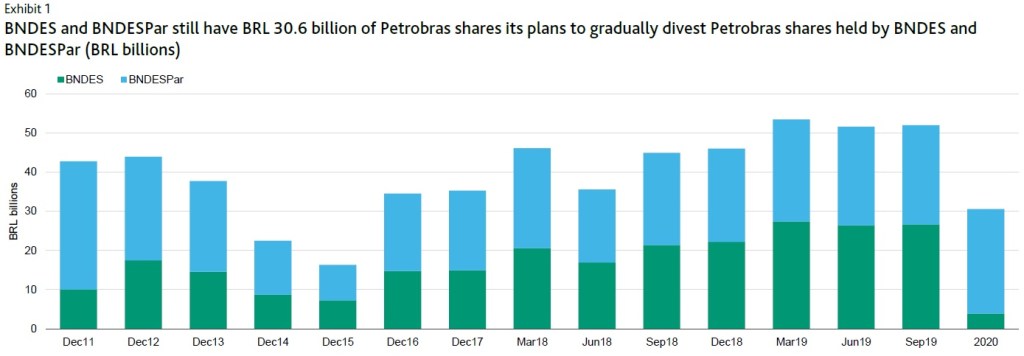
The sale does not include Petrobras preferred shares that BNDES and its investment subsidiary BNDES Participações – BNDESPar (Ba2 stable) hold. BNDES and BNDESPar also have BRL30.6 billion of voting and preferred Petrobras shares that it plans to divest within the next three years (Exhibit 1), subject to market conditions. BNDES could divest another BRL70 billion of other equity in the same time frame, depending on market conditions. To accommodate its goal, BNDES cut the value at risk limit for variable income securities in its equity portfolio to BRL600 million as of 2019 from BRL3 billion as of 2018.
Source: BNDES

Divestment proceeds will be primarily allocated to sustainable projects with relevant social and environmental impact. This strategy will support BNDES’ focus on smaller companies and having a key role within fintech and digital transformation, in addition to its preeminent position supporting infrastructure projects. Structuring and advising projects mainly related to the government’s agenda for privatizations and public-and-private partnerships also have traction in the bank’s business strategy.
A portion of the divestment proceeds will likely be used to pay additional dividends to the Government of Brazil (Ba2 stable) to alleviate the government deficit. This practice, used 2009-13, declined after a new dividend policy that limited dividend distribution to a maximum of 60% of adjusted net income. While the bank distributed a dividend equating to 25% of adjusted net income between 2017 and 2018, in 2019, it has already anticipated dividends of 60% of adjusted net income (Exhibit 2).

Source: BNDES

We estimate that the distribution of 60% of the net gains from the sale of its Petrobras stake will not have a material effect on the bank’s capitalization because BNDES’ (Moody’s-adjusted) tangible common equity2 to risk-weighted assets ratio (TCE to RWA) should decline to 15.8%, from 17% in June 2019. BNDES has improved its capitalization since 2016, with sharply lower dividend distributions to the Government of Brazil and steady loan contraction.

Source: BNDES

For B3 S.A. – Brasil, Bolsa, Balcao (Ba1 stable), Brazil`s stock market operator, the size of secondary offering is also credit positive given that the amount traded with it is approximately 19% of the total of initial and secondary offerings that occurred in 2019. The issuance of these Petrobras shares will enable B3 to gain additional trading and post trading revenues at a time when it continues to report record levels of earnings.

Credit Outlook: 10 February 2020. Pg. 34
Moodys
Countries

Argentina Local Currency Ratings Lowered To ‘SD’ On Distressed Debt Exchange; ‘CCC-/C’ Foreign Currency Ratings Affirmed

Argentina, January 20, 2020 – The administration of President Alberto Fernandez launched and concluded an exchange on its peso-denominated short-term debt on Jan. 20, 2020. This followed the Dec. 19, 2019, unilateral extension (until August 2020) of U.S. dollar-denominated short-term paper held by private-sector market participants. We classify this peso-debt exchange as a distressed exchange, which constitutes a default under our criteria, and we are lowering our local currency sovereign credit ratings on Argentina to ‘SD/SD’ from ‘CCC-/C’. We are also affirming our long-term foreign currency sovereign credit rating at ‘CCC-‘, and the outlook remains negative. The negative outlook reflects prospects for a further restructuring of sovereign debt as the administration holds dialogues with bondholders, financial intermediaries, and official creditors on its policy priorities, economic strategy, and re-profiling plans.

Rating Action: On Jan. 21, 2020, S&P Global Ratings lowered its local currency sovereign credit ratings on Argentina to ‘SD/SD’ from ‘CCC-/C’ (our criteria do not distinguish between short term and long term when there is a default). We affirmed the foreign currency sovereign credit ratings at ‘CCC-/C’. The outlook on the long-term foreign currency sovereign credit rating remains negative. We also took the following rating actions:

  • We lowered the long-term local currency-denominated issue ratings to ‘CC’ from ‘CCC-‘;
  • We affirmed the long-term foreign currency issue ratings at ‘CCC-‘;
  • We affirmed our ‘B-‘ transfer and convertibility assessment on Argentina; and
  • We lowered our national scale rating on Argentina to ‘SD’ from ‘raCCC-‘.

Outlook: The negative outlook on the long-term foreign currency rating reflects the downside risks to timely and full payment of debt over the short term amid stressed economic and financial market dynamics. The sovereign’s access to liquidity is likely to remain constrained as the Fernandez Administration outlines its economic policies while engaging in dialogue with bondholders, bankers, and the International Monetary Fund. We could lower the foreign currency ratings if the government finalizes terms with bondholders for a potential debt restructuring that is characterized as a distressed debt exchange based on our methodology. Such a restructuring could entail an extension of maturities, which will not be compensated by the issuer, or a reduction in the face value of debt. Additionally, we could lower the ratings if economic and financial stresses further threaten timely debt service or the sovereign misses a debt payment. We could raise the ratings following implementation of a debt restructuring if policy signals and execution start to successfully turn around or stabilize private-sector confidence, market turbulence subsides, and the government regains access to market financing.

S&P Global Ratings, January 21, 2020

Countries

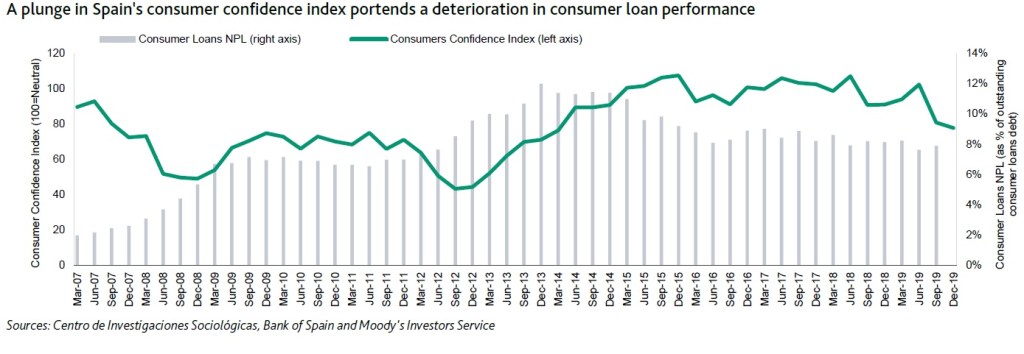
Falling consumer confidence is credit negative for Spanish ABS

Spain, January 7, 2020 – Centro de Investigaciones Sociológicas (Center for Sociological Research, or CIS) reported that Spain’s consumer confidence index had plunged to 77.7 in December 2019, 13 points below the levels in December 2018 and the lowest level since 2013. The significant decline in consumer confidence, consistent with other negative data reported in recent days, is credit negative for asset-backed securitisations (ABS) collateralised by Spanish consumer loans. Consumer confidence data provide a forward indicator that asset risks will increase and consequently weaken the performance of securitised loans. Falling consumer confidence somewhat correlates to weaker future performance in consumer credit, as the exhibit shows. Indeed, consumer confidence plunged in mid-2007 before Spanish consumer nonperforming loan (NPL) ratios surged.

The sharp decrease in consumer confidence during the second half of 2019 reflects an increasing concern among Spanish consumers about the national economy and employment. We expect that borrowers will face more challenges repaying their consumer loans because of a gradual moderation in the growth performance of the Spanish economy: we expect GDP growth of 1.8% for 2020 compared to 3% growth in 2016-17. The decline in consumer confidence is consistent with other negative data reported in recent days, including a 4.8% drop in 2019 car registrations, according to data from Spain’s associations of auto manufactures (Anfac), dealers (Faconauto) and vendors (Ganvam). The drop is the first in Spain since 2012.
Adding to these challenges is that consumer lending continues rising despite indications of economic deceleration. The overall stock of household debt in 2019 was relatively flat compared with 2018, but there were different trends when comparing secured lending and unsecured lending. According to the Bank of Spain, the stock of consumer loans in 2019 increased 4% from a year earlier (November 2019 data), doubling GDP growth, while the stock of mortgage debt fell 1% over the same period, suggesting the mortgage market is adapting to a decelerating economy.
The combination of the decline in consumer confidence and an increase in unsecured debt will continue to put pressure on Spanish ABS. However, the effect will not be the same for all types of consumer loans. We expect that auto-loan ABS will perform better owing to these borrowers’ higher quality. But consumer loans with no specific purpose are often used by borrowers facing financial troubles in household economies, and they will likely be most negatively affected. Still, the performance of Spanish consumer-loan ABS is better than the national average of consumer NPL given the stronger eligibility criteria applied to Spanish securitisations.

Credit Outlook: 13 January 2020. Pg. 19
Moodys

Banking

Banco Sabadell sells its asset management unit, a credit positive

Spain, January 21, 2020 – Banco Sabadell, S.A. (Baa2/Baa3 stable, ba2) announced that it had reached an agreement to sell its 100% interest in asset management unit Sabadell Asset Management, S.A. S.G.I.I.C., Sociedad Unipersonal (SabAM), to Amundi Asset Management for €430 million. As part of the agreement, Banco Sabadell and Amundi entered a 10-year partnership. The transaction is credit positive for Banco Sabadell because it will generate a capital gain of €351 million and will improve the bank’s regulatory capital metrics.
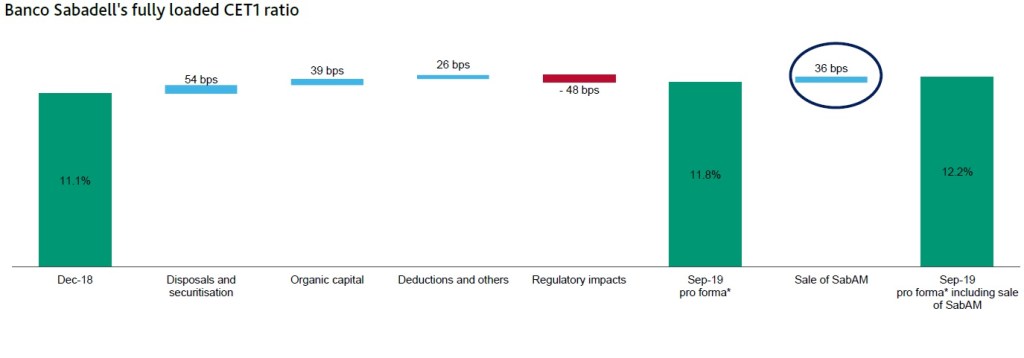
Upon the closing of the transaction, which the parties expect will occur in third-quarter 2020, Banco Sabadell estimates that its fully loaded Common Equity Tier 1 (CET1) ratio will increase 36 basis points (bps) from the pro forma fully loaded CET 1 ratio of 11.8% reported at the end of September 2019. Banco Sabadell expects an additional seven-basis-point increase related to specific guarantees in effect over the length of the distribution agreement that will be accrued proportionally over the next 10 years. This disposal is concurrent with Banco Sabadell’s strategy of divesting noncore assets and raising its fully loaded CET1 ratio to around 12%. (see exhibit)

The sale of this unit will have a relatively modest effect on the group’s profitability. Banco Sabadell disclosed that SabAM had an estimated net profit of €34 million as of year-end 2019, including, among other things, €65 million of net fee and commission income and €17 million of operating expenses. SabAM’s net profit constitutes around 4% of the bank’s annualized net income as of the end of September 2019 (net of the €135 million extraordinary gains from the Solvia disposal).

In the current environment of low interest rates and decelerating economic growth in Spain, the loss of this revenue source risks putting an additional strain on the bank’s earnings generation capacity. The sale of SabAM limits the potential growth of fee and commission income that could help ongoing challenges to Banco Sabadell’s net interest income. However, these downside risks should be broadly offset by cost savings derived from the de-risking of the bank’s balance sheet and the cost-efficiency plan, while the bank expects its subsidiary TSB Bank plc (Baa2 negative, baa2) to generate profit starting in 2020. Banco Sabadell also expects to benefit from increased distribution fees as a result of the partnership with Amundi.

Credit Outlook: 27 January 2020. Pg. 26
Moodys

Infrastructure

Deferral of Argentina’s gas tariff increase is credit negative for regulated gas utilities

Argentina, November 25, 2019 – Argentina’s Energy Secretariat announced an additional deferral on a tariff increase for gas distribution and transport margins that was to take effect in October 2019. The deferral is credit negative for regulated gas utilities because it will continue to erode their revenue amid rising costs related to Argentina’s very high inflation rates. Additionally, the deferral adds to the uncertainty about the future consistency of Argentina’s regulatory framework.

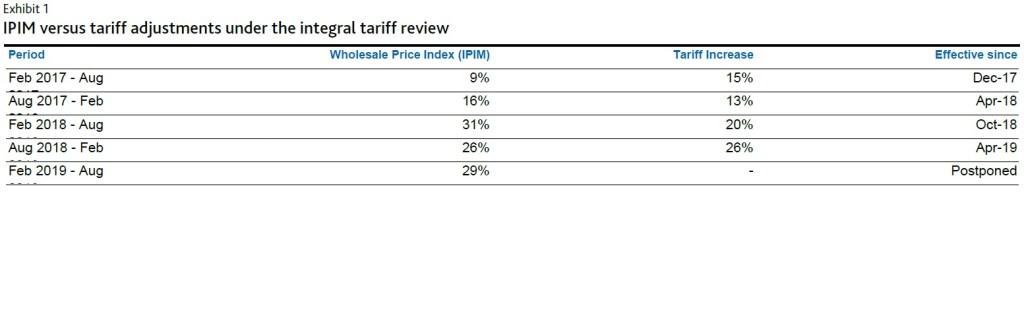
According to an integral tariff review (RTI), the adjustment, which was postponed until 1 February 2020, corresponds to the six-month period that ended August 2019 and should follow Argentina’s wholesale price index (IPIM) at almost 30% (see Exhibit 1).

The tariff increase corresponding to February/August 2018 follows the average between IPIM, construction cost index (ICC) and salary variation index (IVS), in order to include in the adjustment variations related to activity levels, salaries and retirement plans among others.
Sources: INDEC and Moody’s Investors Service

Argentina’s regulatory framework and the sufficiency of future regulated rates has become more uncertain in the context of the ongoing government transition and the arrival of a new administration with yet unclear policy orientation in the sector. While most companies have low leverage and other strong credit metrics, rising costs amid very high inflation rates, constrained market access and tight liquidity increases the risk that they will take measures such as delaying payments to suppliers to continue operations.

The regulatory environment for utilities in Argentina historically has been evolving.(1) During the 12 years under Argentina’s previous leadership, regulated tariffs remained almost frozen despite high inflation and utilities’ increased costs. As a result, utilities did not have enough cash to spend on capital investments and the quality of service deteriorated significantly. By passing the RTI the current administration ended with the 12 year tariff freeze, a credit positive; however, the government postponed the second-half 2019 tariff adjustment because of increased consumer criticism and political opposition.

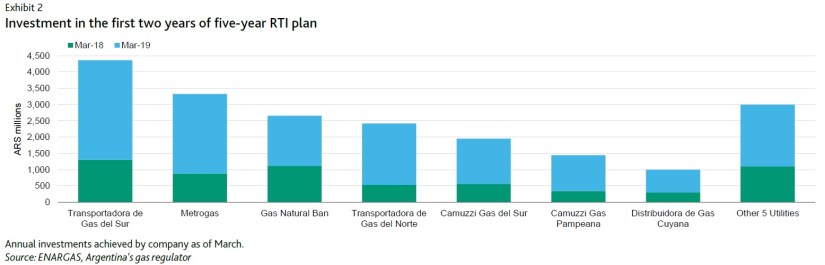
If there were to be no adjustment to utilities’ tariffs, the improvements since RTI’s implementation would reverse and negatively affect their revenue. Moreover, under the RTI, companies committed to a five-year mandatory investment plan to expand coverage and improve their service quality and standards. Without the additional funds derived from the now-deferred tariff, utilities would find it difficult to fulfill these commitments.(2) Exhibit 2 shows the level of investments in years one and two of the five-year plan that companies were able to achieve because of the RTI plan that began in 2017.

Endnotes
1. See Argentine legislation to revoke tariff increase is credit negative for regulated utilities, 4 June 2018.
2. Along with the tariff increase deferral, the ministry enables gas utilities to ask for a reduction of their investment requirements by an amount equal to the effect of the tariff adjustment deferral

Credit Outlook: 2 December 2019. Pg. 14
Moodys